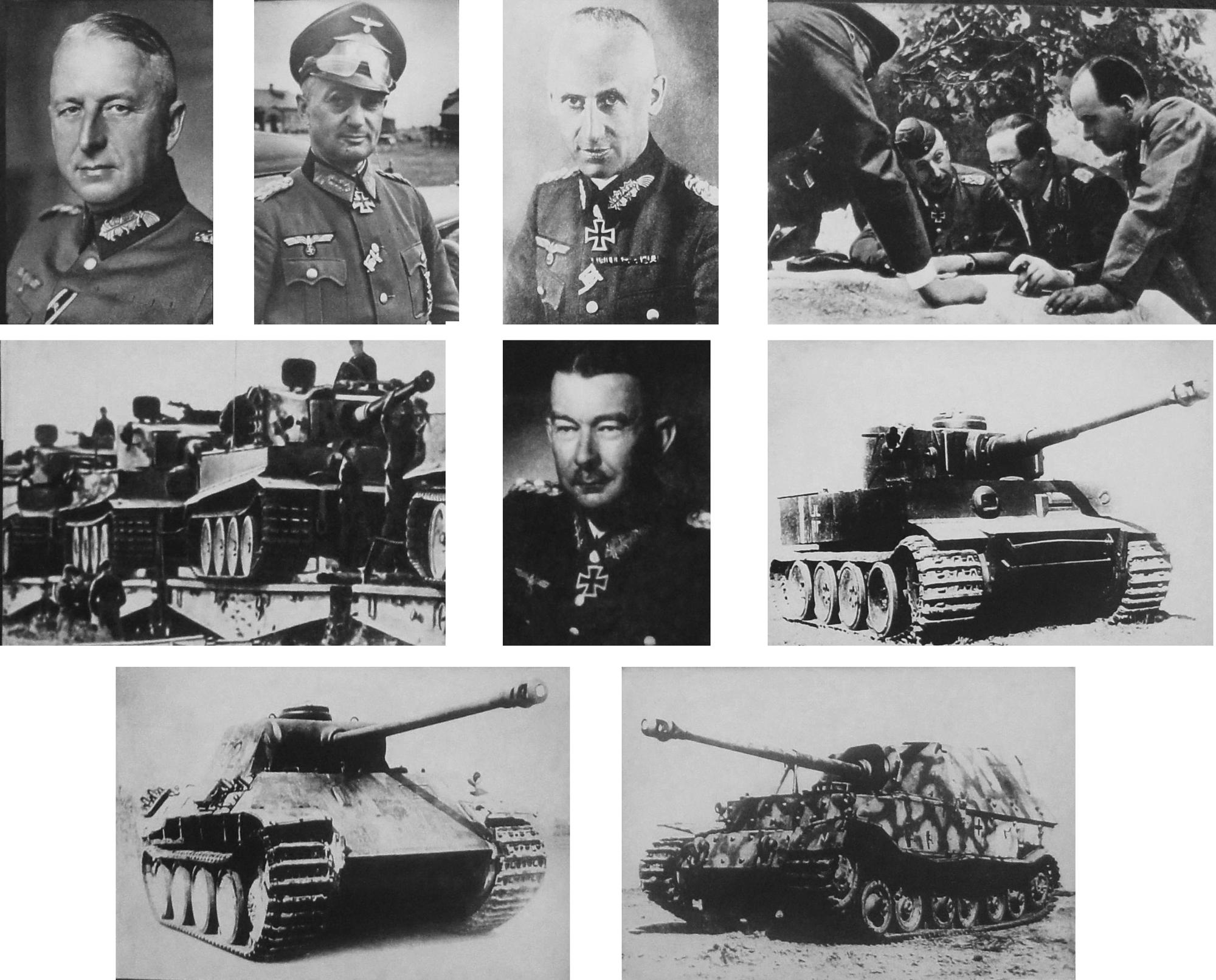


In the winter of 1943, German troops concentrated in build-up areas in the vicinity of Orel and Belgorod with the Kursk Salient in between, where forces of the Central and the Voronezh Fronts were standing on the defensive. The Wehrmacht General Staff decided to make use of the current configuration and launch a knockout blow on the Red Army, cut it to pieces and march towards Moscow again. In view of this, the Citadel assault operation was masterminded. To take on such a role, two robust commands were created. In the North, the Ninth Army under Model’s command was getting ready, near Belgorod the Fourth Armored Army under Hoth’s command was being intensively reinforced with manpower and materiel. In furtherance of the operation, still one more task-force under the code name Kempf under command of Kempf was created. The overall leadership of the Army Group South was entrusted on Field Marshall General Erich von Manstein.
50 divisions numbering up to 900,000 men were engaged in the battle. 18 armored divisions were reinforced with 439 pieces of brand-new Panzer Tiger and Panther supported by drlf-propelled antitank guns Ferdinand. The remotely-cable-controlled light destructive charge carrier Goliath was deployed here for the first time. The troops were reinforced with SS armored divisions Leibstandarte SS Adolf Hitler, Reich and Totenkopf. Yet the advance of this large formation of tanks (Armada) was arrested and thrown back. This battle is deemed to be the World War II most grandstand tank warfare. Two Air Forces were securing the air-ground support.
The commanding general of the Citadel operation was an ancestral officer, his ancestor chart included 16 generations of German generals. He campaigned in the battle of Verdun in World War I, where he was awarded Iron Crosses, 1st and 2nd classes. He was considered the most gifted strategist in Wehrmacht. He was Chief-of-Staff of the Army Group South which attacked Poland in 1939. He had masterminded the expansionist war plan against France and took part in its implementation. He was promoted to Field Marshall General and awarded the Knight’s Cross in 1942 for seizure of Sebastopol. Yet he failed to either overrun the defense lines of Leningrad or deliver Paulus’s besieged troops. The Field Marshall General was eager to make up for it by having the upper hand in the Battle of Kursk, however, here again he was in for a big disappointment.
50 divisions numbering up to 900,000 men were engaged in the battle. 18 armored divisions were reinforced with 439 pieces of brand-new Panzer Tiger and Panther supported by drlf-propelled antitank guns Ferdinand. The remotely-cable-controlled light destructive charge carrier Goliath was deployed here for the first time. The troops were reinforced with SS armored divisions Leibstandarte SS Adolf Hitler, Reich and Totenkopf. Yet the advance of this large formation of tanks (Armada) was arrested and thrown back. This battle is deemed to be the World War II most grandstand tank warfare. Two Air Forces were securing the air-ground support.
The commanding general of the Citadel operation was an ancestral officer, his ancestor chart included 16 generations of German generals. He campaigned in the battle of Verdun in World War I, where he was awarded Iron Crosses, 1st and 2nd classes. He was considered the most gifted strategist in Wehrmacht. He was Chief-of-Staff of the Army Group South which attacked Poland in 1939. He had masterminded the expansionist war plan against France and took part in its implementation. He was promoted to Field Marshall General and awarded the Knight’s Cross in 1942 for seizure of Sebastopol. Yet he failed to either overrun the defense lines of Leningrad or deliver Paulus’s besieged troops. The Field Marshall General was eager to make up for it by having the upper hand in the Battle of Kursk, however, here again he was in for a big disappointment.