

The altar tabernacle or ciborium is the awning over the altar at a temple. Typically, the altar hay is a square that rests on columns with arches. In iconography, the image of ciborium symbolizes the altar. Supposedly, in ancient Egyptians, it was called the lotus fruit, which served as a drinking vessel. Later with the Greeks and Romans, the name was given to a metal drinking vessel of the same shape, and with the Christians - to a hanging metal gift-keeper who descended from the tabernacle of the altar and finally to the tabernacle itself above the altar. Kivorius appeared in Christian temples in the 4th and 6th centuries. Initially, it served to fasten the curtains that closed the throne at certain moments of worship and between services. There were also ciboria over the Amun, a crescent dome. The term in both its meanings passed from Byzantium to Russia. Ciboria were often placed over relics, revered icons, sacred sources, thrones and prayer places of tsars, bishops, abbots and wealthy benefactors. The underside of the ciborium was called the sky. It was painted with temper or oil paints - represented by angels and saints.
The sky of the ciborium from the collection of the Belozersky Regional Museum of Local History was formerly located in the Cathedral of the Transfiguration of the Saviour of the city of Belozersk. The cathedral was built in the second half of the 17th century on the territory of the Belozersky Kremlin. In the next century the temple was rebuilt, and in this form it survived to the present day.
In the 18th century, a wooden carved iconostasis, ciborium, wall-mounted and column-mounted carved frames for icons were installed at the cathedral. They were decorated with gold-plating and painting, and the iconostasis with decorated with gilded sculpture. The iconostasis of the Transfiguration of the Saviour Cathedral resembles a triumphal arch in its shape, as opposed to the traditional Russian iconostasis, which represent a continuous barrier separating the altar from the prayer space.
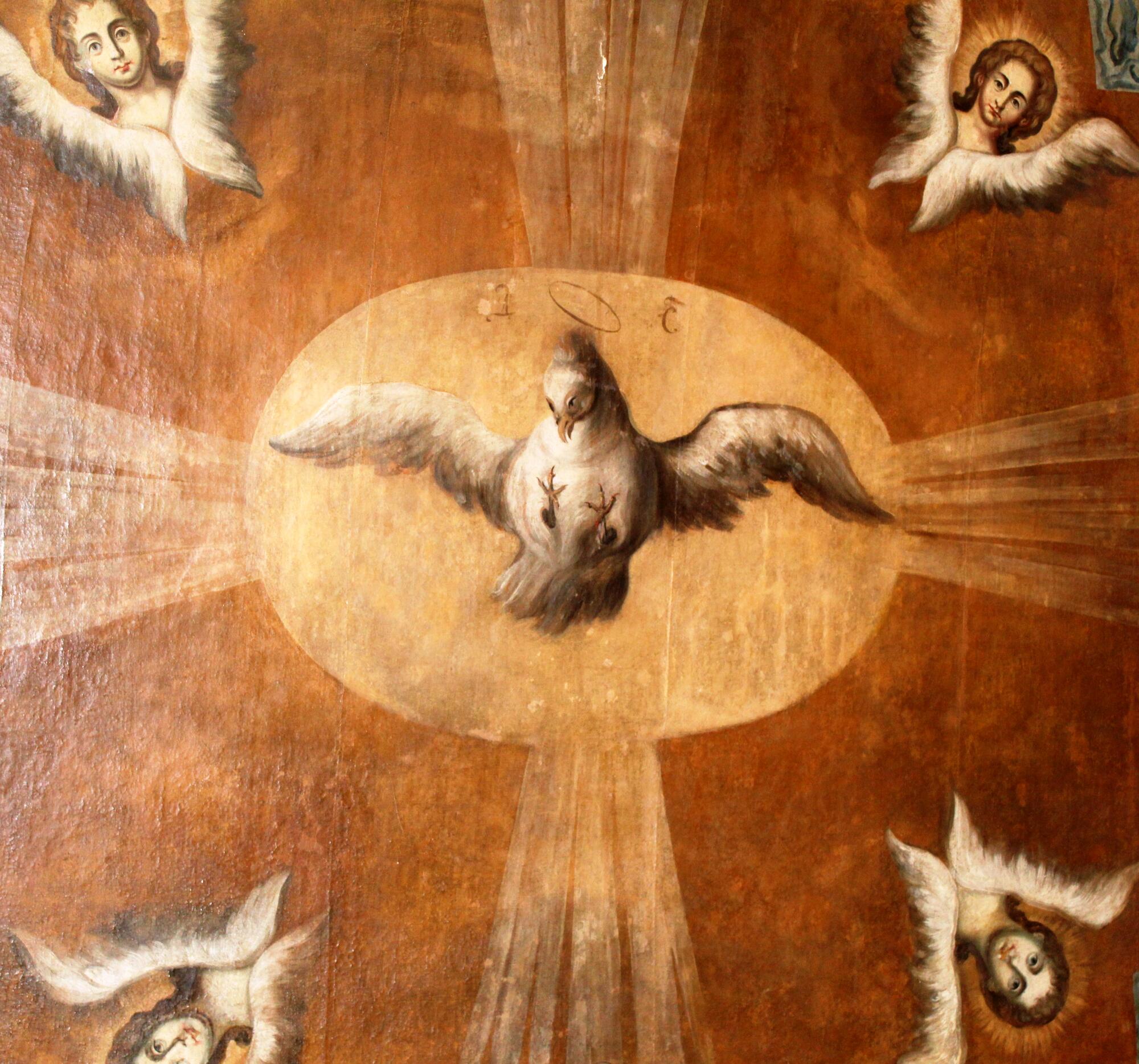
Four cherubs are depicted on the ciborium from the ‘Belozersk historical’ exposition and in the center - the Holy Spirit in the image of a white dove in the rays of glory. The sky is surrounded by a complex ornament with abstract patterns.
The sky of the ciborium from the collection of the Belozersky Regional Museum of Local History was formerly located in the Cathedral of the Transfiguration of the Saviour of the city of Belozersk. The cathedral was built in the second half of the 17th century on the territory of the Belozersky Kremlin. In the next century the temple was rebuilt, and in this form it survived to the present day.
In the 18th century, a wooden carved iconostasis, ciborium, wall-mounted and column-mounted carved frames for icons were installed at the cathedral. They were decorated with gold-plating and painting, and the iconostasis with decorated with gilded sculpture. The iconostasis of the Transfiguration of the Saviour Cathedral resembles a triumphal arch in its shape, as opposed to the traditional Russian iconostasis, which represent a continuous barrier separating the altar from the prayer space.
Four cherubs are depicted on the ciborium from the ‘Belozersk historical’ exposition and in the center - the Holy Spirit in the image of a white dove in the rays of glory. The sky is surrounded by a complex ornament with abstract patterns.