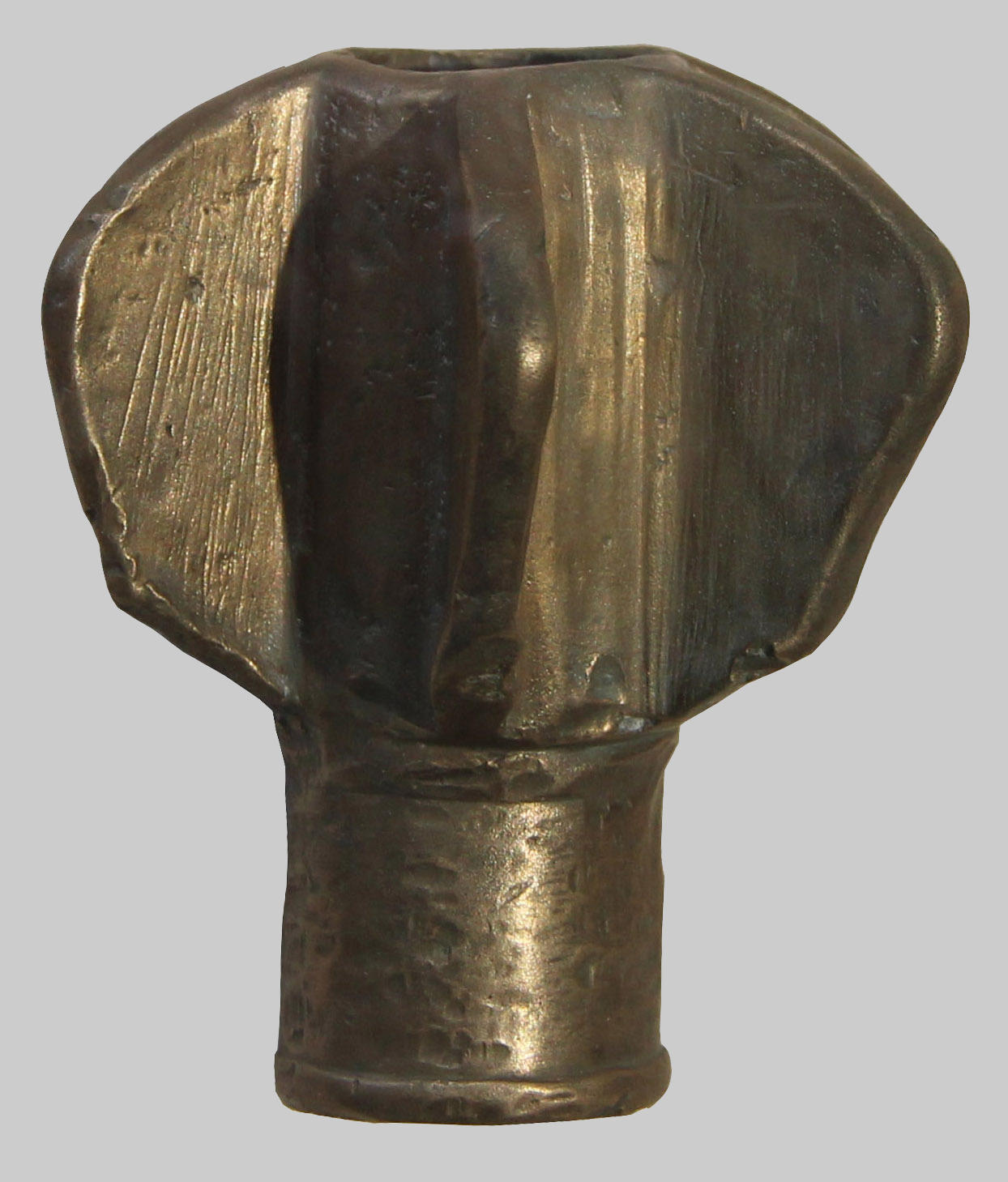


This shestopyor head was found by N.V. Zavaryukhin and N.S. Rusinovich in early May 2007 near the village of Kamenka in the Atyashevsky District of the Republic of Mordovia. Transferred to the museum funds by N.V. Zavaryukhin.
The shestopyor head has a round tubular hollow base, five quadrangular plates, expanding upwards, are fixed on it. The sixth plate is missing. The plates are firmly welded to the tubular base. The head was mounted on a short shaft and was used as a striking weapon with high destructive force.
The name shestopyor came from the shape of the tip – it was made of six (shest in Russian) or more plates (feathers; a feather is pero in Russian). The predecessors of this type of weapon are considered to be multiflaged maces, which were used as far back as the 10th century in the countries of the Middle East. In massive pommels blades of rectangular or triangular shape were cut from iron, bronze and hardwood.
In the 13th century the skill of the gunsmiths, who learned to rivet the blades to the base, heating the metal in the forge, significantly increased. In this period, the shestopyors appeared in Rus’. They quickly replaced maces, which required remarkable physical strength and were inconvenient in close combat. The hexagonal head weighed little, moreover, the center of gravity did not shift in such weapons, so they could be used quickly.
The length of the first shestopyors or pernachs, as they were called in Rus’, was no more than 60 cm. The edges of the blades were usually in the form of a triangle. To make the handle easier to hold in hand, a guard was made on it – a kind of hilt. Later, more massive types of pernachs appeared with a broad variety of face types: semicircular, rectangular and even curly.
The manufacturing technology was considered to be complex, and the pernachs were expensive, so complex items could only be seen among the nobility. The squads were also armed with pernachs. For the first time this type of weapon is mentioned in the First Pskov Chronicle, where the story about the victory of the Russian army over German knights at the Battle of Ghelmed is told.
Shestopyors were effective in battles with armored opponents. In such combats, all-metal pernachs were often used. They were slightly heavier, but due to the low weight of the head they were better balanced. In the 16th century modifications with smoothed edges spread in Europe – such a form made it possible to quickly free the weapon from the enemy’s punched armor.
Subsequently, special protective discs were added to the design, which were attached at the bottom. They defended hands and allowed to wield shestopyor with a weakened grip, which was necessary in close combat. The popularity of this type of weapon fell with the gradual disappearance of armor.
With the appearance of powder guns and pistols, shestopyor began to play a decorative role. It was used as a parade costume element and a ceremony detail. In Eastern Europe, pernach had long been served as a symbol of power.
The shestopyor head has a round tubular hollow base, five quadrangular plates, expanding upwards, are fixed on it. The sixth plate is missing. The plates are firmly welded to the tubular base. The head was mounted on a short shaft and was used as a striking weapon with high destructive force.
The name shestopyor came from the shape of the tip – it was made of six (shest in Russian) or more plates (feathers; a feather is pero in Russian). The predecessors of this type of weapon are considered to be multiflaged maces, which were used as far back as the 10th century in the countries of the Middle East. In massive pommels blades of rectangular or triangular shape were cut from iron, bronze and hardwood.
In the 13th century the skill of the gunsmiths, who learned to rivet the blades to the base, heating the metal in the forge, significantly increased. In this period, the shestopyors appeared in Rus’. They quickly replaced maces, which required remarkable physical strength and were inconvenient in close combat. The hexagonal head weighed little, moreover, the center of gravity did not shift in such weapons, so they could be used quickly.
The length of the first shestopyors or pernachs, as they were called in Rus’, was no more than 60 cm. The edges of the blades were usually in the form of a triangle. To make the handle easier to hold in hand, a guard was made on it – a kind of hilt. Later, more massive types of pernachs appeared with a broad variety of face types: semicircular, rectangular and even curly.
The manufacturing technology was considered to be complex, and the pernachs were expensive, so complex items could only be seen among the nobility. The squads were also armed with pernachs. For the first time this type of weapon is mentioned in the First Pskov Chronicle, where the story about the victory of the Russian army over German knights at the Battle of Ghelmed is told.
Shestopyors were effective in battles with armored opponents. In such combats, all-metal pernachs were often used. They were slightly heavier, but due to the low weight of the head they were better balanced. In the 16th century modifications with smoothed edges spread in Europe – such a form made it possible to quickly free the weapon from the enemy’s punched armor.
Subsequently, special protective discs were added to the design, which were attached at the bottom. They defended hands and allowed to wield shestopyor with a weakened grip, which was necessary in close combat. The popularity of this type of weapon fell with the gradual disappearance of armor.
With the appearance of powder guns and pistols, shestopyor began to play a decorative role. It was used as a parade costume element and a ceremony detail. In Eastern Europe, pernach had long been served as a symbol of power.