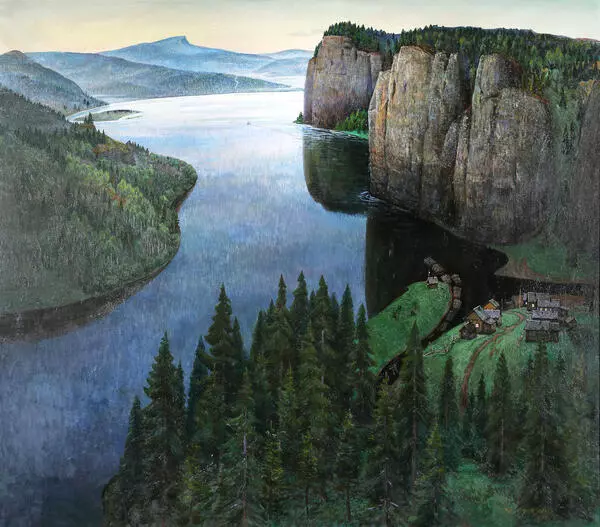
The Irbit Museum of Fine Arts presents “Still Life with a Flask” by Mikhail Vasilyevich Gumyonnykh. His work is distinguished by its profound engagement with themes that became his artistic signature: the Russian North, Kamchatka, and the austere, dignified life of ordinary people.
In “Still Life with a Flask”, seemingly mundane household objects are transformed into vessels of quiet beauty. The viewer is drawn to a row of dried fish suspended above a carefully composed arrangement on a wooden board: a glass flask, a loaf of bread, a slice of red smoked fish, and several heads of garlic. At the center, a glass ball entwined in a rope braid catches the eye — a traditional fishing float, once essential to northern maritime life.
These glass floats ranged in diameter from 3–5 centimeters to as large as 50–60 cm. Used to keep nets and trawls afloat, they were originally developed in Norway in the 1840s and soon adopted across the globe. Typically, they came in three forms: spherical, cylindrical, or teardrop-shaped. With the rise of synthetic materials in the late 20th century, glass floats gradually disappeared from practical use — yet they became cherished collector’s items.
Though landscape was one of Gumyonnykh’s favored genres, he also produced compelling still lifes. The artists Tatiana and Alexander Stepanov describe his works in this genre as follows:
“Still life held a special place in Gumyonnykh’s oeuvre. In these compositions, he acted as a ‘director’, crafting intimate, emotionally resonant ‘mise-en-scènes’. When creating still lifes, Gumyonnykh relied on the objects themselves, carefully selecting them from the multitude of surrounding things, and modeling each with meticulous care and deep affection. When one looks at Gumyonnykh’s still lifes, one might recall Paul Valéry’s observation: ‘Painting allows you to see things as they once were when they were treated with love’.”
Born in the village of Bornevka, Sokolovsky District, North Kazakhstan Region, Mikhail Gumyonnykh moved to Sverdlovsk (now Yekaterinburg) in 1952. There, he worked for several years as a theater decorator and later in art workshops, forging close ties with local craftsmen. In 1970, he was admitted to the Union of Artists of the USSR.