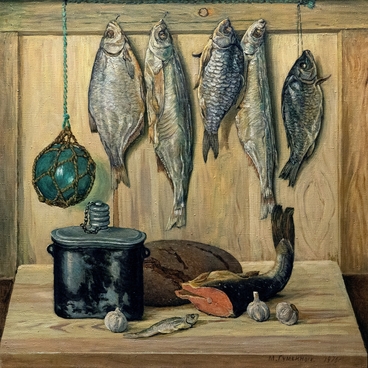
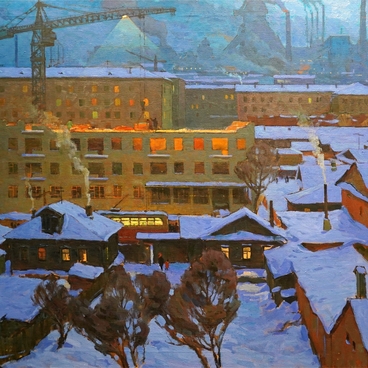
The artistic legacy of Mikhail Mikhailovich Gardubey is remarkably diverse, encompassing still lifes, landscapes, portraits, and large-scale thematic compositions. His works vividly capture the nostalgic vistas of old Tyumen, the intimate landscapes and people of his Transcarpathian homeland, as well as epic, mythological, and biblical narratives.
Deeply inspired by literature, Gardubey created an acclaimed series of drawings for Goethe’s “Faust” and a suite of graphic works inspired by Jorge Luis Borges’ short stories — and these were not simple illustrations. Equally significant is his cycle of paintings devoted to Cervantes’ “Don Quixote”, in which the artist reimagines the literary hero. One notable example, the painting titled “Don Quixote 2”, resides in the collection of the Irbit Museum of Fine Arts and stands as a powerful embodiment of this enduring figure.
Don Quixote, the titular character of Miguel de Cervantes Saavedra’s seminal novel “The Ingenious Gentleman Don Quixote of La Mancha” is the tragicomic figure of Alonso Quixano, a retired nobleman from La Mancha who, having immersed himself in chivalric romances, loses touch with reality and sets out as a knight-errant under the name Don Quixote. Accompanied by his pragmatic and loyal squire, Sancho Panza, and mounted on the weary steed Rocinante, he pursues impossible ideals, stumbling into absurd yet poignant encounters.
Though conceived as a satire of outdated chivalric tropes, Cervantes’ masterpiece transcended parody to become one of the foundational texts of Western literature. The novel was published in two volumes: the first in 1605, the second in 1615. Don Quixote became a satirical embodiment of the ideal of Spanish Golden Age culture — the “man of the pen and the sword”. This work is one of the most celebrated books in world literature, exerting a profound influence on the culture and art of subsequent eras. The image of Don Quixote has been repeatedly invoked in literature, theater, music, and cinema. The “knight of the sorrowful countenance” (as Sancho Panza calls his master) has also found powerful expression in visual art. Alongside Gardubey, Don Quixote has been portrayed by Gustave Doré, Pablo Picasso, Salvador Dalí, and many other artists.
Mikhail Mikhailovich Gardubey (Gardobey) (1948–2022) was born in the village of Kamyanskoye, Irshava District, Transcarpathian Region (then part of the Ukrainian SSR). From 1968, he lived and worked in Tyumen, where he taught at the Tyumen College of Art and the Tyumen branch of Ural Institute of Design. Gardubey’s works are held in museums and private collections across Russia, Slovakia, Austria, France, Germany, England, Hungary, and the United States.