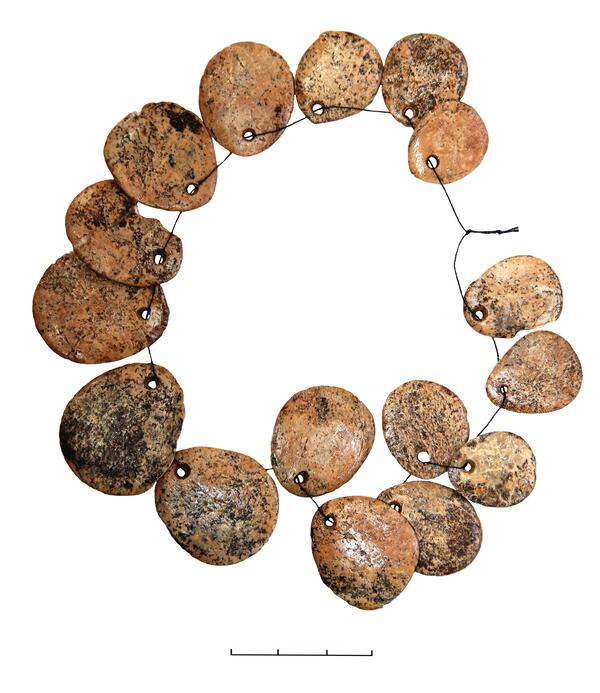
The pendants featured in the museum’s collection are made of bone. They are oval, leaf-shaped, with a hole for fastening (sewing). These objects date back to the early Bronze Age (14th–9th centuries BCE). Experts attribute the pendants to the Andronovo cultural and historical community. The purpose of the pendants was to decorate a costume or horse harness, or they were used as fasteners. The pendants were sewn onto clothes directly from the front side. The symbolism of such jewelry was indirectly connected with the worship of the sun and the forces of nature. Placed in a burial, such objects were supposed to retain the social status of their bearer in the afterlife.
The origin of these appliques is directly related to the Tashkovo archaeological culture that existed in the forest-steppe zone of the Trans-Urals in the Early Bronze Age. For some reason, in the 15th century BCE, its representatives moved east, reaching the shores of the Irtysh in 100 years. This culture was characterized by ceramics with geometric patterns made with a comb stamp, and oval-shaped pendants made of purple minerals. In the studied burials of the Tashkovo people, the number of such jewelry necklaces is measured in dozens. But as the people moved away from the sources of the stone, the number of such pendants decreased — there are almost no purple objects in the Irtysh region. Keen on preserving their tradition, the craftsmen began to make such jewelry from materials of a different color that they had at hand. In this case, the craftsman made appliques from bone. This was the way ancient people preserved their memory of the abandoned homeland.
The objects were discovered during the
archaeological study of the burial ground Borovyanka-XVII by the expedition of
the National Archaeological Natural Park “Batakovo” under the leadership of
Leonid Ivanovich Pogodin and Albert Viktorovich Polevodov in 2005–2006. This
burial ground belongs to two eras at once. Numerous ground burials of the
Andronovo period (Bronze Age, 14th–11th centuries BCE), as well as no less
numerous mounds of the Sargat culture dating back to the Early Iron Age (5th
century BCE — 5th century CE) have been documented and studied here. The burial
ground is located in the Chigar meander core.