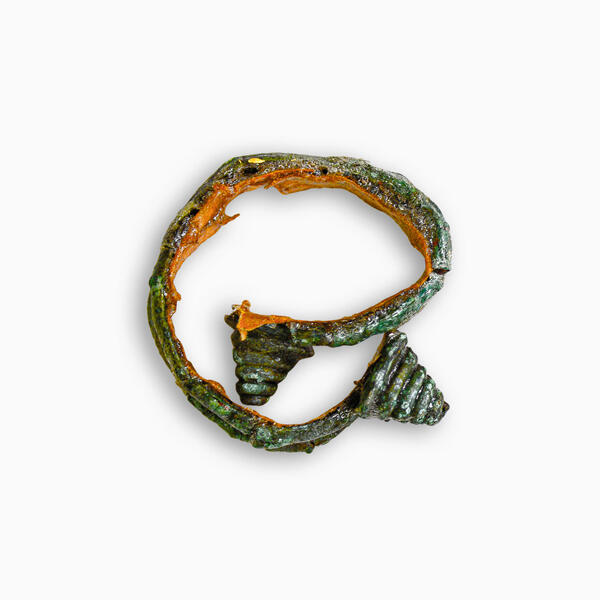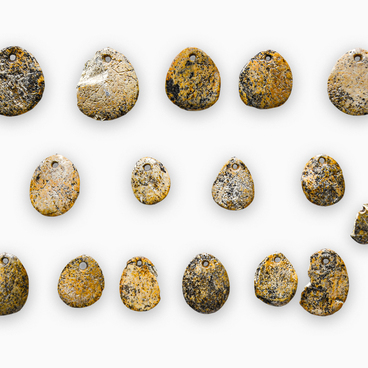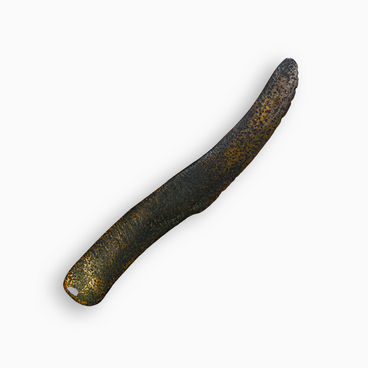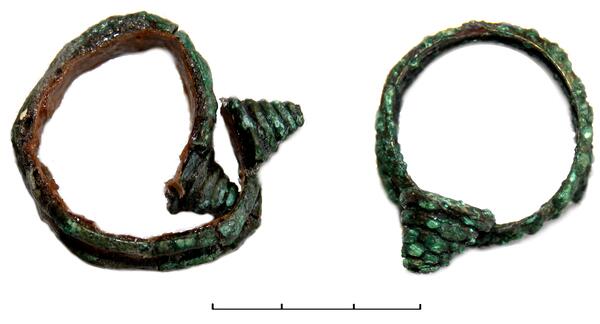
The rings presented in the museum’s collection were discovered during the archaeological study of the Borovyanka-XVII burial ground in one of the ground burials, which researchers attributed to the Andronovo time (Bronze Age, 14th–11th centuries BCE).
The rings are bent from a flat bronze plate. The finds were fixed on the phalanges of the fingers of the buried, therefore they are identified as removable finger jewelry. Similar objects can be found on almost all Andronovo sites studied in Western Siberia and the Trans-Urals. They are also present in Northern Kazakhstan. Such rings were worn mainly by children and teenagers, less often they are documented in women’s burials. Near the main craft centers, burials contain many rings of this type. In the Irtysh region, such a center was located on Lake Inberen in the Bolsherechensky district of the Omsk region.
Despite the rather primitive technology of producing metal and casting objects, the skill of ancient craftsmen was high and allowed them to create elegant and colorful high-quality products. Forging, casting, embossing and polishing were used to make jewelry.
The symbolism of such jewelry was connected with the worship of the forces of nature and the spirits of ancestors. They could also play the role of amulets that warded off evil forces, and talismans for good luck. It is worth noting that the circle was also a symbol of the sun, a symbol of life.
In addition to the actual finger rings, temporal rings were also common at that time. The rings are found in hairstyle decorations (nakosniks plait decorations). All of them are women’s jewelry. Men’s rings became widespread only in the early Iron Age. Similar objects made of gold can also be found in the burials of the upper strata of the Andronovo population.
From the Neolithic era jewelry became one of the
visible symbols of demonstrating social status, so it was often placed in
burials to retain the status of the deceased in the afterlife. In the
subsequent era of the Early Iron Age, objects with similar symbolism spread in
Scythian-type cultures; they are also known from the excavations of ancient
monuments.