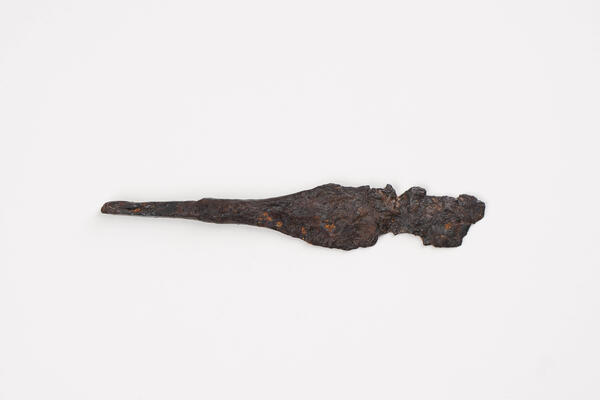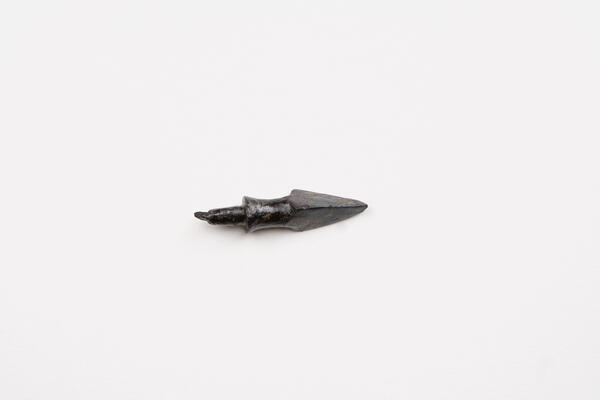
This arrowhead from the permanent exhibition “Relics from the Battle of Kulikovo” was discovered during 2013 in excavations conducted by the military-historical unit of the Upper-Don archaeological expedition of the State Historical Museum and the State Museum-Reserve “Kulikovo Field”. The archaeological dig took place in the upper reaches of the Smolka River to the north of the Khvorostyanka village. Historians believe that the final stage of the battle took place exactly in that area.
The arrowhead is well preserved although part of the tang is missing. The tanged head is shaped into a solid three-sided pyramid, with a projecting socket which is round in cross section and a stop flange for the shaft. The socket and the stop flange were made in the swaging technique. This shape was common in the territory of the Muslim East in the 13th and 14th centuries. Old Russian arrowheads of the same design were used from the second half of the 11th century to the 14th century. In Eastern Europe, such arrowheads were quite popular — they were used to penetrate body armor and wooden shields.
Written records provide reliable evidence that the armies under the united command of Prince Dmitry of Moscow and those under the command of khan Mamai consisted of several regiments. Each regiment engaged in several cavalry encounters which the Old Russian manuscripts called “sostupy” or, in the Turkic language, “suimy”. The first suim that often decided the outcome of the entire battle was usually the most bloody. If the first encounter failed to determine the winner, a series of skirmishes was to follow one after another. Each sostup began with the archers’ attack, and only then sometimes developed into hand-to-hand combat. This was not always the case as the sostup could end right after the archers’ attack. There is plenty of evidence that this tactic was popular at the time of the battle — arrowheads make up half of all the finds on the battlefield of Kulikovo. Unfortunately, few of them were fully preserved so it is not always possible to claim that the find is indeed an arrowhead.
The arrowhead is well preserved although part of the tang is missing. The tanged head is shaped into a solid three-sided pyramid, with a projecting socket which is round in cross section and a stop flange for the shaft. The socket and the stop flange were made in the swaging technique. This shape was common in the territory of the Muslim East in the 13th and 14th centuries. Old Russian arrowheads of the same design were used from the second half of the 11th century to the 14th century. In Eastern Europe, such arrowheads were quite popular — they were used to penetrate body armor and wooden shields.
Written records provide reliable evidence that the armies under the united command of Prince Dmitry of Moscow and those under the command of khan Mamai consisted of several regiments. Each regiment engaged in several cavalry encounters which the Old Russian manuscripts called “sostupy” or, in the Turkic language, “suimy”. The first suim that often decided the outcome of the entire battle was usually the most bloody. If the first encounter failed to determine the winner, a series of skirmishes was to follow one after another. Each sostup began with the archers’ attack, and only then sometimes developed into hand-to-hand combat. This was not always the case as the sostup could end right after the archers’ attack. There is plenty of evidence that this tactic was popular at the time of the battle — arrowheads make up half of all the finds on the battlefield of Kulikovo. Unfortunately, few of them were fully preserved so it is not always possible to claim that the find is indeed an arrowhead.