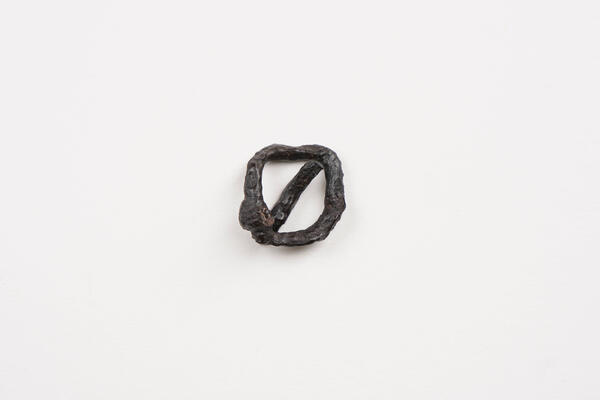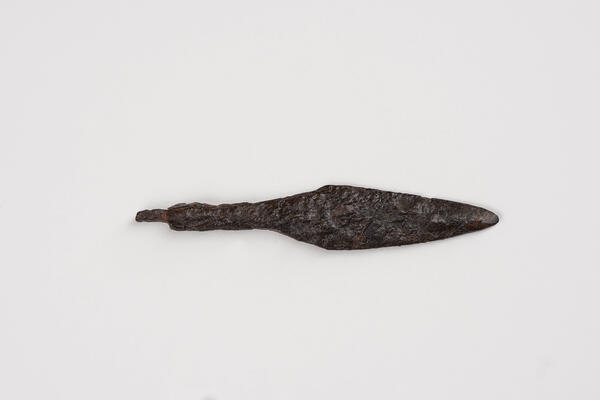
This arrowhead was discovered in 2014 in excavations conducted by the military-historical unit of the Upper-Don archaeological expedition of the State Historical Museum and the State Museum-Reserve “Kulikovo Field”. The archaeological dig was conducted in the upper reaches of the Smolka River to the north of the Khvorostyanka village, Kurkinsky District, Tula Oblast.
The arrowhead that was attached to the shaft with a tang has a wide diamond-shaped asymmetric body, a long neck and a stop flange for the shaft. The last two parts are both made in the swaging technique. The ratio of the neck to the total length of the body is one to three, its diameter is 0.7 cm. The rounded tang is mostly missing, and its diameter is 0.3 cm at the base. This is a common form of arrowheads, used on the territory of Old Rus from the 10th to the end of the 14th century.
The length of the arrows and the bow had to match the body proportions and strength of each archer. In the Middle ages, Russian, Arabic and Persian bows could be from 140 to 180 cm long. The arrows that were most widely used in Old Rus could be from 75 to 90 cm long. This was about half the length of the kibiti bow. In the 13th and 14th centuries, the nomads used arrows of the same length.
According to an Arabic manual of the 15th century, medieval archers estimated the ratio between the length of the arrows and the length of the archer’s limbs. Some believed that the length of the arrow should be equal to either the length of the archer’s arm from the armpit to the tip of the middle finger, or the sum of the lengths of the shoulder and forearm (75–90 cm), or the length of the lower leg and foot (75 cm), or the length of the lower leg and forearm (about 90 cm), or the length of the forearm and the width of the chest (about 85 cm). Others claimed the length of the arrow should reach either 8–12 fist circumference (72–108 cm), or the distance between the ends of the drawn bow, or the distance between the ends of the bow with the string on.
Most Old Russian arrowheads weighed from 8 to 10 grams, but there were also especially large points that weighed up to 40 grams. An Arabic manual of the 15th century informed that the weight of an arrowhead should have been one seventh of the total weight of the arrow.
The arrowhead that was attached to the shaft with a tang has a wide diamond-shaped asymmetric body, a long neck and a stop flange for the shaft. The last two parts are both made in the swaging technique. The ratio of the neck to the total length of the body is one to three, its diameter is 0.7 cm. The rounded tang is mostly missing, and its diameter is 0.3 cm at the base. This is a common form of arrowheads, used on the territory of Old Rus from the 10th to the end of the 14th century.
The length of the arrows and the bow had to match the body proportions and strength of each archer. In the Middle ages, Russian, Arabic and Persian bows could be from 140 to 180 cm long. The arrows that were most widely used in Old Rus could be from 75 to 90 cm long. This was about half the length of the kibiti bow. In the 13th and 14th centuries, the nomads used arrows of the same length.
According to an Arabic manual of the 15th century, medieval archers estimated the ratio between the length of the arrows and the length of the archer’s limbs. Some believed that the length of the arrow should be equal to either the length of the archer’s arm from the armpit to the tip of the middle finger, or the sum of the lengths of the shoulder and forearm (75–90 cm), or the length of the lower leg and foot (75 cm), or the length of the lower leg and forearm (about 90 cm), or the length of the forearm and the width of the chest (about 85 cm). Others claimed the length of the arrow should reach either 8–12 fist circumference (72–108 cm), or the distance between the ends of the drawn bow, or the distance between the ends of the bow with the string on.
Most Old Russian arrowheads weighed from 8 to 10 grams, but there were also especially large points that weighed up to 40 grams. An Arabic manual of the 15th century informed that the weight of an arrowhead should have been one seventh of the total weight of the arrow.