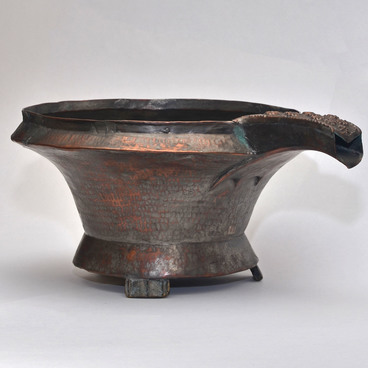
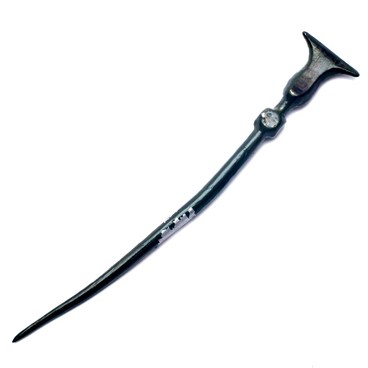
The bronze leaf-shaped spearhead was found on the premises of the Bryansk Machine Building Factory in 1946 together with a shaft-hole battle axe. Researchers believe that it was a burial place of some chieftain who was traditionally buried with his weapons.


#1

Spearhead
#2
#3
Both items date to the third quarter of the second millennium before Common Era. In that period, the Bryansk lands were inhabited by the tribes of the Middle Dnieper archeological culture who moved here from the west and southwest. They lived in the Desna, Sudost, and Iputi river valleys.
#4
The Middle Dnieper tribes were the first in the lands of Bryansk who spoke an Indo-European language and used metal tools. Those tribes brought with them the practice of farming and cattle breeding, and the custom of kurgan burials. Most frequent archeological finds are ceramic vessels with a coil-cord decorative pattern, knives, scrapers, and spearheads.
#5
Bronze items dating to that period are rarely found by archeologists. Such alloys were not made in the Bryansk area. They were bought from the Caucasian and Balkan tribes. Hence, bronze weapons were rare and expensive and usually owned by chieftains and military commanders, and as such were perceived as symbols of power.
#6
The cast spearhead from the collection of the Bryansk Museum of Local History has the contour of a laurel leaf. Such a shape was meant to inflict wide and deep wounds on the enemy. Bronze is a fairly soft material. That is why the spearheads were additionally strengthened so as to prevent bending in a battle: they were made with a raised reinforcing mid rib, increasingly widening from the tip down and extending to the conical socket. The spear shaft may be up to 2 meters long. Its end was pushed into the socket and then fixed by nails or pins. The spearhead from the Bryansk collection of ancient relics has two holes intact needed for such fixing.
#7
Socketed spearheads were preceded by broadly used shanked spearheads. They had the battle section shaped in the same way, but were fixed to the spear shaft differently. Such a spearhead would have a long shank on one side hammered into the shaft. The connection point was tightened by leather bands for additional strength. However, such a connection was short-lived, and socketed spearheads quickly replaced the shanked ones.
#8
#9
Axe with a hanging pole
#10
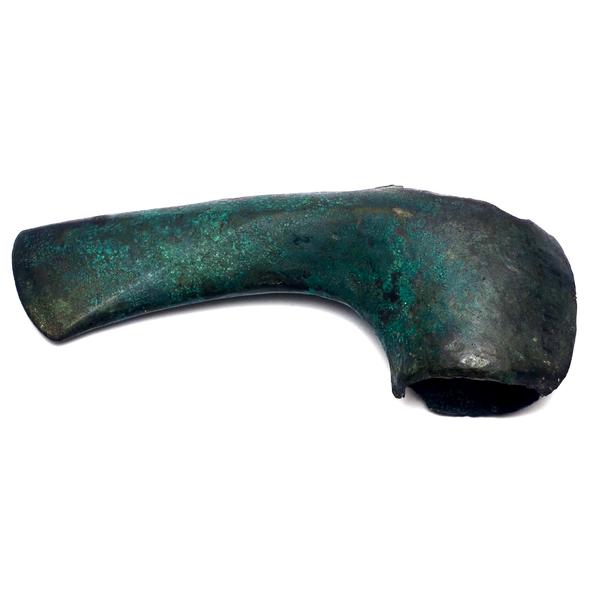
This bronze axe with a hanging pole was discovered in 1946 in the town of Beshits, Bryansk region. A spearhead was discovered close by. The scientists made a conclusion that these items were part of a tribal leader burial.
#11
Axes of this sort were made in the end of the II millennium BC. At that time, the middle Dnepr tribes inhabited the modern Bryansk region. They came from the western and south-western lands, partly drove off and partly mixed with the Finno-Ugrian inhabitants. Archeologists found many items from that period in the Bryansk region. Among these were ceramic vessels with curl cord ornaments, bronze daggers, axes and spearheads.
#12
Axes with hanging poles were used as weapons. Their name can be explained by a pole which is situated lower than the blade, as if ‘hanging’ below it. Such items were also called socketed axes: they had internal sockets with a handle fixed inside it. Sometimes the axes were decorated with ornaments but more often they were smooth. There was no need for decorative components on weapons of war.
There were no bronze allows in the Bryansk region. By using chemical examination scientists discovered that at that time this metal was brought here from the North Caucasus and later the Balkans. It was used to make not only weapons but also domestic knifes, sewing awls and different jewelry including necklaces, temple rings and bracelets.
#13
Axe with a hanging pole from the ‘Bryansk antiquities’ collection was casted form bronze as a whole, its handle has not been preserved up to our days. The item has a bent quite long narrow blade. This weapon was suitable for close-in combat: its massive war-head increased momentum after swinging whereas its long handle allowed to keep enough distance between the enemies.
#14
Middle Dnepr tribes considered metallic weaponry to be a symbol of generic authority. Only tribal leaders and high-ranking warriors had access to such weapons — axes were found only in their burial mounds. Burial sites were quite modest and usually contained several types of weapons and ceramic vessels and, less frequently, bronze jewelry. Archeologists never found any luxury articles in the burial mounds.
#15
Bryansk State Regional Ethnography Museum, a State budgetary cultural institution
read morehide
00:00
00:00
1x
Spearhead, Axe with a hanging pole
Technique
Bronze, casting
Collection
Exhibition
7
 Point your smartphone camera to open in the app
Open in app
Share