#1
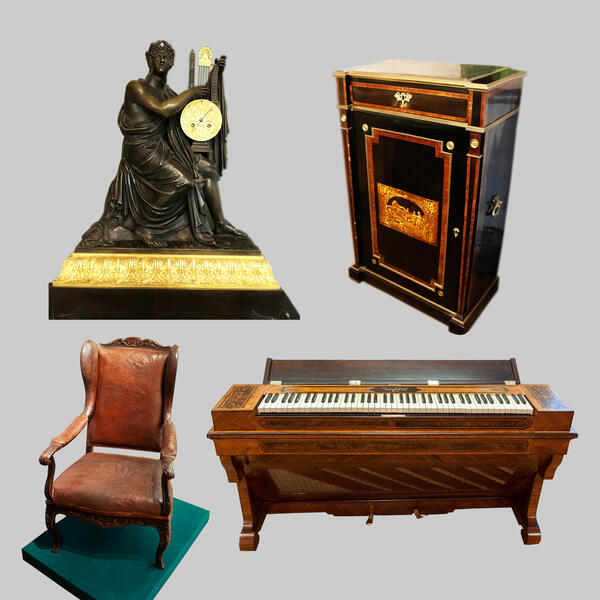
Minipiano, Oak cabinet, Bronze clock, Armchair
#2
#3
#4
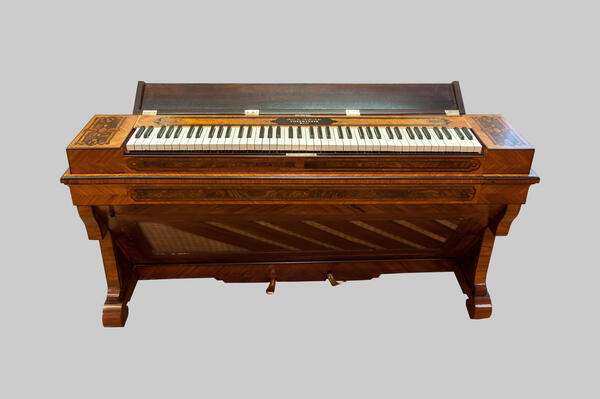
French minipiano manufactured at an Eigenmenger Parish factory. This original piece was created by master Michel Eisenmenger in 1855. The work is truly impressive with its small size. The soundboard, which is responsible for the instrument’s sound, is positioned inside the body at an angle, while grand pianos and square pianos have horizontal soundboards, and soundboards in standard modern pianos are vertically-oriented.
The keyboard is situated at the top part of the instrument, while the piano action mechanism, a device consisting of levers, belts, and hammers, is positioned in a way that allows the piano to have strings of the necessary length despite the extremely low height of its body.
By the way, this feature proved to be appealing not only to piano players, but also to their listeners. Being only 80 centimeters in height, this instrument allowed to see both the pianist’s torso and hands during performances.
The piano is finished with walnut with floral intarsia patterns of cherry, pear, and ash veneer.
Intarsia (from Italian intarsio, meaning ‘inlay’) is a kind of decorative art that involves inserting one material into another by ‘cutting’ its pieces in. In this case, it is wood inlaid with wood. This technique is done exclusively by hand and is applied, for instance, in the production of expensive furniture. This is done by selecting pieces of wood of different color, which, after the removal of all defects, are cut into very thin veneer strips. The resulting strips are glued together to form sheets of the desired size that are then cut into mosaic pieces. The elements of the pattern are tightly fitted to each other, glued together, and inserted into pre-cut grooves in the workpiece. The face side of the mosaic is then carefully polished.
Same as inlay, intarsia originated in the Ancient East, in Egypt, and was later perfected in Ancient Greece and Rome, where ornaments were commonly created with the use of maple, boxwood, holly, ironwood, and dogwood.
The keys of this minipiano are covered with bone tops. Traditionally, keys used to be manufactured from ivory. However, increasingly strict bans on ivory poaching led to its replacement – first, with walrus tusks, and then with plastic, which is still used for this purpose to this day.
The keyboard is situated at the top part of the instrument, while the piano action mechanism, a device consisting of levers, belts, and hammers, is positioned in a way that allows the piano to have strings of the necessary length despite the extremely low height of its body.
By the way, this feature proved to be appealing not only to piano players, but also to their listeners. Being only 80 centimeters in height, this instrument allowed to see both the pianist’s torso and hands during performances.
The piano is finished with walnut with floral intarsia patterns of cherry, pear, and ash veneer.
Intarsia (from Italian intarsio, meaning ‘inlay’) is a kind of decorative art that involves inserting one material into another by ‘cutting’ its pieces in. In this case, it is wood inlaid with wood. This technique is done exclusively by hand and is applied, for instance, in the production of expensive furniture. This is done by selecting pieces of wood of different color, which, after the removal of all defects, are cut into very thin veneer strips. The resulting strips are glued together to form sheets of the desired size that are then cut into mosaic pieces. The elements of the pattern are tightly fitted to each other, glued together, and inserted into pre-cut grooves in the workpiece. The face side of the mosaic is then carefully polished.
Same as inlay, intarsia originated in the Ancient East, in Egypt, and was later perfected in Ancient Greece and Rome, where ornaments were commonly created with the use of maple, boxwood, holly, ironwood, and dogwood.
The keys of this minipiano are covered with bone tops. Traditionally, keys used to be manufactured from ivory. However, increasingly strict bans on ivory poaching led to its replacement – first, with walrus tusks, and then with plastic, which is still used for this purpose to this day.
#5
Author: Manufactured at Eigenmenger Parish by master Michel Eisenmenger
Date: 1855
Technique: bone, metal, mahogany
Dimensions: 145×60×55 cm
Collection: History of engineering
Copyright: Ramenskoye History and Art Museum
Date: 1855
Technique: bone, metal, mahogany
Dimensions: 145×60×55 cm
Collection: History of engineering
Copyright: Ramenskoye History and Art Museum
#6
Small oak cabinet, style of G. Jacob
#7
#8
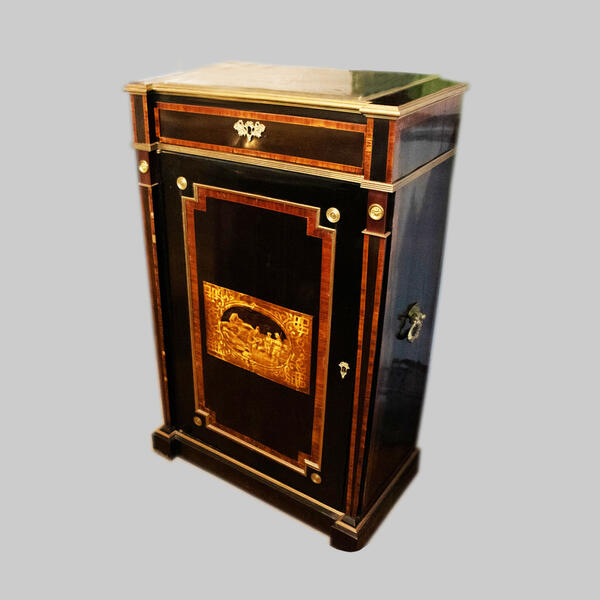
Small oak cabinet, black. Veneered with black walnut (dyed and stained). The door features pilasters on the sides and a drawer at the top.
The themed composition in the center of the door depicts a group of people, probably negotiating a purchase. Two young men in sailor uniforms are standing on the seashore against the background of wooden houses. They are facing an old fisherman with a boat behind him. The composition is placed in an oval and is surrounded by Chinese-style geometric patterns.
Since the early 19th century, the words ‘G. Jacob’s style’ have been used to describe mahogany furniture with glued on ribbed brass strips. The style was named after its founder, Georges-Alphonse Jacob, who first started making such furniture in his workshops.
Georges Jacob was the first furniture maker to set the stage for the emergence of the Empire style. Many cabinet makers used his designs in their furniture and forged his stamp. The most famous forger of Georges Jacob’s stamp was Henri Jacob, with whom he shared the same last name. The furniture produced by Henri Jacob’s workshops was in no way inferior in quality to the works of his famous predecessor, and he received commissions from the court and various dignitaries.
This small cabinet presumably belonged to the Talyzin family from the Denezhnikovo estate situated in the Bronnitsy District.
Based on the known documents, the Talyzin family tree dates back to the 15th century. The names of its members are found in accounts of many significant events in the history of the Russian state.
The estate ensemble of Denezhnikovo was built by a member of the Admiralty Board since 1748, admiral Ivan Lukyanovich Talyzin (1700–1779). Ivan Lukyanovich was a relative of Nikita Ivanovich Panin, a diplomat in charge of the Russian foreign policy. Another relative of Ivan Talyzin was the Chancellor of the Russian Empire Alexey Petrovich Bestuzhev-Ryumin.
Eventually, Denezhnikovo passed on to Ivan Lukyanovich’s male heir, Alexander Fyodorovich Talyzin (1731–1787).
Alexander Talyzin played a prominent role in the plot to overthrow Peter III and crown Catherine the Great. The Empress entered Petersburg disguised in Talyzin’s uniform. This uniform was kept as an heirloom by the Apraksin family first in the village of Olgovo in the Moscow Province, and then in Denezhnikovo.
Suvorov visited the Denezhnikovo estate more than once. In 1795, he became the god-son of Stepan Aleksandrovich Talyzin. Subsequently, the commander’s godson, Alexander, married Suvorov’s granddaughter, Olga Nikolaevna Zubova (1803–1882).
Since then, portraits of the Zubovs and the Suvorovs have been on the walls of the house in Denezhnikovo. The portrait of Alexander Suvorov occupied a special and honorable place. In addition, the estate contained a large collection of the Field-Marshal’s belongings. In the park of the estate, there is an oak, which, according to legend, was planted by Suvorov himself.
After the death of Alexander Stepanovich Talyzin, Denezhnikovo was inherited by his children. In 1918, the estate was nationalized.
The themed composition in the center of the door depicts a group of people, probably negotiating a purchase. Two young men in sailor uniforms are standing on the seashore against the background of wooden houses. They are facing an old fisherman with a boat behind him. The composition is placed in an oval and is surrounded by Chinese-style geometric patterns.
Since the early 19th century, the words ‘G. Jacob’s style’ have been used to describe mahogany furniture with glued on ribbed brass strips. The style was named after its founder, Georges-Alphonse Jacob, who first started making such furniture in his workshops.
Georges Jacob was the first furniture maker to set the stage for the emergence of the Empire style. Many cabinet makers used his designs in their furniture and forged his stamp. The most famous forger of Georges Jacob’s stamp was Henri Jacob, with whom he shared the same last name. The furniture produced by Henri Jacob’s workshops was in no way inferior in quality to the works of his famous predecessor, and he received commissions from the court and various dignitaries.
This small cabinet presumably belonged to the Talyzin family from the Denezhnikovo estate situated in the Bronnitsy District.
Based on the known documents, the Talyzin family tree dates back to the 15th century. The names of its members are found in accounts of many significant events in the history of the Russian state.
The estate ensemble of Denezhnikovo was built by a member of the Admiralty Board since 1748, admiral Ivan Lukyanovich Talyzin (1700–1779). Ivan Lukyanovich was a relative of Nikita Ivanovich Panin, a diplomat in charge of the Russian foreign policy. Another relative of Ivan Talyzin was the Chancellor of the Russian Empire Alexey Petrovich Bestuzhev-Ryumin.
Eventually, Denezhnikovo passed on to Ivan Lukyanovich’s male heir, Alexander Fyodorovich Talyzin (1731–1787).
Alexander Talyzin played a prominent role in the plot to overthrow Peter III and crown Catherine the Great. The Empress entered Petersburg disguised in Talyzin’s uniform. This uniform was kept as an heirloom by the Apraksin family first in the village of Olgovo in the Moscow Province, and then in Denezhnikovo.
Suvorov visited the Denezhnikovo estate more than once. In 1795, he became the god-son of Stepan Aleksandrovich Talyzin. Subsequently, the commander’s godson, Alexander, married Suvorov’s granddaughter, Olga Nikolaevna Zubova (1803–1882).
Since then, portraits of the Zubovs and the Suvorovs have been on the walls of the house in Denezhnikovo. The portrait of Alexander Suvorov occupied a special and honorable place. In addition, the estate contained a large collection of the Field-Marshal’s belongings. In the park of the estate, there is an oak, which, according to legend, was planted by Suvorov himself.
After the death of Alexander Stepanovich Talyzin, Denezhnikovo was inherited by his children. In 1918, the estate was nationalized.
#9
Date: late 18th–early 19th century
Technique: mosaic, veneer, woodwork
Dimensions: 126×76,7×42 cm
Collection: Furniture
Copyright: Ramenskoye History and Art Museum
Technique: mosaic, veneer, woodwork
Dimensions: 126×76,7×42 cm
Collection: Furniture
Copyright: Ramenskoye History and Art Museum
#10
Bronze clock ‘Orpheus playing the cither’
#11
#12
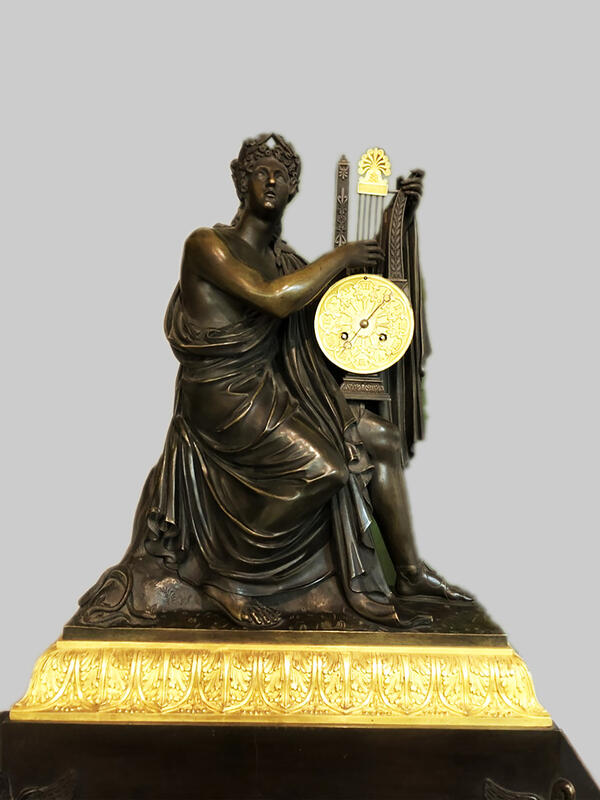
Mechanical mantle clock in a decorative case. The clock could plausibly be dated to the early 19th century: the inscription ‘Avril 1828’ (April, 1828) was found on an old mainspring. If we assume that this is an original part, we could accurately determine the exact age of the clock based on that date.
On the outside of the plate, another inscription was found—"Bechot.’ This may be the name of the bronzer. In this context, “plate” is an interesting usage. In clock terminology, this word usually refers to the largest part of the frame of the clockwork mechanism. Platinum is used to fasten bridges and bearings of watch gears, often defining the shape of the whole mechanism.
The artistic solution of the watch case refers to the Ancient Greek myth of Orpheus and Eurydice. Their love story is one of the most poetic and dramatic myths.
Apollo gave his son Orpheus a lyre and taught him to play it. Orpheus mastered the instrument bestowed onto him, and so great was his talent that the teacher himself was amazed at his skill.
Orpheus fell in love with the forest nymph Eurydice and then married her, however, Hymenaeus (the deity of marriage), whom they invited to bless the marriage, predicted that their happiness would not last long. And indeed it did not. Shortly thereafter, Eurydice was bit by a snake whilst walking with the nymphs through the forest and died.
Orpheus expressed his grief in music. His songs touched everything and everyone in the world of the living. Then he decided to descend into the realm of the dead and get to Hades himself. The god of the underworld allowed Orpheus to take Eurydice, but on one condition. She must follow her husband, staying behind him, and Orpheus must not turn around, or he will never see her again.
Orpheus accepted that condition. However, when Orpheus was approaching the exit from the underworld, he did not hear the steps of Eurydice behind him. He thought that Hades had deceived him. Unable to bear it, he turned around, only to see the shadow of a nymph returning back to the kingdom of the dead.
Orpheus tried to return to the underworld, but a person cannot enter the kingdom of Hades twice during their lifetime. And so he lost Eurydice forever.
After Orpheus himself died, the muses decided to preserve the memory of him among living people so that the musical thread would not be interrupted.
The name of Orpheus is associated with the emergence of the cult rites of the Orphic mysteries and the religious and philosophical doctrine - Orphism. Some believe that Orphism became the prototype of later monotheistic religions, in particular, Christianity, since it marked the transition from polytheism to worship of the One God.
On the outside of the plate, another inscription was found—"Bechot.’ This may be the name of the bronzer. In this context, “plate” is an interesting usage. In clock terminology, this word usually refers to the largest part of the frame of the clockwork mechanism. Platinum is used to fasten bridges and bearings of watch gears, often defining the shape of the whole mechanism.
The artistic solution of the watch case refers to the Ancient Greek myth of Orpheus and Eurydice. Their love story is one of the most poetic and dramatic myths.
Apollo gave his son Orpheus a lyre and taught him to play it. Orpheus mastered the instrument bestowed onto him, and so great was his talent that the teacher himself was amazed at his skill.
Orpheus fell in love with the forest nymph Eurydice and then married her, however, Hymenaeus (the deity of marriage), whom they invited to bless the marriage, predicted that their happiness would not last long. And indeed it did not. Shortly thereafter, Eurydice was bit by a snake whilst walking with the nymphs through the forest and died.
Orpheus expressed his grief in music. His songs touched everything and everyone in the world of the living. Then he decided to descend into the realm of the dead and get to Hades himself. The god of the underworld allowed Orpheus to take Eurydice, but on one condition. She must follow her husband, staying behind him, and Orpheus must not turn around, or he will never see her again.
Orpheus accepted that condition. However, when Orpheus was approaching the exit from the underworld, he did not hear the steps of Eurydice behind him. He thought that Hades had deceived him. Unable to bear it, he turned around, only to see the shadow of a nymph returning back to the kingdom of the dead.
Orpheus tried to return to the underworld, but a person cannot enter the kingdom of Hades twice during their lifetime. And so he lost Eurydice forever.
After Orpheus himself died, the muses decided to preserve the memory of him among living people so that the musical thread would not be interrupted.
The name of Orpheus is associated with the emergence of the cult rites of the Orphic mysteries and the religious and philosophical doctrine - Orphism. Some believe that Orphism became the prototype of later monotheistic religions, in particular, Christianity, since it marked the transition from polytheism to worship of the One God.
#13
Date: 1828
Technique: bronze, brass, steel
Dimensions: 72×54×24 cm
Collection: History of engineering
Copyright: Ramenskoye History and Art Museum
Technique: bronze, brass, steel
Dimensions: 72×54×24 cm
Collection: History of engineering
Copyright: Ramenskoye History and Art Museum
#14
Fireplace armchair. ‘Voltaire’ armchair with a soft seat and a back with soft sides.
#15
#16
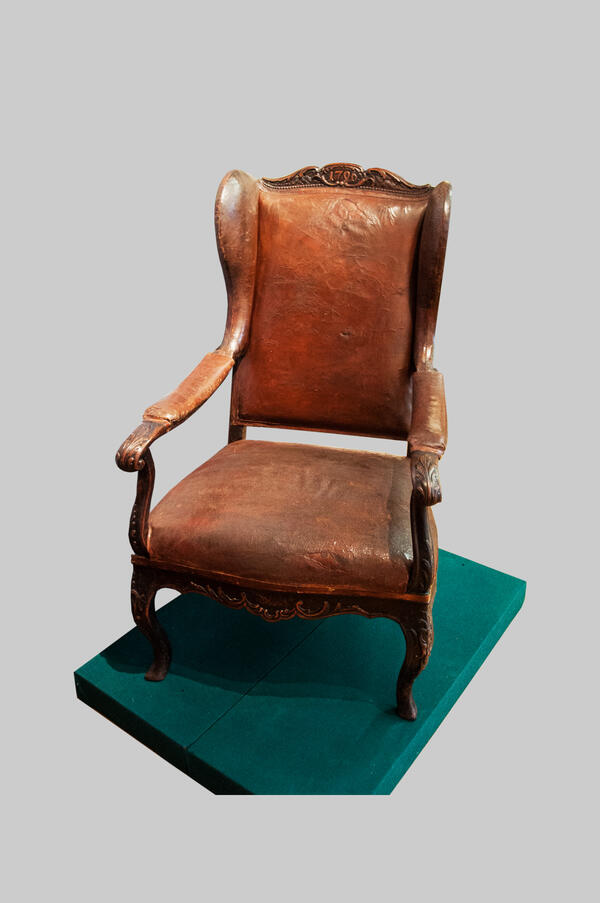
The so-called ‘Voltaire’ chair on low legs with a soft seat and back, and soft sides on the upper part of the back.
The edges of the drawer side (the crossbeam connecting the furniture legs) and the upper part of the back are decoratively carved. The legs and arms of the armrests are curved. On the drawer side, the outer part of the armrests, the back, and the sidewalls there is a low relief carving of leaves and curls. The date ‘1796’ is carved into the top of the back. It is highly likely that this is the year the armchair was manufactured: it matches the style of the item, and the techniques used in its manufacturing are typical for that time period. The armchair is upholstered in brown leather.
This armchair used to belong to TalYzin family and used to be a part of the interior of the Denezhnikovo estate in the Bronnitskiy Uyezd (administrative territorial unit). Based on the known documents, the Talyzin family tree dates back to the 15th century. This family name is found in accounts of many significant events in the history of the Russian state.
The estate ensemble of Denezhnikovo was built by a member of the Admiralty Board since 1748, admiral Ivan Lukyanovich Talyzin (1700–1779). Ivan Lukyanovich was a relative of Nikita Ivanovich Panin, a diplomat in charge of the Russian foreign policy. Another relative of Ivan Talyzin was the Chancellor of the Russian Empire Alexey Petrovich Bestuzhev-Ryumin.
It was he who famously replied to the envoys of Peter III that they should ‘leave the way they came, for he had not seen any Emperor of Russia, and serves faithfully only to the sole Empress of All Russia, Catherine II.’
Eventually, Denezhnikovo passed on to Ivan Lukyanovich’s male heir, Alexander Fyodorovich Talyzin (1731–1787). He was promoted to lieutenant captain, then to captain; he was a gentleman of the bedchamber of the Imperial Court, then a secret councilor, senator, and chamberlain; he was decorated with the highest orders, and had a distinct honor of wearing a diamond epaulette on his left shoulder.
Alexander Talyzin played a prominent role in the plot to overthrow Peter III and crown Catherine the Great.
In 1792, Alexander Talyzin was in Poland with Suvorov. In 1794 he was promoted to colonel and appointed commander of the Oryol infantry regiment. Generalissimus Suvorov visited the Denezhnikovo estate. In 1795, Alexander Suvorov became the godfather of Stepan Alexandrovich Talyzin’s son. Subsequently, the godson of the great commander, Alexander, marries Suvorov’s granddaughter, Olga Nikolaevna Zubova (1803–1882).
Since then, portraits of the Zubovs and the Suvorovs have been on the walls of the house in Denezhnikovo. The portrait of Alexander Suvorov occupied a special and honorable place. In addition, the estate contained a large collection of the Field-Marshal’s belongings. In the park of the estate, there is an oak, which, according to legend, was planted by Suvorov himself.
After the death of Alexander Talyzin, Denezhnikovo was inherited by his children. In 1918, the estate was nationalized.
The edges of the drawer side (the crossbeam connecting the furniture legs) and the upper part of the back are decoratively carved. The legs and arms of the armrests are curved. On the drawer side, the outer part of the armrests, the back, and the sidewalls there is a low relief carving of leaves and curls. The date ‘1796’ is carved into the top of the back. It is highly likely that this is the year the armchair was manufactured: it matches the style of the item, and the techniques used in its manufacturing are typical for that time period. The armchair is upholstered in brown leather.
This armchair used to belong to TalYzin family and used to be a part of the interior of the Denezhnikovo estate in the Bronnitskiy Uyezd (administrative territorial unit). Based on the known documents, the Talyzin family tree dates back to the 15th century. This family name is found in accounts of many significant events in the history of the Russian state.
The estate ensemble of Denezhnikovo was built by a member of the Admiralty Board since 1748, admiral Ivan Lukyanovich Talyzin (1700–1779). Ivan Lukyanovich was a relative of Nikita Ivanovich Panin, a diplomat in charge of the Russian foreign policy. Another relative of Ivan Talyzin was the Chancellor of the Russian Empire Alexey Petrovich Bestuzhev-Ryumin.
It was he who famously replied to the envoys of Peter III that they should ‘leave the way they came, for he had not seen any Emperor of Russia, and serves faithfully only to the sole Empress of All Russia, Catherine II.’
Eventually, Denezhnikovo passed on to Ivan Lukyanovich’s male heir, Alexander Fyodorovich Talyzin (1731–1787). He was promoted to lieutenant captain, then to captain; he was a gentleman of the bedchamber of the Imperial Court, then a secret councilor, senator, and chamberlain; he was decorated with the highest orders, and had a distinct honor of wearing a diamond epaulette on his left shoulder.
Alexander Talyzin played a prominent role in the plot to overthrow Peter III and crown Catherine the Great.
In 1792, Alexander Talyzin was in Poland with Suvorov. In 1794 he was promoted to colonel and appointed commander of the Oryol infantry regiment. Generalissimus Suvorov visited the Denezhnikovo estate. In 1795, Alexander Suvorov became the godfather of Stepan Alexandrovich Talyzin’s son. Subsequently, the godson of the great commander, Alexander, marries Suvorov’s granddaughter, Olga Nikolaevna Zubova (1803–1882).
Since then, portraits of the Zubovs and the Suvorovs have been on the walls of the house in Denezhnikovo. The portrait of Alexander Suvorov occupied a special and honorable place. In addition, the estate contained a large collection of the Field-Marshal’s belongings. In the park of the estate, there is an oak, which, according to legend, was planted by Suvorov himself.
After the death of Alexander Talyzin, Denezhnikovo was inherited by his children. In 1918, the estate was nationalized.
#17
Author: unknown author
Date: 1796
Technique: carpentry, carving
Dimensions: 114×66×56 cm
Collection: Furniture
Copyright: Ramenskoye History and Art Museum
Date: 1796
Technique: carpentry, carving
Dimensions: 114×66×56 cm
Collection: Furniture
Copyright: Ramenskoye History and Art Museum
read morehide
00:00
00:00
1x
Minipiano, Oak cabinet, Bronze clock, Armchair
Collection
0
 Point your smartphone camera to open in the app
Open in app
Share