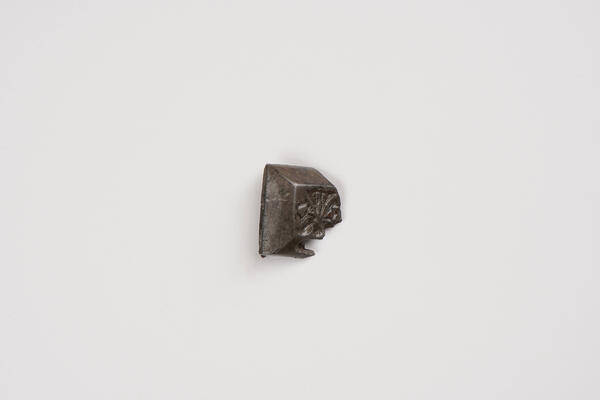
The permanent exhibition “Relics from the Battle of Kulikovo” presents a detail of horse tack, a belt set or a costume of the 14th century. The overall dimensions of the belt plate are 1.8×2.0 cm. The object has not been completely preserved: part of the bezel and two of the sides are lost. The belt plate is cast, convex, and hollow inside. The bezel has a sub-rectangular shape (1.1×1.1 cm) with an embossed image of a blossoming flower. The quality of casting is high. In cross section, the plate has the shape of a truncated pyramid 1.8 cm high. On its inner side, two rivets which are rounded in cross section (the diameter is 0.1 cm) have been preserved — they were used to attach the plate to the base. The rivet was fastened in round sockets located in the corners of the inner surface of the bezel.
This plate was discovered in 2014 during excavations conducted by the military-historical unit of the Upper-Don archaeological expedition of the State Historical Museum and the State Military-Historical and Natural Museum-Reserve “Kulikovo Field” in the upper reaches of the Smolka River, on the territory of the Kulikovo Field.
Similar plates were widespread among the nomadic antiquities from the 13th to the 14th centuries. For example, similar plates were found among the finds of the Golden Horde barrow necropolis near the village of Ust-Kurdyum in the middle Volga region. There, during the excavation of mound number eight, a burial was discovered, in which not only a metal belt set was preserved, but also fragments of a leather belt along with metal fittings attached to it.
On the reverse, the belt plate that is on display in the museum was fastened with rounded pins, which were riveted into washers of irregular rounded shape, cut from a thin bronze plate. Such hollow plates with pins in the corners originated in Askiz territory during medieval Khakass culture. The plates fixed the ends of the belts threaded into the belt divider. The floral pattern, including images of blossoming flowers, was one of the most popular motifs in the ornamental compositions of the Golden Horde.
This plate was discovered in 2014 during excavations conducted by the military-historical unit of the Upper-Don archaeological expedition of the State Historical Museum and the State Military-Historical and Natural Museum-Reserve “Kulikovo Field” in the upper reaches of the Smolka River, on the territory of the Kulikovo Field.
Similar plates were widespread among the nomadic antiquities from the 13th to the 14th centuries. For example, similar plates were found among the finds of the Golden Horde barrow necropolis near the village of Ust-Kurdyum in the middle Volga region. There, during the excavation of mound number eight, a burial was discovered, in which not only a metal belt set was preserved, but also fragments of a leather belt along with metal fittings attached to it.
On the reverse, the belt plate that is on display in the museum was fastened with rounded pins, which were riveted into washers of irregular rounded shape, cut from a thin bronze plate. Such hollow plates with pins in the corners originated in Askiz territory during medieval Khakass culture. The plates fixed the ends of the belts threaded into the belt divider. The floral pattern, including images of blossoming flowers, was one of the most popular motifs in the ornamental compositions of the Golden Horde.