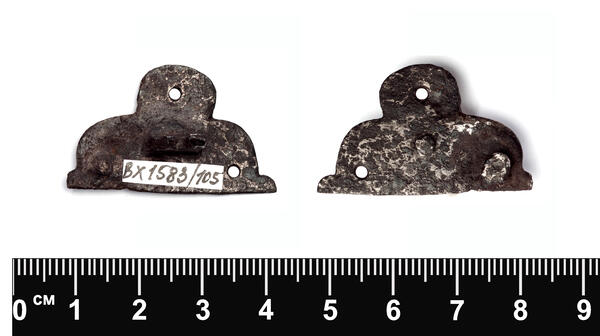
The permanent exhibition features an iron plate of the 14th century in the form of a flat bezel measuring 2.1×3.4 cm, trefoil in shape, with three round holes (0.2 cm in diameter) and a fragment of a rivet in one of them. On the reverse side of the plate, in the center, there are the remains of a flat sub-rectangular loop with a round through hole which is 0.3 cm in diameter.
In 2011, this plate was discovered by a joint archaeological expedition of the State Historical Museum and the State Military Historical and Natural Museum-Reserve “Kulikovo Field” on the watershed of the Rybiy Verkh and Prudovaya ravines. The archaeological dig was conducted to the north of the Khvorostyanka village, Kurkinsky District, Tula Oblast, site No. 22, grid 11, square 10.
The plate turned out to be a clasp for a waist bag or a purse with a back plaque and a locking pin, which were widely used in the 13th and 14th centuries from the northern Russian principalities to Lithuania and the Cis-Azov region. Iron plates of similar shape were attached to the flaps of quadrangular leather bags known among the medieval nomads of Eastern Europe. A similar trefoil clasp on a leather bag was discovered during excavations of Barrow No. 1 of the Mordovian Atkar burial ground of the 13th–14th century.
A “kalita” was the so-called money bag. It was borrowed by the Russians from the Turkic nomads, as was its name (“kalta”). A kalita was first mentioned in the 14th century and was used in everyday life until the 18th century. At first, it was a leather sack, then it acquired a trapezoidal shape. It was carried on the belt. Such bags were used to store and carry both individual items as well as sets of items, including tinderboxes (flint, a fire striker, tinder, and a tinder tube), accessories used for trade and money. Kalitas were made mainly from leather and decorated with slits, metal overlays made of copper or tin, and appliqués. The most valuable kalitas were the ones made of morocco leather. These purses featured the images of animals embroidered with gold and were decorated with precious stones.
In 2011, this plate was discovered by a joint archaeological expedition of the State Historical Museum and the State Military Historical and Natural Museum-Reserve “Kulikovo Field” on the watershed of the Rybiy Verkh and Prudovaya ravines. The archaeological dig was conducted to the north of the Khvorostyanka village, Kurkinsky District, Tula Oblast, site No. 22, grid 11, square 10.
The plate turned out to be a clasp for a waist bag or a purse with a back plaque and a locking pin, which were widely used in the 13th and 14th centuries from the northern Russian principalities to Lithuania and the Cis-Azov region. Iron plates of similar shape were attached to the flaps of quadrangular leather bags known among the medieval nomads of Eastern Europe. A similar trefoil clasp on a leather bag was discovered during excavations of Barrow No. 1 of the Mordovian Atkar burial ground of the 13th–14th century.
A “kalita” was the so-called money bag. It was borrowed by the Russians from the Turkic nomads, as was its name (“kalta”). A kalita was first mentioned in the 14th century and was used in everyday life until the 18th century. At first, it was a leather sack, then it acquired a trapezoidal shape. It was carried on the belt. Such bags were used to store and carry both individual items as well as sets of items, including tinderboxes (flint, a fire striker, tinder, and a tinder tube), accessories used for trade and money. Kalitas were made mainly from leather and decorated with slits, metal overlays made of copper or tin, and appliqués. The most valuable kalitas were the ones made of morocco leather. These purses featured the images of animals embroidered with gold and were decorated with precious stones.