#1
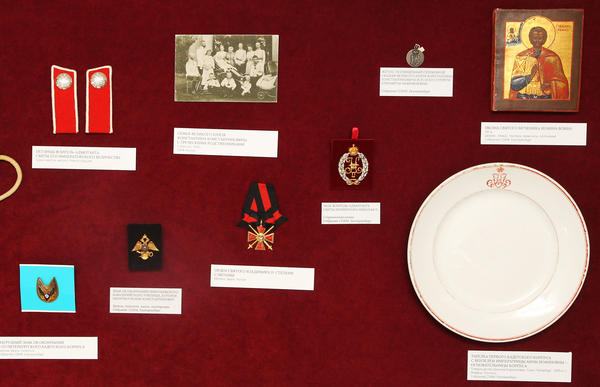
Badges, Order, John the Warrior
#2
#13
#7
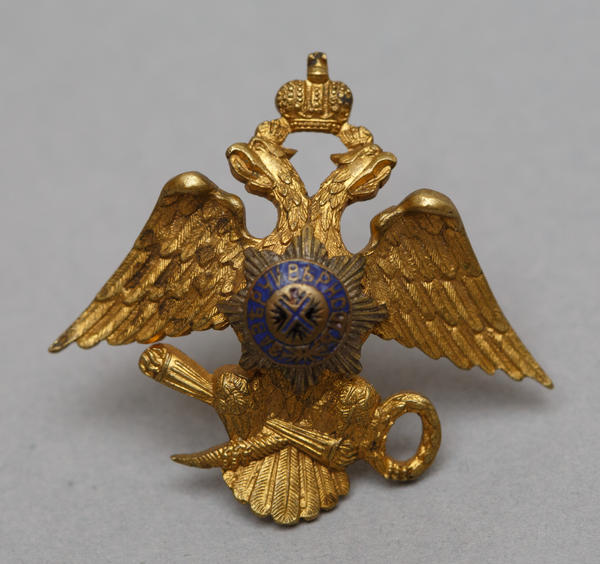
One of the graduates of the Nicholas Cavalry School, known to have worn the school’s graduation badge, was Prince Ioann Konstantinovich of Russia.
The Nicholas Cavalry School was the oldest cavalry school in the country. It only admitted aristocracy – either to study or to teach, and trained officers for the cavalry. Students aged 17 to 18 were selected from the best graduates of the Cadet School. Some students were admitted after graduation from civilian schools but only provided they had passed a strict selection routine and a medical examination.
Pupils of the military school studied special disciplines such as art of war, tactics, topography and artillery. They were divided between the squadron and the Cossack sotnia. A lot of time was devoted to horse-riding which the pupils practiced in their special riding hall. They learned to become expert riders and to clear obstacles.
Amongst cavalry troops, the school was familiarly known as the “Splendid School”. It maintained a military discipline and a strict regime, and contemporaries referred to the living conditions there as spartan. Should pupils have insulted each other or been caught in a brawl, both students were dismissed with immediate effect, irrespective of the cause for the conflict.
All pupils were rated on a 12-point scale: those scoring 9 and above would be admitted to the privileged Guards Corps. After a 2-year course, the students graduated as cornets in the cavalry troop of the army or the Guards, or in the Cossack cavalry corps. It was deemed a great honour to be an officer of the Guards Corps, which consisted largely of hereditary nobility. The pupils who scored under 9 points were to serve in the army troops.
Prince Ioann Konstantinovich graduated from the cavalry school in 1907, and was enlisted, with the rank of cornet, in the Life Guard Horse Regiment. He was decorated with orders and the St. George Sword for displaying valour, bravery and accomplishing dangerous missions during WWI. The sword with a gilded hilt was conferred for bravery and gallantry in combat.
The cavalry school was closed down in 1917, and today its former building houses a radio equipment plant
The Nicholas Cavalry School was the oldest cavalry school in the country. It only admitted aristocracy – either to study or to teach, and trained officers for the cavalry. Students aged 17 to 18 were selected from the best graduates of the Cadet School. Some students were admitted after graduation from civilian schools but only provided they had passed a strict selection routine and a medical examination.
Pupils of the military school studied special disciplines such as art of war, tactics, topography and artillery. They were divided between the squadron and the Cossack sotnia. A lot of time was devoted to horse-riding which the pupils practiced in their special riding hall. They learned to become expert riders and to clear obstacles.
Amongst cavalry troops, the school was familiarly known as the “Splendid School”. It maintained a military discipline and a strict regime, and contemporaries referred to the living conditions there as spartan. Should pupils have insulted each other or been caught in a brawl, both students were dismissed with immediate effect, irrespective of the cause for the conflict.
All pupils were rated on a 12-point scale: those scoring 9 and above would be admitted to the privileged Guards Corps. After a 2-year course, the students graduated as cornets in the cavalry troop of the army or the Guards, or in the Cossack cavalry corps. It was deemed a great honour to be an officer of the Guards Corps, which consisted largely of hereditary nobility. The pupils who scored under 9 points were to serve in the army troops.
Prince Ioann Konstantinovich graduated from the cavalry school in 1907, and was enlisted, with the rank of cornet, in the Life Guard Horse Regiment. He was decorated with orders and the St. George Sword for displaying valour, bravery and accomplishing dangerous missions during WWI. The sword with a gilded hilt was conferred for bravery and gallantry in combat.
The cavalry school was closed down in 1917, and today its former building houses a radio equipment plant
#3
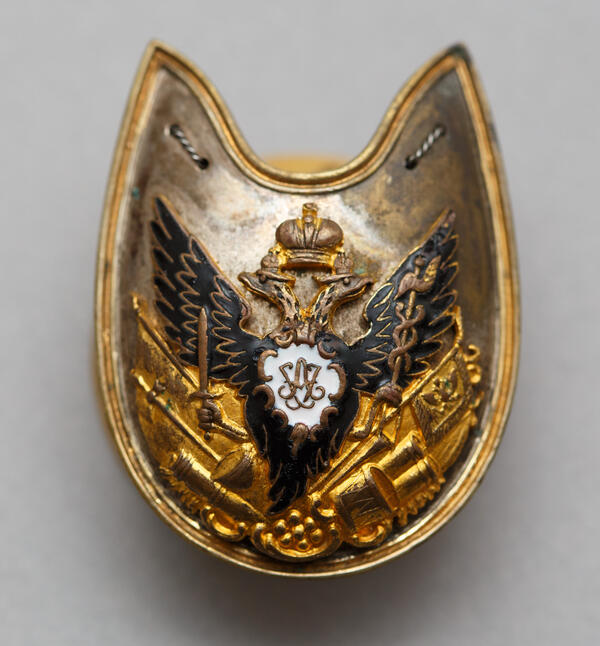
Badge of the First St. Petersburg Cadet Corps
#14
#10
In 1905, Born Prince Ioann Konstantinovich graduated from the St. Petersburg Cadet Corps. Such educational institutions in Russia functioned as primary schools where boys were trained for a military career from a young age.
The first cadet corps in St. Petersburg opened in 1732, and it was located in the Menshikov Palace. Teachers of the corps had to pass rigid casting. The cadets lived there on full board basis, and the training lasted 7 years. The daily regimen in the corps was quite strict. The pupils were taught discipline from the very start. They studied general subjects and military science, STEM disciplines and humanities; they also learned to dance and to ride, studied theatrical art and music.
Throughout the history of the corps, academic programs changed; all the innovations in the educational process were primarily introduced here. At the end of the 18th century, the corps was headed by the outstanding commander Mikhail Kutuzov. He revised the training of the future officers, putting first military disciplines that had not been a priority before, for example, tactics and military history. He replaced all civilian teachers with officers and divided the students into squadrons. Military classes were taken not only by the cadets, but also by officers; Mikhail Kutuzov personally taught tactics. In summer, the cadets went camping and lived in tents.
The cadet corps was often visited by the Royal Family; each of the rulers wanted to contribute to the education of the future officers. The headmasters were appointed only with the consent of the Emperor. Students who graduated from the Cadet Corps were admitted to many military schools of the country without exams.
Over the years, many future famous military and public figures had graduated from the Corps: writers Alexander Sumarokov and Mikhail Kheraskov, Decembrist Kondraty Ryleev and many others. After graduation, the cadets were solemnly awarded the badge. Born Prince Ioann Konstantinovich, one of the future prisoners of the Alapaevsk School, also wore this.
By 1917, there were 30 cadet corpses in different cities of Russia. After the Bolsheviks came to power, those educational institutions were abolished.
The first cadet corps in St. Petersburg opened in 1732, and it was located in the Menshikov Palace. Teachers of the corps had to pass rigid casting. The cadets lived there on full board basis, and the training lasted 7 years. The daily regimen in the corps was quite strict. The pupils were taught discipline from the very start. They studied general subjects and military science, STEM disciplines and humanities; they also learned to dance and to ride, studied theatrical art and music.
Throughout the history of the corps, academic programs changed; all the innovations in the educational process were primarily introduced here. At the end of the 18th century, the corps was headed by the outstanding commander Mikhail Kutuzov. He revised the training of the future officers, putting first military disciplines that had not been a priority before, for example, tactics and military history. He replaced all civilian teachers with officers and divided the students into squadrons. Military classes were taken not only by the cadets, but also by officers; Mikhail Kutuzov personally taught tactics. In summer, the cadets went camping and lived in tents.
The cadet corps was often visited by the Royal Family; each of the rulers wanted to contribute to the education of the future officers. The headmasters were appointed only with the consent of the Emperor. Students who graduated from the Cadet Corps were admitted to many military schools of the country without exams.
Over the years, many future famous military and public figures had graduated from the Corps: writers Alexander Sumarokov and Mikhail Kheraskov, Decembrist Kondraty Ryleev and many others. After graduation, the cadets were solemnly awarded the badge. Born Prince Ioann Konstantinovich, one of the future prisoners of the Alapaevsk School, also wore this.
By 1917, there were 30 cadet corpses in different cities of Russia. After the Bolsheviks came to power, those educational institutions were abolished.
#5
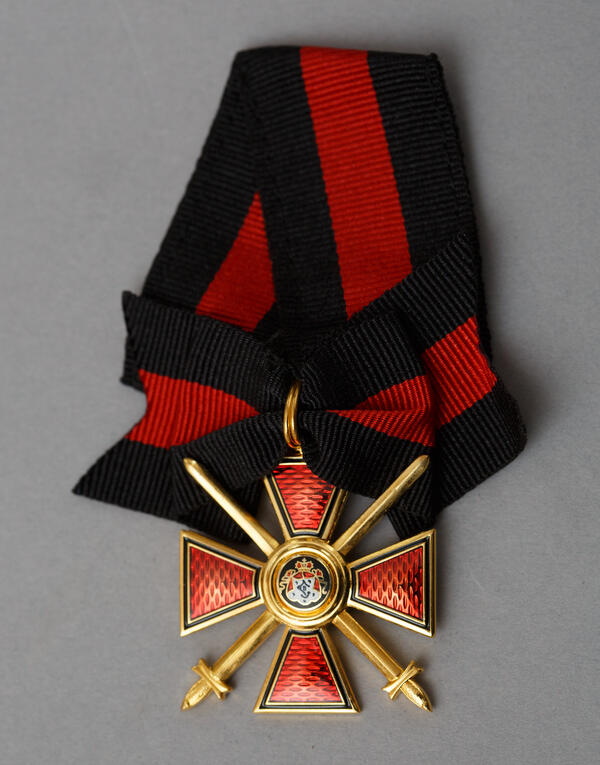
The Order of Saint George, 4th class
#16
#12
The museum collection has a modern copy of Ioann Konstantinovich’s award. A Prince of the Imperial Blood, he went to the front right after the beginning of the First World War. He took part in battles in East Prussia and, for his military merits, was awarded the Order of Saint Vladimir 4th Degree with Swords and a Bow.
This decoration of 4 degrees was established by Empress Catherine II at the end of the 18th century. It was introduced to mark 20 years of her reign. It was named in honour of Saint Vladimir, an outstanding military commander and Baptiser of Rus’ who was one of the first to adopt Christianity. In ballads and legends he was referred to as Krasno Solnyshko [the Radiant Sun] (Vladimir the Fair).
The St. Vladimir Order consisted of a decoration, a star and a ribbon. It was given for special merits to civilian people or for merits in the battlefield to military people. The higher degrees were awarded only to generals, while the 4th degree could be given to any military officer. When the Order was awarded for deeds at the front, more attributes were added - crossed swords and a special fold of the ribbon, a ‘bow’. Military officers valued the Oder of the 4th degree with a bow more than higher-degree orders because it was given only for personal bravery and combat skills. That was the decoration Prince Ioann Konstantinovich was honoured with.
From the 19th century, the St. Vladimir Order, irrespective of the degree, guaranteed hereditary noble estate. The decoration, however, was often given to major industrialists and merchants for charity. Therefore, a decree was issued in 1900 under which the 4th degree entitlement was only individual noble estate but not hereditary.
The junior degree was also awarded for a certain length of service, 35 years. In that case, the inscription ‘35 years’ in gold or silver was made on the face of the order. The place where the different degrees were to be worn was strictly regulated: the 4th degree cross was affixed to the tunic on the chest.
It was forbidden to add precious stones to the decorations or wear them in any fashion other than what was prescribed by the rules. The order came with an annual pension, the amount of which varied subject to the decree but was fairly handsome by the standards of those times.
This decoration of 4 degrees was established by Empress Catherine II at the end of the 18th century. It was introduced to mark 20 years of her reign. It was named in honour of Saint Vladimir, an outstanding military commander and Baptiser of Rus’ who was one of the first to adopt Christianity. In ballads and legends he was referred to as Krasno Solnyshko [the Radiant Sun] (Vladimir the Fair).
The St. Vladimir Order consisted of a decoration, a star and a ribbon. It was given for special merits to civilian people or for merits in the battlefield to military people. The higher degrees were awarded only to generals, while the 4th degree could be given to any military officer. When the Order was awarded for deeds at the front, more attributes were added - crossed swords and a special fold of the ribbon, a ‘bow’. Military officers valued the Oder of the 4th degree with a bow more than higher-degree orders because it was given only for personal bravery and combat skills. That was the decoration Prince Ioann Konstantinovich was honoured with.
From the 19th century, the St. Vladimir Order, irrespective of the degree, guaranteed hereditary noble estate. The decoration, however, was often given to major industrialists and merchants for charity. Therefore, a decree was issued in 1900 under which the 4th degree entitlement was only individual noble estate but not hereditary.
The junior degree was also awarded for a certain length of service, 35 years. In that case, the inscription ‘35 years’ in gold or silver was made on the face of the order. The place where the different degrees were to be worn was strictly regulated: the 4th degree cross was affixed to the tunic on the chest.
It was forbidden to add precious stones to the decorations or wear them in any fashion other than what was prescribed by the rules. The order came with an annual pension, the amount of which varied subject to the decree but was fairly handsome by the standards of those times.
#6
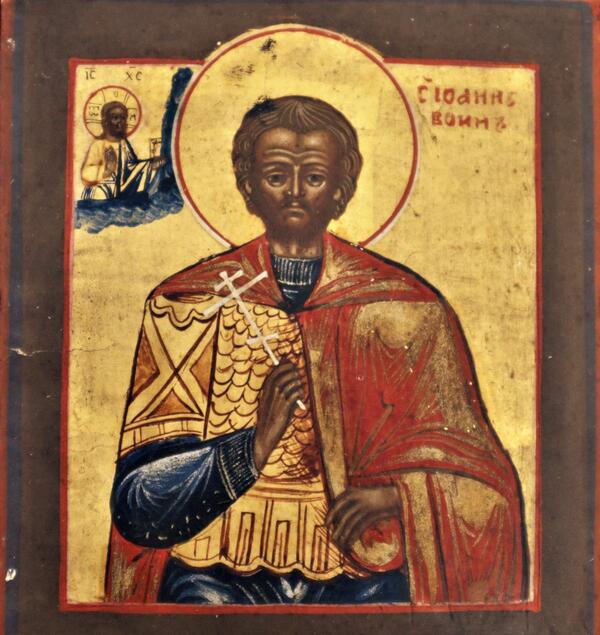
The Holy Martyr John the Warrior
#17
#8
The Christian Holy Martyr John the Warrior was the heavenly patron of Grand Duke John (Rus. Ioann) Konstantinovich Romanov. Among the exhibits of the Museum Napolnaya School in the Town of Alapaevsk, there is also an akathist dedicated to this Saint. John the Warrior is one of the most revered patron saints: in the Orthodox tradition, people pray to him for support in troubles.
During the persecution of Christians in the VI century, John served in the army of the Roman Emperor and in the line of duty was forced to oppress the faithful. However, he only pretended to be fiercely persecuting them. In fact, John secretly sympathized with Christians and helped them escape from death: he informed the believers about attacks, visited prisoners in dungeons, and helped them flee. It was not only Christians who the mercy of John the Warrior was for: he strived to support the poor and the week he encountered.
The Emperor found out about the support secretly provided to the believers; he ordered to imprison John. The chained Martyr spent many months awaiting execution, and suffered great hardship and pain. After Emperor Julian died in a battle, John was released and devoted the rest of his life to serving his neighbours.
John the Warrior lived to a ripe old age. Legend has it that after his death, his spirit came to a pious woman and showed her the place of his burial. His relics were taken to a church, and since then they have been considered miracle-working. The grieving and the bitter ask Saint John for solace and intercession. People have prayed to him for those who were confined or incarcerated.
The displayed image was cut out of a multipart icon of the XIX century, and the saw cut destroyed a fragment of the owner’s inscription. In iconography, John is usually depicted in the garb of a warrior: he wears a knitted vest, trousers, and scale armor. Numerous icons of the Saint traditionally include his three attributes: The cross that signifies the faith that he kept despite so many trials. The spear representing the power that God gave to John in order to fight irreligion and sin. The shield that symbolizes the divine protection from all misfortunes.
During the persecution of Christians in the VI century, John served in the army of the Roman Emperor and in the line of duty was forced to oppress the faithful. However, he only pretended to be fiercely persecuting them. In fact, John secretly sympathized with Christians and helped them escape from death: he informed the believers about attacks, visited prisoners in dungeons, and helped them flee. It was not only Christians who the mercy of John the Warrior was for: he strived to support the poor and the week he encountered.
The Emperor found out about the support secretly provided to the believers; he ordered to imprison John. The chained Martyr spent many months awaiting execution, and suffered great hardship and pain. After Emperor Julian died in a battle, John was released and devoted the rest of his life to serving his neighbours.
John the Warrior lived to a ripe old age. Legend has it that after his death, his spirit came to a pious woman and showed her the place of his burial. His relics were taken to a church, and since then they have been considered miracle-working. The grieving and the bitter ask Saint John for solace and intercession. People have prayed to him for those who were confined or incarcerated.
The displayed image was cut out of a multipart icon of the XIX century, and the saw cut destroyed a fragment of the owner’s inscription. In iconography, John is usually depicted in the garb of a warrior: he wears a knitted vest, trousers, and scale armor. Numerous icons of the Saint traditionally include his three attributes: The cross that signifies the faith that he kept despite so many trials. The spear representing the power that God gave to John in order to fight irreligion and sin. The shield that symbolizes the divine protection from all misfortunes.
#9
The icon exhibited at the Museum is a rare image of the Saint: here it is only the cross that John holds in his hand – a spiritual, not material, weapon.
read morehide
00:00
00:00
1x
Badges, Order, John the Warrior
0
 Point your smartphone camera to open in the app
Open in app
Share