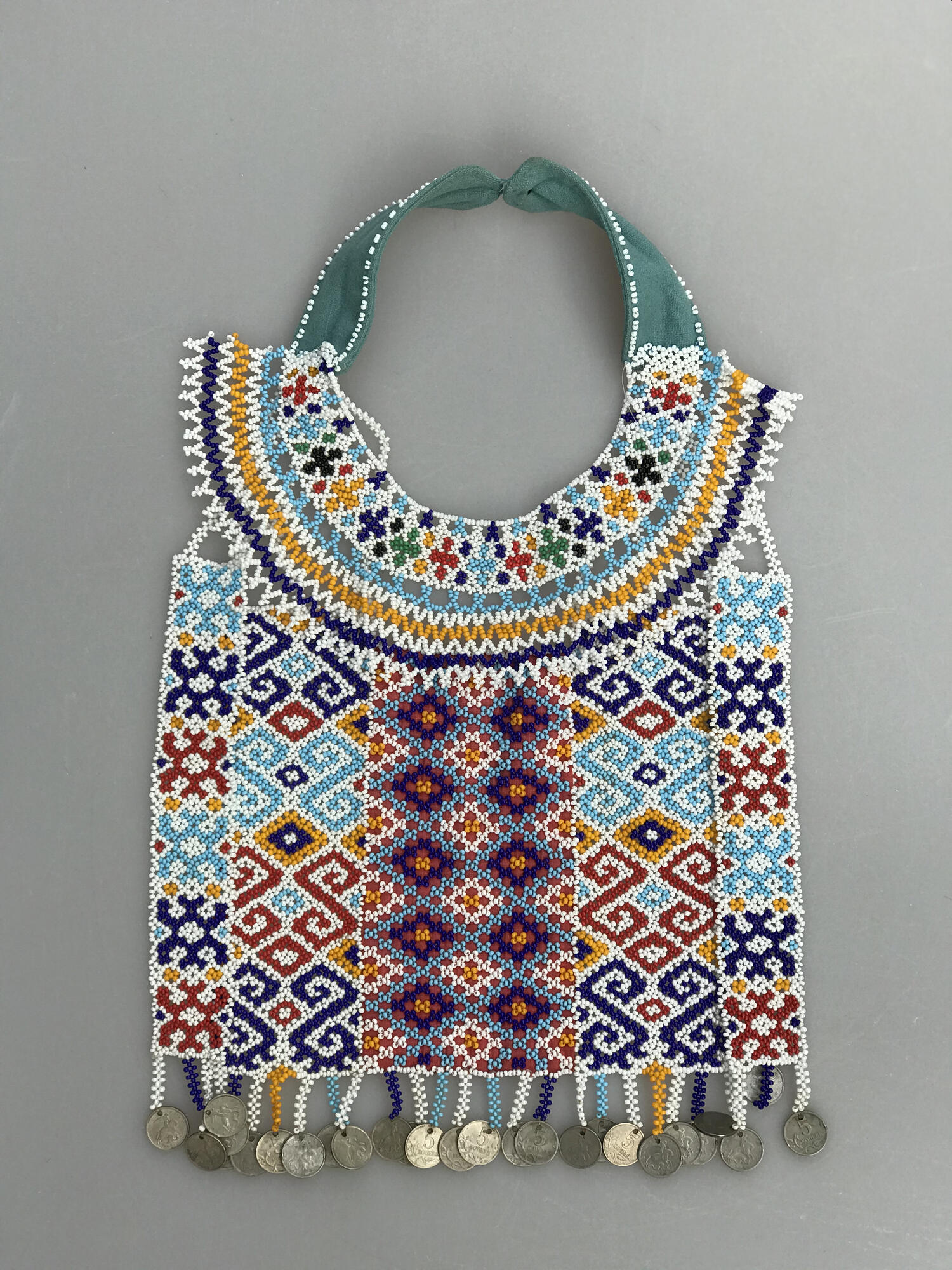


The women’s bib of the early 20th century, that is exhibited in the museum, was made in the traditional bead weaving technique in the village of Kazym, Beloyarsky district of Yugra. The craftswoman Zinaida Kaksina created this piece using blue, orange, white and blue beads. In addition, the bib is decorated with five-kopeck coins.
In the culture of the Ob-Ugrians, women’s jewelry could be either decorative or ritualized. Decorative jewelry did not have any sacred meaning, since these pieces were not decorated with sacred ornaments. Such jewelry was worn with a festive costume. According to the beliefs of the northern peoples, ritual accessories performed a protective function as they protected the owner from evil spirits. For example, if someone wore a sacred decoration on his chest, it covered and protected the heart.
Detachable breast ornaments woven from beads were called “mavlops”. This word translates from the Khanty language as a “breast keeper”. The neck accessory was called “turlops” which means “flap at the throat”.
In the past, the indigenous northern peoples decorated their clothes only with natural materials: shells, stones, teeth and vertebrae of animals, balls of clay. Beads appeared in the decorative arts of the Khanty people only with the development of trade routes in the North.
The process of stringing beads on a fishing line was called “sak karatty” in the northern dialect of the Khanty language, which means “placing beads one by one”. The eastern Khanty called this craft “suk pulte”, which translates as “harnessing pebbles”.
To create jewelry, the Khanty and Mansi preferred to use bright colored beads, for example, blue, light blue, orange, green, and yellow ones. The artisans tried to put the beads of contrasting shades one after another.
Two ancient techniques of working with beads still remain nowadays. They are embroidery and weaving. The methods of knitting beads differ in the number of threads: there can be up to thirty of them in one item. In ancient times, craftswomen used threads made from deer tendons or horsehair. Nowadays, they have been replaced by thin wire or fishing lines. They weave beaded jewelry by hand, alternating geometric, stylized plant, and zoomorphic patterns.
In the culture of the Ob-Ugrians, women’s jewelry could be either decorative or ritualized. Decorative jewelry did not have any sacred meaning, since these pieces were not decorated with sacred ornaments. Such jewelry was worn with a festive costume. According to the beliefs of the northern peoples, ritual accessories performed a protective function as they protected the owner from evil spirits. For example, if someone wore a sacred decoration on his chest, it covered and protected the heart.
Detachable breast ornaments woven from beads were called “mavlops”. This word translates from the Khanty language as a “breast keeper”. The neck accessory was called “turlops” which means “flap at the throat”.
In the past, the indigenous northern peoples decorated their clothes only with natural materials: shells, stones, teeth and vertebrae of animals, balls of clay. Beads appeared in the decorative arts of the Khanty people only with the development of trade routes in the North.
The process of stringing beads on a fishing line was called “sak karatty” in the northern dialect of the Khanty language, which means “placing beads one by one”. The eastern Khanty called this craft “suk pulte”, which translates as “harnessing pebbles”.
To create jewelry, the Khanty and Mansi preferred to use bright colored beads, for example, blue, light blue, orange, green, and yellow ones. The artisans tried to put the beads of contrasting shades one after another.
Two ancient techniques of working with beads still remain nowadays. They are embroidery and weaving. The methods of knitting beads differ in the number of threads: there can be up to thirty of them in one item. In ancient times, craftswomen used threads made from deer tendons or horsehair. Nowadays, they have been replaced by thin wire or fishing lines. They weave beaded jewelry by hand, alternating geometric, stylized plant, and zoomorphic patterns.