Font
Color
Graphics
Изображение точки

To see AR mode in action:

1. Install ARTEFACT app for iOS or Android;

2. Find the exhibition «Gelendzhik: Past and Present»

3. Push the «Augmented reality» button and point your phone's camera at the exhibit;

Скрыть точки интересаПоказать точки интереса
Показать в высоком качестве

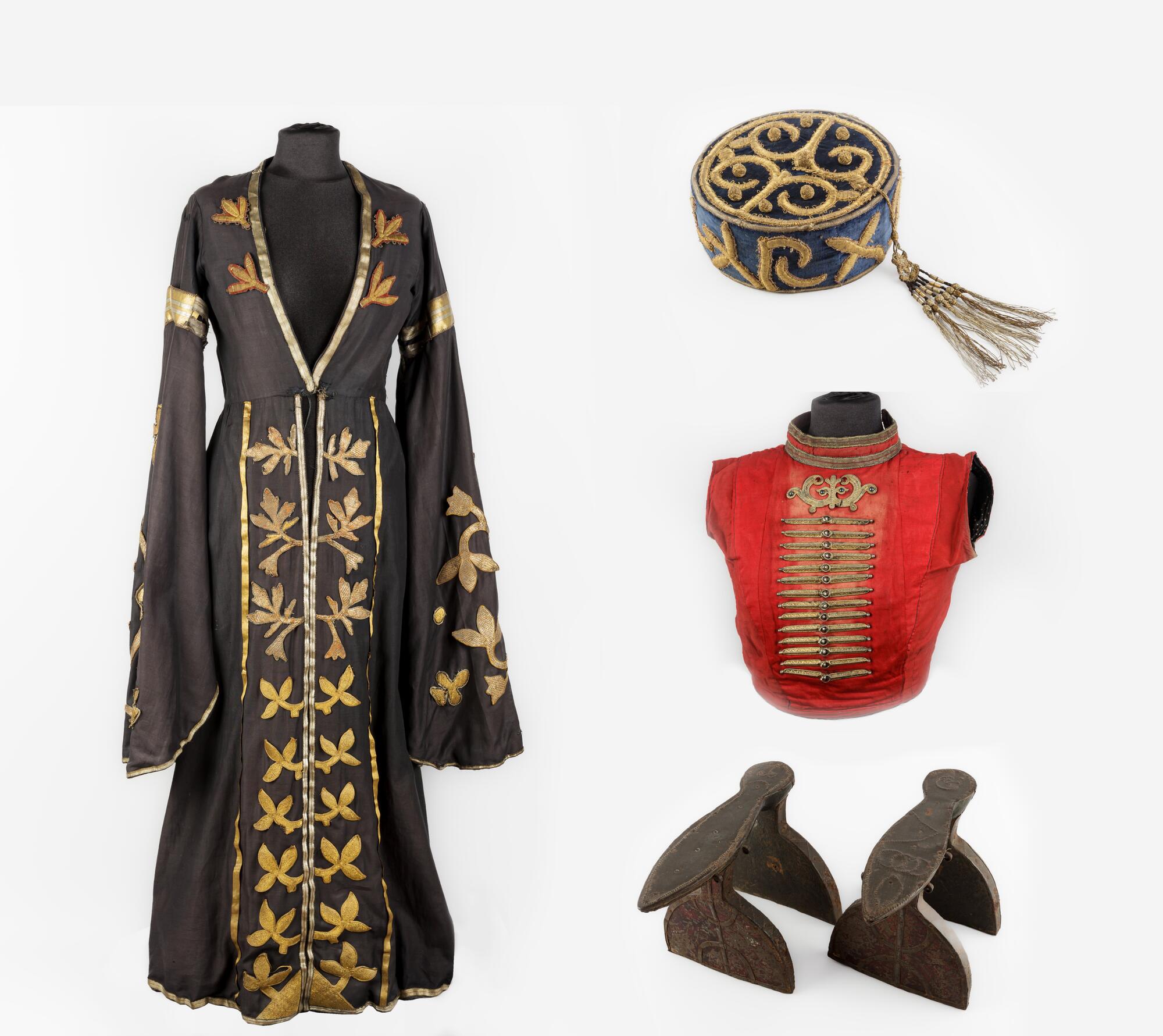
Shirtfront, Women’s dress (sai), Cothurni, Cap

0
Open in app
#1
Shirtfront
#2
A false shirtfront is an integral part of the Circassian costume. Initially, a short caftan was worn over a long shirt, and a dress with long false sleeves (sai) was put on top. The caftan was sewn from velvet and decorated with gold and silver embroidery. A little later, by the late 19th century, an imitation of a caftan became widespread — it was a small rectangular shirtfront, which often had a standing collar. Like the caftan, this clothing item had from 14 to 16 pairs of fasteners with cast metal loops. However, unlike the caftan, which could be fastened only with strong tension, so it would fit snugly to the body, the shirtfront clasps had a decorative function and were connected with hooks.

At the beginning of the 20th century, shirtfronts began to be sewn from any dense fabric that the family could afford. Only wealthy or noble families still had their shirtfronts decorated with gold and silver embroidery, as well as precious and semiprecious stones. Still, a shirtfront was a more affordable variation of a caftan, since it needed less expensive material.

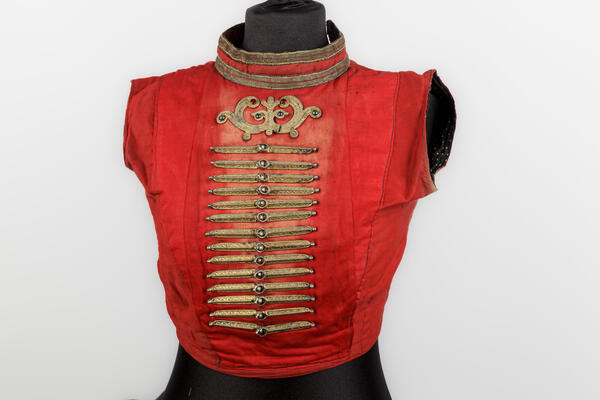
The museum exhibition includes a shirtfront of the early 20th century. It was made of dense red cloth and has a standing collar and 14 pairs of false bronze clasps with cast loops descending from the collar to the belt. The shirtfront was fastened around the neck with hooks, and at the waist it was girdled with a thin belt. The collar is decorated with galloon — a dense woven braid. Galloons were woven both in Europe and in the Caucasus, where this technique was widely used among the Circassian tribes.

Looms were made of quadrangular thin wooden boards measuring from 6 to 8 cm. Depending on the complexity of the pattern, the number of boards could vary from 15 to 120 pieces. Four to six holes were drilled in the corners of each plank. Craftswomen pulled threads of several colors through these holes to get the desired pattern. The beauty of these patterns depended on the complexity of thread patterns. After each stage, the fragment of the pattern was fixed with a thread on a wooden slider. The finished part of the galloon was wound on a metal hook attached to the belt of the craftswoman. Galloons not only decorated Circassian festive costumes, but were also used to hide side seams made by hand. At the neck of the shirtfront there is a massive bronze decoration inlaid with colored glass. It is made using the granulation technique — an ornament in the form of tiny spheres of different diameters, which were soldered onto jewelry.
#3
Наименование: Shirtfront
Дата создания: the early 20th century
Техника: cloth, bronze, glass, cutting, sewing
Место создания: Adygea, Russia
Размеры: 29×18,5×15,5 cm
#4
Women’s dress (sai)
#5
The rich history and cultural heritage of the Caucasian peoples are reflected in national costumes. An interesting fact is that, despite the large number of different Circassian tribes, the highlander’s costume is surprisingly homogenous. There are only slight differences in decoration. This is largely due to the similar culture of all Circassian tribes and the natural and geographical living conditions they share.

The Circassian national costume as we know it appeared in the 16th–17th centuries. An interesting fact is that different social status was demonstrated not so much by the clothes design as by the quality of the fabric. The main elements of the women’s costume were a caftan, a dress with a false shirtfront and a belt, a headdress and shoes. The clothes were richly decorated with various patterns embroidered with gold and silver threads.

The traditional women’s dress (sai) was long and reached the floor. It was unbuttoned and made from velvet or thick silk. A sai was richly decorated with gold and silver embroidery and galloons — gold-woven ribbons or braid made of precious metals. There were patterns on the sides, hem and bottom of the sleeves, and all seams were covered with galloons. Usually such dresses were black and dark red. Blue, dark green and purple colors were less common.

The sleeve started just below the shoulder and gradually flared into a rounded piece, which could reach the hem of the dress. By the late 19th century, such decorated sleeves became a separate element of the costume — they were called sleeve pendants. A girl’s hands never remained open above the elbow: they were covered by a caftan or an undershirt. A thin waist was tightly girdled by a silver chased belt, which was often encrusted with precious and semi-precious stones, and could also be supplemented with various pendants.

The museum exhibits a dress dating back to the early 20th century. This festive Circassian outfit is made of black satin and cashmere; it is fastened at the waist with one hook. The outfit is richly decorated with gold embroidery and galloons. The dress features a floral pattern in the form of stems and shamrocks. Such an ornament was traditional and became widespread after Islam became widespread in the Caucasus: Muslim culture prohibits the depiction of animals and people.

Such clothes were very expensive and took years of painstaking work, so only women of the upper classes could afford them. At the end of the 19th century, girls from the most prosperous peasant families also began to wear these dresses to imitate the nobility.
#6
Наименование: Women’s dress (sai)
Дата создания: the early 20th century
Техника: sewing, embroidery
Место создания: Adygea, Russia
Размеры: 136×37 cm
#7
Women’s cothurni
#8
Shoes with high soles have been known since ancient times. The actors of the ancient Greek theater put on shoes with very thick soles — “cothurni”. In the 14th century, visitors of public baths in the Middle East wore wooden “kabkabs”, which were decorated with shells and ivory. They protected the feet of the visitors from hot wet floors. In the mediaval Europe, representatives of all classes wore shoes with high wooden soles so as not to avoid getting mud stains on their clothes. These shoes were called “chopins”. In China, men, mostly military commanders and aristocrats, wore shoes with wide cotton soles. A little later, the actors of the Peking Opera wore such shoes to indicate who were the important characters on the stage.

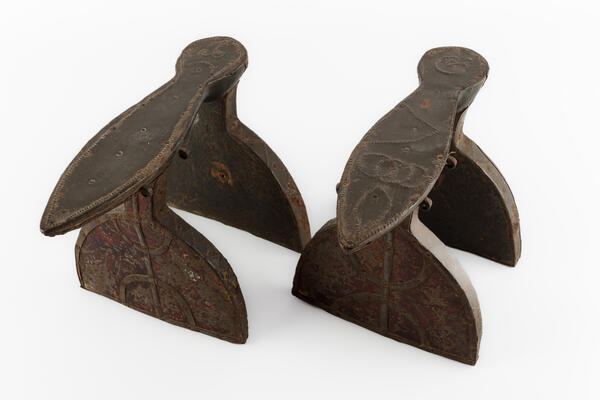
Therefore, the Northwest Caucasus was also influenced by this interesting fashion of wearing high soles. These shoes were called “cothurni”. This is the oldest type of women’s shoes that the Circassians continued to wear in the 19th century. They were open stilt shoes with high props.

Usually women wore such shoes only for feasts. However, representatives of noble families wore them every time they left the house, emphasizing their special social status. In these shoes, it was possible to move only in small, smooth steps — exactly such a gait was considered by the Circassians to be the most graceful and feminine.

Cothurni were not worn on bare feet. First, women put on soft leather slippers, and only then they put on the cothurni. If a woman or a girl was invited to dance, she gracefully removed the cothurni at the edge of the dance floor and went to dance in her leather slippers. After the dance, she again put on the stilts.

The process of making cothurni was quite complicated and time-consuming. The artisan carved a base of wood in the shape of a female foot but with a pointed toe. Then the base was strengthened on two props of the same size, their height could reach up to 18 centimeters. To make the shoes more stable, the props were made semicircular, expanding downward. On top they sewed a wide galloon ribbon or lace to the base of the cothurni. The cothurni from the museum exhibition have the shape of a bench. The props are decorated with figured overlays made of red tin with a punched pattern. Both sides of the base have a pair of metal loops for laces.
#9
Наименование: Women’s cothurni
Дата создания: the late 19th — early 20th century
Техника: wood, tin, carving, chasing
Место создания: Adygea, Russia
Размеры: 19,5×15×25 cm
#10
Women’s cap
#11
The permanent exhibition includes a traditional cap — low, cylindrical, with a flat top. It is richly decorated with floral patterns of stylized leaves, stems and crescents. The cap is embroidered with gold and silver threads in the technique of satin stitch. A stencil was cut out of paper or thin cardboard, sewn onto fabric, and then embroidered with gold or silver threads, securing them with silk along the outline of the pattern. Thus, the stencil turned out to be sewn into the design and was used only once. This made the embroidery look more convex. Sometimes, as in this cap, the contours were outlined with thin braid.

An additional decoration of the headdress is a long fringe brush with weaving in the form of a star and a crescent and six short strings of beads. A ball of hard cord is used to attach it to the cap. Such balls were often used as fasteners, and they could also replace expensive silver finials of women’s headdresses.

A small fabric cap is an integral part of the Adyghe women’s costume. It has been part of the women’s and girls’ garment since ancient times. Back in the Middle Ages, beautiful women wore high pointed hats. Over time, the number of styles increased: cone-shaped, small and semicircular caps, and high caps with a flat top had emerged. All caps, regardless of style, were created on a solid base so that the headdress had a clear shape. Linings were made from leather or fabric. The ornament had a certain sacred meaning. Therefore, craftswomen chose the pattern for embroidery very carefully. Initially, landscapes and wild animals were preferred, but over time the images became schematic, turning into a set of symbols and lines. Many scientists associate these symbols with the cult of the sun that was especially revered by many peoples in the past.

A scarf or a headscarf was a mandatory additional accessory to the cap. A scarf was either worn over the cap to cover the shoulders and back, while the ends were left in front, or attached to the top of the headdress — to the ball — so that the fabric freely descended along the back. Also, an Adyghe girl could cross the ends of the scarf under her chin and fasten them to the top of the cap.

The exhibit was handed over to the museum in 1972 by a resident of the village of Ponezhukai K.T. Tlekhuray.
#12
Наименование: Women’s cap
Дата создания: the early 20th century
Техника: velvet, sewing, embroidery
Место создания: Adygea, Russia
Размеры: 7×17,5 cm
#13
read morehide
00:00
00:00
1x

Shirtfront, Women’s dress (sai), Cothurni, Cap

0
Point your smartphone camera to open in the app
Share
VkontakteOdnoklassnikiTelegram
Share on my website
Copy linkCopied
Copy
Open in app
To see AR mode in action:
  1. Install ARTEFACT app for 
  2. iOS or Android;
  3. Find and download the «Paintings in Details» exhibition
  4. Push the «Augmented reality» button and point your phone's camera at the painting;
  5. Watch what happens on your phone screen whilst you flip through the pictures.
 
We use Cookies
Cookies on the Artefact Website. We use cookies to ensure that we give you the best experience on our website. If you continue without changing your settings, we'll assume that you are happy to receive all cookies on the Artefact website. However, if you would like to, you can change your cookie settings at any time.
Learn more about useHide
Content is available only in Russian

X

Нашли опечатку?...

%title%%type%