A horse is a highlander’s true friend. In the Caucasus, the peoples still pay reverence towards this animal. The Circassians admire its grace, strength and loyalty to man. Horsemen spared neither time nor money to decorate their horses. The harness was made of the best leather, richly decorated with bronze, silver, and sometimes gold.
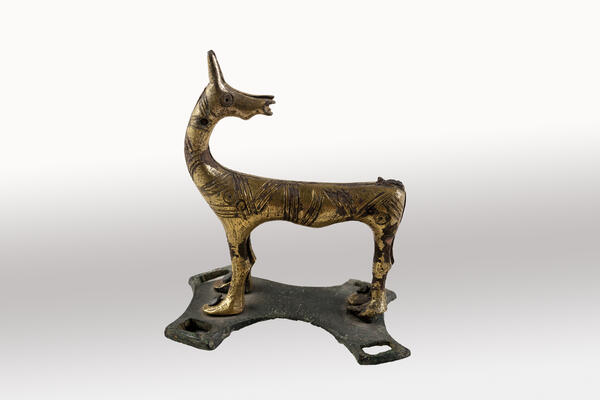
The museum’s permanent exhibition includes one of the best examples of medieval art — a bronze frontlet in the form of a figurine of a fallow deer, which adorned the head of a horse. Zoomorphic images were used by many nomadic peoples — the Scythians, Sarmatians, and Alans.
This frontlet was discovered by the museum employees M.G. Mineev and A.B. Grigoriev in 1987. They also found other items of horse harness at the “Potomstvenny” burial with traces of cremation. The burial was located on the territory of the Mikhailovsky Pass state farm in the village of Pshada. It dated back to the 10th–12th centuries and was destroyed during agricultural works. There were 308 objects found there: 49 bronze pear-shaped gilded bells and 7 fragments of them, 6 sets of bells, 52 spherical bronze buttons and 7 fragments of them, 1 bronze button of a conical shape, 24 cowries (obviously part of a necklace), 12 pieces of glass beads, 6 round glass beads, 15 round crystal beads and 25 fragments thereof, 9 jet beads, 2 red carnelian beads, 1 carnelian pendant, 11 beads, 1 amber pendant, 31 amber beads, bronze triangular pendant plaques, gilded pendants in the form of combined triangles, with an attached oval and ornamented, a gilded belt plaque, temporal rings, earrings made of bronze wire, bracelets made of thick bronze wire, gilded bronze plates, 8 fragments of a gilded glass vessel, mother-of-pearl amulet shell, fragment of a funerary urn and a thin-walled vessel, as well as two gilded bronze frontlets.
A large number of fine objects covered with a thin layer of gilding, as well as beads — an imported and therefore expensive piece of jewelry — suggest that this burial belonged to the category of the upper class burials and, possibly, had a pair. There are no other samples of the frontlet in the form of a fallow deer in the Northwest Caucasus. Most likely, it testifies to the cultural influence of nomads on local tribes.
The museum’s permanent exhibition includes one of the best examples of medieval art — a bronze frontlet in the form of a figurine of a fallow deer, which adorned the head of a horse. Zoomorphic images were used by many nomadic peoples — the Scythians, Sarmatians, and Alans.
This frontlet was discovered by the museum employees M.G. Mineev and A.B. Grigoriev in 1987. They also found other items of horse harness at the “Potomstvenny” burial with traces of cremation. The burial was located on the territory of the Mikhailovsky Pass state farm in the village of Pshada. It dated back to the 10th–12th centuries and was destroyed during agricultural works. There were 308 objects found there: 49 bronze pear-shaped gilded bells and 7 fragments of them, 6 sets of bells, 52 spherical bronze buttons and 7 fragments of them, 1 bronze button of a conical shape, 24 cowries (obviously part of a necklace), 12 pieces of glass beads, 6 round glass beads, 15 round crystal beads and 25 fragments thereof, 9 jet beads, 2 red carnelian beads, 1 carnelian pendant, 11 beads, 1 amber pendant, 31 amber beads, bronze triangular pendant plaques, gilded pendants in the form of combined triangles, with an attached oval and ornamented, a gilded belt plaque, temporal rings, earrings made of bronze wire, bracelets made of thick bronze wire, gilded bronze plates, 8 fragments of a gilded glass vessel, mother-of-pearl amulet shell, fragment of a funerary urn and a thin-walled vessel, as well as two gilded bronze frontlets.
A large number of fine objects covered with a thin layer of gilding, as well as beads — an imported and therefore expensive piece of jewelry — suggest that this burial belonged to the category of the upper class burials and, possibly, had a pair. There are no other samples of the frontlet in the form of a fallow deer in the Northwest Caucasus. Most likely, it testifies to the cultural influence of nomads on local tribes.