Throughout spring and summer, peasants toiled in the fields to ensure their families would eat well during the long, harsh winter. In spring, the land was plowed and grain sown; in summer, the ripe ears were harvested and threshed; and in autumn, the bounty was carefully stored in grain pits and granaries. By the time harvest season ended, the most crucial task remained: safeguarding those precious reserves.
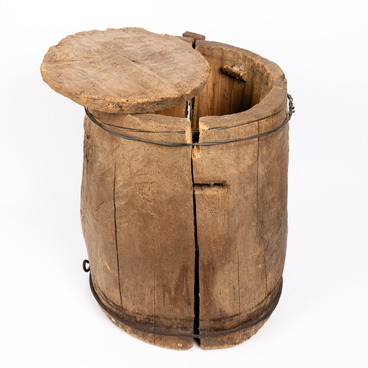
To protect their grain, peasants built barns raised on high foundations — and in some regions, even atop tall stilts — to deter rodents. Yet mice, ever resourceful, still found their way into the storage vaults. In response, villagers devised homemade mousetraps: some carved from a single block of wood with a hollowed-out chamber, others assembled from multiple planks.
Surprisingly, the familiar spring-loaded mousetrap is a relatively recent invention — dating only to the late 19th century. In 1882, Texas inventor James Williams introduced an unusual — and unmistakably “Wild West style” — solution: a mousetrap that fired a revolver. According to his design, a mouse stepping onto a trigger plate would activate a spring, which pulled a hook connected to the gun’s trigger, discharging a shot.
Though Williams’ creation was more theatrical than practical, it may have spurred others to develop simpler, more efficient traps. Indeed, in 1894, American inventor William Hooker patented a design that would become the prototype for the modern mousetrap: a compact, spring-loaded lever mechanism that was both effective and easy to produce.
The Unecha Local Lore Museum preserves examples of wooden mousetraps from the mid-20th century, known locally as “tunnel traps”. Designed to catch one or two pests at a time, they operated on a clever principle: bait was placed at the far end of a narrow wooden tunnel. Lured by the scent, a mouse would enter and encounter a taut thread blocking its path. In trying to reach the food, it would gnaw through the thread — releasing a spring attached to a metal noose. The loop would snap shut instantly, pinning the mouse against the tunnel’s ceiling. These traps were used not only in grain stores but also inside peasant homes.