#1
Musical instruments
#3
#4
#2
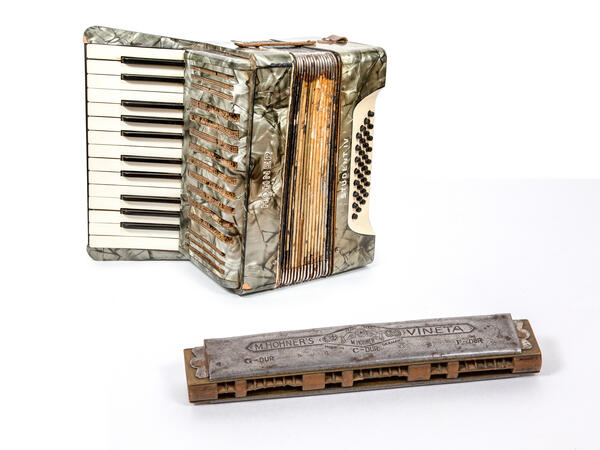
According to experts, the German mouth organ from the Museum Resource Center collection was made between 1937 and 1939 at the Hohner factory, a famous musical instrument manufacturing company in Germany.
German watchmaker Matthias Hohner founded the company in 1857 with money he inherited from his father. Since the competition among watchmaking companies was too high, Hohner decided to start a more lucrative business.
Originally, the Hohner company specialized in mouth-organs, which were created manually up until 1860. One master could only make one instrument per day. However, as the company expanded, Hohner managed establish mass production of mouth organs. The parts were produced on steam powered milling machines, and hired workers assembled the instruments.
In 1862, Hohner sold the first batch of mouth organs to the United States, where the Civil War was already gaining momentum. He gave some mouth organs to the soldiers' families for free.
Mouth organs were popular among the Wehrmacht’s soldiers during the Second World War since it was a light, compact instrument and it was easy to play simple melodies on it. Military command encouraged this hobby in every way. Therefore, the company ‘Hohner’ began to produce mouth organs for the German military department.
Many German soldiers kept a mouth organ in the top left pocket out of their military jackets. It was believed that if a bullet hit the pocket, the instrument would take the brunt. The German mouth organ was a favorite trophy among the Red Army soldiers.
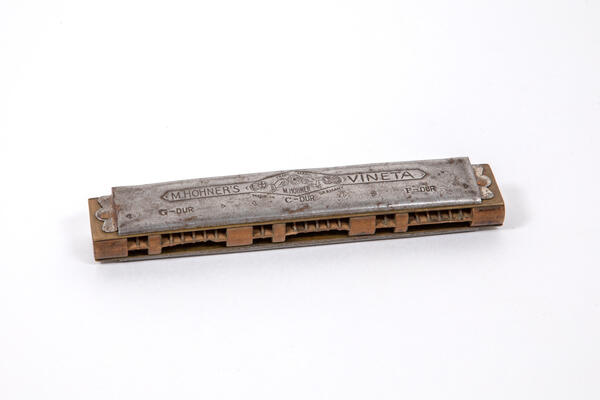
The M. Hohner Vineta No.4 Harmonica from the museum collection belonged to a German soldier. It has a dark brown wooden case, onto which metal plates with 48 reeds are fixed. The elongated reed cells and square play holes are arranged in two rows. A group of four holes makes up one chord.
Musician tightly wrapped his lips around the mouth organ and closed or opened the necessary holes with his tongue to produce the needed sounds. The top row of holes produced sounds on exhaling, the bottom row — on inhaling. While playing the mouth organ, musician moved the instrument itself, whereas his head had to be still, which required a certain skill.
German watchmaker Matthias Hohner founded the company in 1857 with money he inherited from his father. Since the competition among watchmaking companies was too high, Hohner decided to start a more lucrative business.
Originally, the Hohner company specialized in mouth-organs, which were created manually up until 1860. One master could only make one instrument per day. However, as the company expanded, Hohner managed establish mass production of mouth organs. The parts were produced on steam powered milling machines, and hired workers assembled the instruments.
In 1862, Hohner sold the first batch of mouth organs to the United States, where the Civil War was already gaining momentum. He gave some mouth organs to the soldiers' families for free.
Mouth organs were popular among the Wehrmacht’s soldiers during the Second World War since it was a light, compact instrument and it was easy to play simple melodies on it. Military command encouraged this hobby in every way. Therefore, the company ‘Hohner’ began to produce mouth organs for the German military department.
Many German soldiers kept a mouth organ in the top left pocket out of their military jackets. It was believed that if a bullet hit the pocket, the instrument would take the brunt. The German mouth organ was a favorite trophy among the Red Army soldiers.
The M. Hohner Vineta No.4 Harmonica from the museum collection belonged to a German soldier. It has a dark brown wooden case, onto which metal plates with 48 reeds are fixed. The elongated reed cells and square play holes are arranged in two rows. A group of four holes makes up one chord.
Musician tightly wrapped his lips around the mouth organ and closed or opened the necessary holes with his tongue to produce the needed sounds. The top row of holes produced sounds on exhaling, the bottom row — on inhaling. While playing the mouth organ, musician moved the instrument itself, whereas his head had to be still, which required a certain skill.
#5
Full name: M. Hohner Vineta No.4 Harmonica. A Wehrmacht soldier’s personal item
Date: around 1937–1939
Technique: factory-made
Place: Germany
Copyright: Museum Resource Center of Noyabrsk
Dimensions: 3,3×18,4×2,8 cm
Goskatalog Number: 16663683
Date: around 1937–1939
Technique: factory-made
Place: Germany
Copyright: Museum Resource Center of Noyabrsk
Dimensions: 3,3×18,4×2,8 cm
Goskatalog Number: 16663683
#6
Trophy accordion
#7
#8
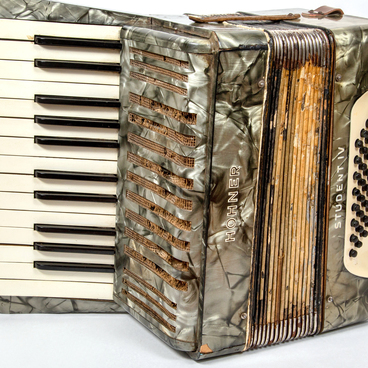
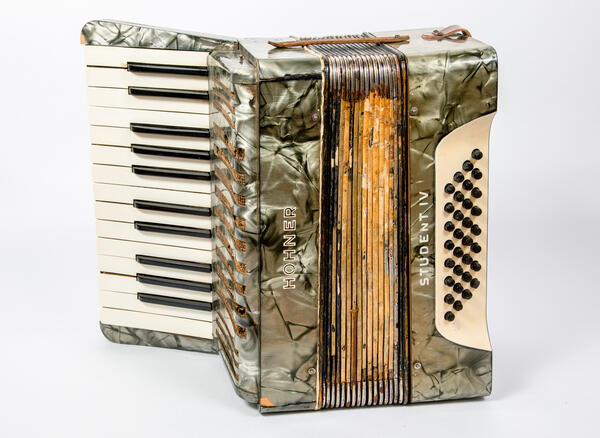
The trophy accordion ‘HOHNER STUDENT’ from the Museum Resource Center collection belonged to Vladimir Ivanov, a veteran of the Great Patriotic War of 1941-1945, who was awarded the medal ‘For the Victory over Japan’. Vladimir Ivanov brought the accordion from Germany as a gift to his daughters. One of them, Nadezhda Bliznyuk, donated the instrument to the museum.
The German company ‘Hohner’ manufactured this accordion. On the right side of the instrument is a box and a musical keyboard similar to a piano. The box contains the right sounding board and resonators, the valves that open free-reeds, and the switches that control the timbre. On the left side is a box with a buttonboard, resonators, and mechanics for the keyboard. It consists of four button rows: two rows for bass buttons, and two more for pre-set chord buttons.
On the left is also a belt for controlling the bellows, which connect both parts of the accordion. While playing, musician opens and closes the bellows, creating a controlled airflow. It causes the metal reeds of the instrument to vibrate and produce sounds.
German watchmaker Matthias Hohner founded the company ‘Hohner’ in 1857. Initially, it specialized in the manufacture of mouth organs, and up until 1860, masters created each instrument manually. Gradually, with the help of his family and hired workers, Hohner managed to launch machine production and produce up to 650 organs per year. Over time, he expanded production and began to produce other musical instruments. The company started producing accordions in 1903.
In the USSR, before the Great Patriotic War, musicians played mainly button accordions (called bayans) and squeezeboxes. After the war, soldiers brought from Germany a lot of trophy accordions produced by various companies: ‘Hohner’, ‘Piaccordio’, ‘Royal Standard’, ‘Sibilia Band’, and others. The instrument quickly gained popularity.
The German company ‘Hohner’ manufactured this accordion. On the right side of the instrument is a box and a musical keyboard similar to a piano. The box contains the right sounding board and resonators, the valves that open free-reeds, and the switches that control the timbre. On the left side is a box with a buttonboard, resonators, and mechanics for the keyboard. It consists of four button rows: two rows for bass buttons, and two more for pre-set chord buttons.
On the left is also a belt for controlling the bellows, which connect both parts of the accordion. While playing, musician opens and closes the bellows, creating a controlled airflow. It causes the metal reeds of the instrument to vibrate and produce sounds.
German watchmaker Matthias Hohner founded the company ‘Hohner’ in 1857. Initially, it specialized in the manufacture of mouth organs, and up until 1860, masters created each instrument manually. Gradually, with the help of his family and hired workers, Hohner managed to launch machine production and produce up to 650 organs per year. Over time, he expanded production and began to produce other musical instruments. The company started producing accordions in 1903.
In the USSR, before the Great Patriotic War, musicians played mainly button accordions (called bayans) and squeezeboxes. After the war, soldiers brought from Germany a lot of trophy accordions produced by various companies: ‘Hohner’, ‘Piaccordio’, ‘Royal Standard’, ‘Sibilia Band’, and others. The instrument quickly gained popularity.
#11
At this time, the guests got up, moved the table and chairs to the window, and Uncle Mitya found himself in the middle of the room with his mysterious suitcase in his hands. He put it on the floor, opened the locks with a key that clicked dryly, turned back the strangely shaped lid and, grunting from the effort, and pulled out an object more beautiful than anything I have ever seen in my life <…> A radiance filled our room; a pearly intermittent luster; a dull, noble shine of black lacquer and a festive midday glow of white lacquer. In short, Uncle Mitya took an accordion out of his case.
‘A man with an accordion’ by Anatoly Makarov, 1974
#9
Full name: Trophy accordion HOHNER STUDENT
Date: the first half of the 20th century
Technique: factory-made
Place: Germany
Copyright: Museum Resource Center of Noyabrsk
Dimensions: 34,5×17,5×44 cm
Goskatalog Number: 16663683
Date: the first half of the 20th century
Technique: factory-made
Place: Germany
Copyright: Museum Resource Center of Noyabrsk
Dimensions: 34,5×17,5×44 cm
Goskatalog Number: 16663683
#10
Ministry of Culture of the Russian Federation
read morehide
00:00
00:00
1x
0
 Point your smartphone camera to open in the app
Open in app
Share