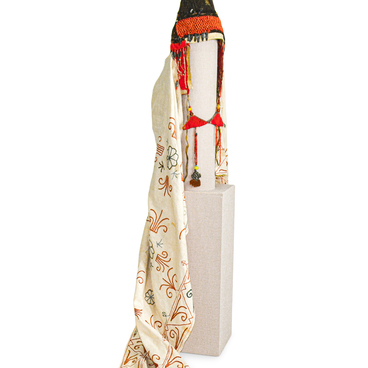
The Evenks are an indigenous small-numbered people of Central and Eastern Siberia. This endonym came into use in the 1930s, with “Tungus” considered an obsolete name. The national costume distinguished the Evenks from other peoples of Siberia. The Russian traveler, geographer, zoologist, botanist and naturalist Alexander Fyodorovich Middendorf called the Evenks “the French of Siberia”. He was referring to the distinctive clothing of these people, emphasizing the elegance and colorfulness of their attires. At the same time, the people’s clothing was adapted to the conditions of the taiga.
The main occupation of the Evenks was hunting. The clothing for hunters was light, not to restrict movement during fast walking. The winter working clothes of men and women were parka-type jackets made of reindeer skin with fur on the outside.
Traditional winter men’s clothing of the late 19th — early 20th century was called mukuke. This light caftan prevented the hunter from sweating during active movement. The back part had a V-shaped bottom edge, which made it possible to sit on ice, stone or cold ground. When walking, it was tied to the belt by a loop.
The caftan from the museum collection was sewn from reindeer skin by hand using sinew threads with fur on the outside. On each side, the caftan had two straps made of reindeer or moose hide suede or cloth. The lower edge of this garment was decorated with rows of alternating strips of dark brown and white reindeer fur. On the hem there was a fringe of goat hair with beads strung onto it. The back and front parts were decorated with long tassels made of straps and goat hair.
There are 14 tassels attached at the waist. The sleeves of the mukuke are long, straight, with mittens sewn on them. On the back of the sleeve, fur was sewn on the outside. On the palm side, the mitten was designed with the fur facing inward. A slit was made on the inside of the sleeve near the wrist so that the hands could be pulled out.
A similar caftan was
used as a men’s winter outer clothing by
all western Evenks in the late 19th — early 20th century. The museum
exhibit was made in the early 20th century. It was collected in the Kezhemskaya
Volost of Yenisei Governorate.