#1
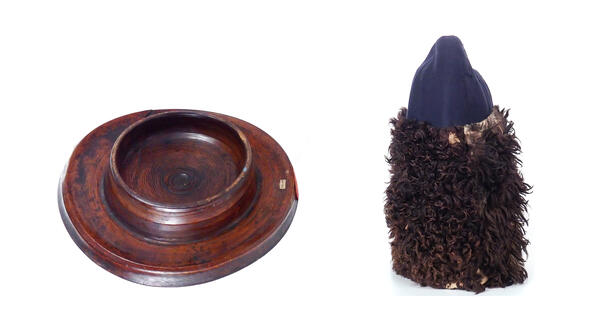
Male cap, Portable table
#16
#17

#2
For mountaineers, the head-dress was not just an element of their costume. It was first and foremost a symbol of men’s dignity and men’s law. That was why Adyghes practically never took off their caps — be it at home, paying a visit or being in the open air, be it at table, in heat or in cold. If during a conversation, a man was asked to take off his cap, the implication was that he was being haughty or misbehaving. If the cap was knocked off the Adyghe’s head it might as well become a reason for no less than a blood feud.
#3
Many mountain peoples have very expressive proverbs which emphasise their respectful attitude to the head-dress: “The cap is worn not for warmth but for honour”; “If you don”t have anyone to ask for advice, ask your cap”; “If the head has survived, it must have a cap on”, etc. There is also a well-known suggestive adage — “If you”re a man and wear a cap…”
#15
For most mountain peoples a “cap” was a papakha, a tall head-dress fully made of fur. They most commonly were made from sheepskin or astrakhan, the latter being a fur of very young lambs from Astrakhan skinned on the first-third day of their life.
#4
Most papakhas had a thick quilted lining with the hair outside. Such caps were warm, waterproof and protected men from snow, rain, wind and any other kinds of adverse weather, or even from a sabre cut in combat. They often served as thick comfortable pillows for shepherds.
#5
Massive long-hair papakhas made from long curly sheep fur or Angora goat skins were popular in many cultures. The crown of such caps was usually made of velvet or good quality felt cloth. They were very expensive and were considered to be ceremonial. They were worn only on special occasions and in daily life were kept with utmost care covered with a kerchief. Often a ceremonial papakha would be put on only when approaching the destination, an ordinary cap worn while travelling.
#6
Over time, papakhas had become an element of the Russian military uniform. By the middle of the 19th century fur caps had been taken on as a winter head-dress by Cossack troops, and 60 years later they were officially introduced for the whole infantry personnel. During the revolution, many soldiers wore Tsarist army papakhas with a red band on the front.
#8
Portable table
#7
#9
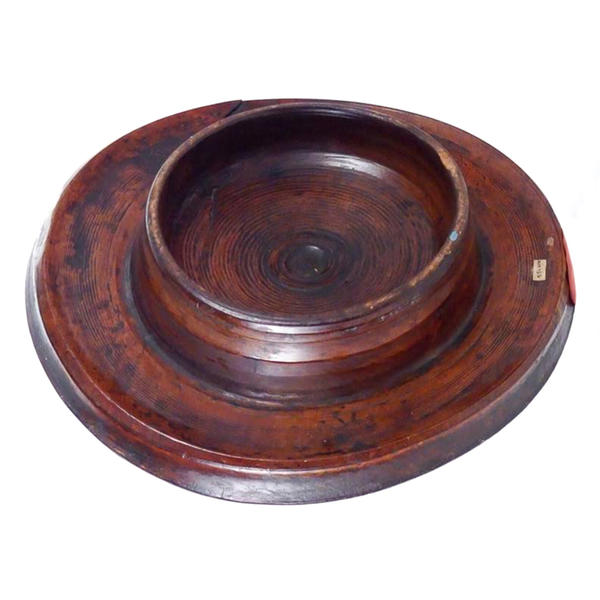
In their domestic life, the Adyghes used two types of tables– traditional three-legged tables and portable tables. The portable table had an interesting design: it was smooth on the edges and had boards in the middle forming a handy bowl for hot food
#10
Portable tables were mainly made from pear wood. After treatment, it acquired a deep reddish colour and, according to the Adyghe pagan beliefs, became ‘kind’. When the table was ready, it was branded with a family coat of arms, tamga.
#11
From time immemorial, the Circassians often were at war as the Caucasus was an object of continuous external expansion. Consequently, the life of the Adyghe people was to a large extent militarised, and they made some of their household articles, a table for one, such that they could be easily taken to a long expedition and fastened to the saddle.
#12
The Circassian warriors were used to eating well both in peaceful times and at war, therefore they had developed a set of staple foods to be taken on an expedition called g’omyl, which can be translated as a “nourishing product”. All the foodstuffs from that set were rich in calories, could be kept for a long time, did not take much space, and were cooked fast.
The basis of g’omyl was dried meat soup, smoked sausage and cheese, honey-boiled pastry, wheat and maize cereals, oil and condiments. The Adyghe warrior would always have a stock of millet, farro and wheat cakes fried in oil, and k’urambyi biscuits made from wheat flour with honey.
#13
Every participant in the military expedition was entitled to a g’omyl ration of his own which was to be approved by the squad commander. He also determined the amount and composition of each meal.
#14
The Adyghe warriors took their meals only when halted and only all together. If the conditions allowed, they made a fire and cooked hot food, for example, boiled dried meat soup. It was a powder-like mass including wheat, ground meat, dried broth and spices. One portion of thick, delicious and nutritious soup required only a pinch of such powder. When on the march, water for the soup was brought from a nearby water reservoir in leather bags on horseback.
read morehide
00:00
00:00
1x
Male cap, Portable table
Creation period
19th century
Exhibition
2
 Point your smartphone camera to open in the app
Open in app
Share