Font
Color
Graphics
Изображение точки

To see AR mode in action:

1. Install ARTEFACT app for iOS or Android;

2. Find the exhibition «The history of the Kolokolnikovs’ estate»

3. Push the «Augmented reality» button and point your phone's camera at the exhibit;

Скрыть точки интересаПоказать точки интереса
Показать в высоком качестве
#1
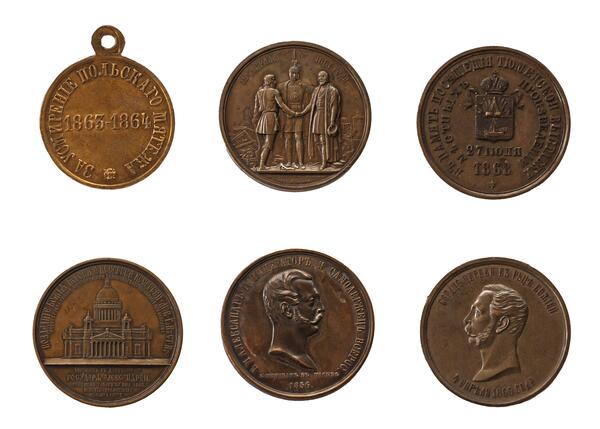
Medals
#3
In Memory of the Emancipation of the Serfs
#4
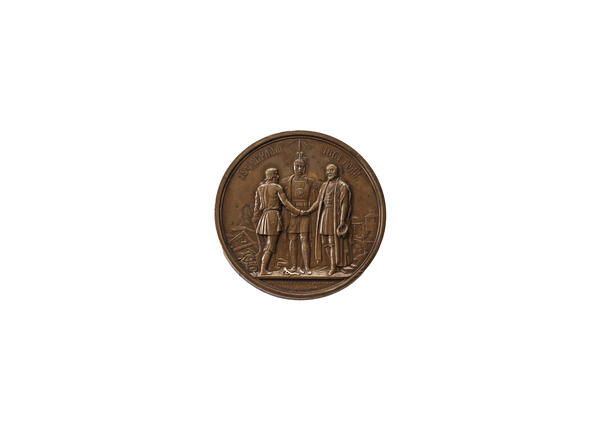
The commemorative medal is dedicated to the most important reform of the state, which was conducted by Emperor Alexander II — the abolition of serfdom.

The model of the medal was created by the famous Russian painter, drafter, and sculptor, Vice-President of the Academy of Arts, Fyodor Tolstoy. His student, the painter-medallist Nikolay Kozin at the Saint Petersburg Mint, made the medal according to Tolstoy’s model.

The medal is made of bronze, with 68 millimeters in diameter and 6 mm thick. The obverse depicts Emperor Alexander II in a helmet, chain mail, and armor, with a sword at his left hip and the Porphyra on his shoulders. He holds by the shoulders a nobleman dressed as a boyar and a peasant, who are shaking hands with each other. A broken oxbow is depicted at the feet of the Emperor. To the left behind the peasant there are sickle, rake, scythe, shovel, basket with fruit, and beehives with bees. Books, helmet, shield, sword, and a globe are depicted to the right of the nobleman. The date is stamped at the top: “February 19, 1861”. Underneath the trim there is writing: “From the model of Count F. Tolstoy, artisan N. Kozin”.

The reverse depicts an eight-pointed cross. The first lines of the manifesto on the abolition of serfdom are carved in a circle:
#21
Cast the sign of the cross upon the Orthodox Christians and call God”s blessing upon your free labor with us.
#5
Alexander II signed “Manifesto on the Abolition of Serfdom” and “General Statute Concerning Peasants Leaving Serf Dependence” on February 19, 1861. These documents regulated the personal emancipation of the peasants and the conditions of their redemption of the land. Peasants were no longer considered serfs, and their houses and all movable property became their property. However, the land itself remained the property of the landlords, who gave the peasants the use of allotments on the condition that they worked off the base service. The working hours ranged from 30 days per year for women between the ages of 17 and 50 and up to 40 days for men between 18 and 55.

If the peasants did not want to work hard, they could buy their land from the property owner. In that case, the peasant paid 20 percent of the land value to the property owner, and the government paid the remaining 80 percent. The peasant had to pay the money back to the state within 49 years at 5.6 percent per annum. According to the original plan of the reform, the full transfer of land to the peasants should have been completed by 1932. However, since January 1, 1907, thanks to the agrarian reform of Pyotr Stolypin, the redemption payments were abolished.
#22
Полное наименование: Commemorative medal “In Memory of the Emancipation of the Serfs”
Правообладатель изображений: Tyumen Museum and Educational Association
Коллекция: Tyumen Museum and Educational Association
Техника: embossing
Автор: Fyodor Petrovich Tolstoy, Nikolay Alexeyevich Kozin
Размеры: 6.8×6.8 cm
Дата создания: 1862
Место создания: Saint Petersburg Mint
#6
In Memory of the Event of April 4, 1866
#7
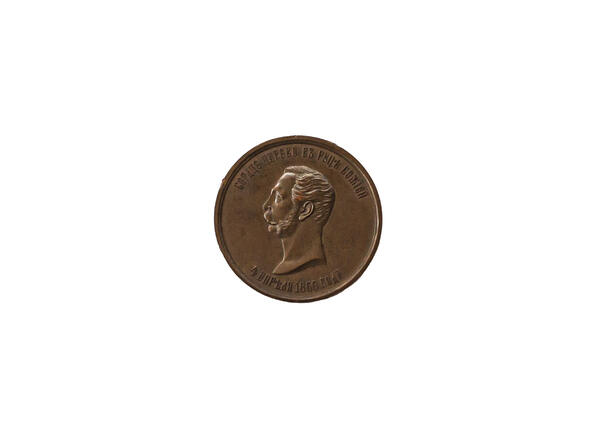
The brass commemorative medal made by Vasily Alexeyev is dedicated to saving Emperor Alexander II during the terrorist attack of April 4, 1866.

The obverse bears the Emperor’s profile with the inscription “The Tsar”s Heart is in God”s Hands” above it. The initials of the author and the date of the assassination attempt are embossed at the bottom. On the reverse of the medal is the image of Jesus Christ on a cloth, under which is written: “Soch. Makarov” (composed by Makarov). Experts suggest that this is the signature of the author of the model after which Alexeyev made the medal.

Former student Dmitry Karakozov made an attempt on the life of Emperor Alexander II. In 1865, he joined the secret revolutionary society “Organization”, headed by his cousin Nikolay Ishutin. Karakozov and other members of the circle were supporters of the tactics of individual terror: they believed that they could induce people to a social revolution only by killing the emperor.

In the spring of 1866, Karakozov came to Saint Petersburg on his initiative to organize an assassination attempt on the Tsar. He set out the motives for his action in a handwritten proclamation “Friends to the Workers”, where he called upon the people for revolution and the establishment of a socialist system after the Tsar’s assassination. One copy of the proclamation was found in the pocket of a terrorist when he was arrested.
#23
It was sad, hard for me to think that… my beloved people are dying out, and so I decided to kill tsar the villain and to die for my dearest people. If I succeed in my plan, I will die with the thought that my death was of use to my dear friend, the Russian peasant. If I fail, I believe that there will be people who will follow my way. I was not able to succeed — they will. To them, my death will be an example and inspiration…
#24
On April 4, 1866, after the stroll through the Summer Garden, Emperor Alexander II was heading to his carriage, surrounded by a crowd of people hoping to see the tsar. At that moment, a shot rang out. The Emperor was not harmed. He was saved by the hat-maker Osip Komissarov, who happened to be in the crowd next to Karakozov and pushed the terrorist away.

On the same evening, Komissarov was received personally by the Emperor at the Winter Palace. He was granted the title of a hereditary nobleman and the Order of Saint Vladimir, 4th degree. Dmitry Karakozov was captured on the spot, tried, and sentenced to death. The sentence was executed on September 3, 1866.
#8
Полное наименование: Commemorative medal “In Memory of the Event of April 4, 1866”
Правообладатель изображений: Tyumen Museum and Educational Association
Коллекция: Tyumen Museum and Educational Association
Автор: Vasily Vladimirovich Alexeyev
Дата создания: 1866
Техника: embossing
Место создания: Saint Petersburg Mint
Размеры: 4.4×4.4 cm.
#9
Medal for Consecration of St. Isaac’s Cathedral
#10
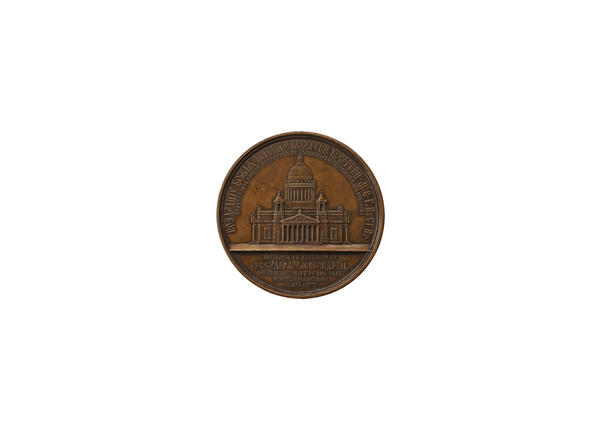
The commemorative bronze medal is dedicated to the completion of St. Isaac’s Cathedral in St. Petersburg, one of the most famous architectural structures in Russia.

On the obverse of the medal, in the center, there is a medallion with a chest-length portrait of Emperor Peter I with a laurel wreath on his head. There are five more medallions around it, separated from each other by laurel, oak branches, and stars. They depict portraits of Catherine II, Paul I, Alexander I, Alexander II, and Nicholas I.

The south facade of St. Isaac’s Cathedral is depicted on the reverse of the medal, and the inscription in a circle: “Give to Caesar what is Caesar”s and to God what is God”s. The reconstruction of the Cathedral began under Alexander I”rule and continued under Nicholas I”. Below, under the edge, there is another embossed inscription: “Reconstruction was ended in the reign of the Sovereign Alexander II. The Cathedral was consecrated in the name of St. Isaac of Dalmatia on May 30, 1858.”

Portrait medalist Alexander Lyalin made the front side of the medal, and Vasily Alexeyev made the reverse side according to Lyalin’s sketch.

The first St. Isaac’s Church in St. Petersburg was laid in 1709. Peter I was married to Catherine there. However, a few years later the church was dismantled. A new one, also dedicated to St. Isaac, was laid in 1717. During the reign of Anna Ioannovna, it was seriously damaged by fire and a few years later began to deteriorate. In 1768, the foundation of the church began being built at the new place, which was consecrated in 1802. However, the architecture of this building proved unsuccessful, so the architect Auguste Montferran was commissioned to design a new cathedral. Erection works began in 1818. The architect managed to preserve all three of the then existing consecrated altars.

The construction of the cathedral lasted for 40 years. The cathedral was solemnly consecrated only in 1858: the high altar was consecrated on May 30, the day of St. Isaac of Dalmatia, and the side-altars — on June 1 and June 8. Huge crowds filled the temple, the square next to it, neighboring streets, and even the roofs of nearby houses on those days. Troops in full ceremonial uniform lined up around the cathedral. The clergy of all St. Petersburg churches in white and gold garments participated in a procession from St. Isaac’s Cathedral to Kazan Cathedral and back.

Emperor Alexander II, grand duchesses, grand dukes, and the entire court marched to the cathedral in a festive cortege. The ceremony on May 30 began at 9 am and ended at about 4 pm. St. Isaac’s Cathedral was proclaimed the cathedral of the Russian Orthodox Church and remained so until 1922.
#11
Полное наименование: In Memory of the Consecration of St. Isaac’s Cathedral in St. Petersburg
Правообладатель изображений: Tyumen Museum and Educational Association
Коллекция: Tyumen Museum and Educational Association
Автор: Vasily Vladimirovich Alexeyev, Alexander Pavlovich Lyalin
Техника: embossing
Место создания: St. Petersburg Mint
Размеры: 8×8 cm
Дата создания: 1858
#12
In Memory of the Coronation of Alexander II
#13
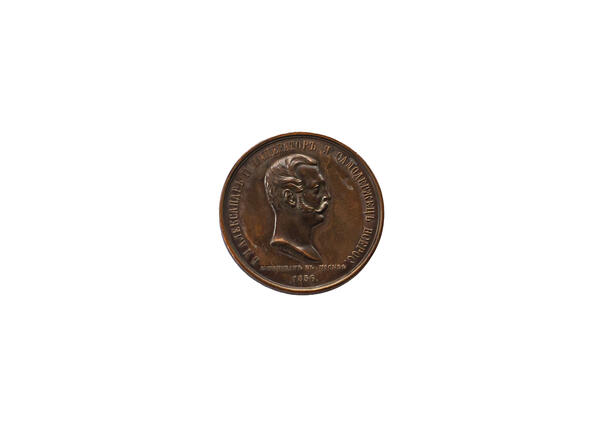
The commemorative medal, display in the exhibition, was made in honor of the coronation of Alexander II.

On the obverse of the medal, there is a chest-length portrait of the Emperor in profile. The inscription is carved on the circle: “B. M. Alexander II Emperor and Autocrat of All Russia.” At the bottom, there is a phrase in two lines: “Crowned in Moscow // 1856.” On the portrait of the emperor, at the very bottom of the neck, you can see the signature of the portrait medallist Vasily Alexeyev.

On the reverse of the medal, there is the coat of arms of the Russian Empire: the double-headed eagle with the wings spread, crowned with three imperial crowns. He holds a scepter and an orb. The breast of the eagle bears the coat of arms of Moscow and the chain of the Order of Saint Andrew the First-Called, while the wings bear the coat of arms of the kingdoms of Kazan, Poland, Tauris, Kyiv, Astrakhan, Siberia, Georgia, and Finland. Above the eagle, there is an inscription: “God is with us.” At the bottom, along the edge, there is the signature of the second craftsman who worked on the medal, Robert Ganneman.

Alexander II ascended the Russian throne after the death of his father, Nicholas I, on February 18, 1855. But it was decided to postpone the ceremony because of the Crimean War. The coronation of the Emperor took place only one and a half years later, already after the signing of the Paris Peace Treaty. Alexander II arrived in Moscow on August 14, 1856, by the Nikolaevskaya railroad and stayed at the Petrovsky Palace. His ceremonial entry into the capital took place on August 17. The tsar rode on horseback, accompanied by grand dukes, foreign princes, numerous retinue, and escorts.

The procession stopped at the Iverskiye Gate and then continued through Red Square to the Spasskiye Gate. These gates were considered holy — an icon was usually placed above them. Since the cross processions passed through them, all men had to remove their hats before entering, thus showing their respect for the holy places. The custom was looked over by the guards. Alexander II entered the Spasskiye Gate with his head uncovered, according to the tradition.

The ceremony was scheduled for August 26. It was announced by heralds in the town squares three days before the ceremony itself. The coronation took place in four traditional stages: a solemn procession to the Assumption Cathedral, laying ceremony of the imperial crown and royal regalia, the sacrament of anointing, a procession to the Cathedral of the Archangel, and the Cathedral of the Annunciation to visit the graves of their ancestors, and a return to the palace with the obligatory threefold bowing to the people from the Red Porch. The feast continued with a dinner in the Faceted Chamber.
#14
Полное наименование: Medal “In Memory of the Coronation of Emperor Alexander II”
Автор: Vasily Vladimirovich Alexeyev, Robert Romanovich Ganneman
Правообладатель изображений: Tyumen Museum and Educational Association
Коллекция: Tyumen Museum and Educational Association
Техника: embossing
Размеры: 5×5 cm
Дата создания: 1856
Место создания: Saint Petersburg Mint
#15
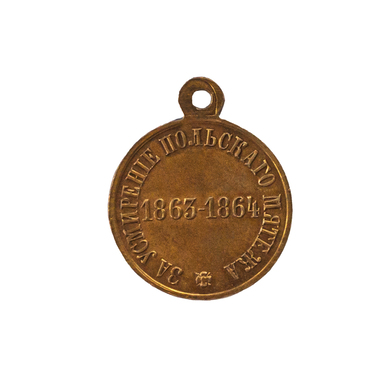
За усмирение польского мятежа
#16
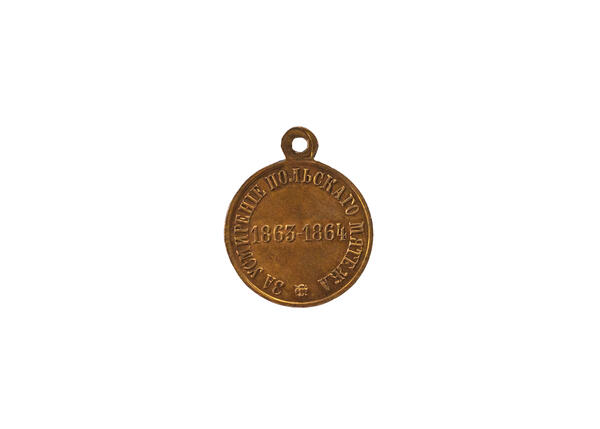
Medal, which was awarded to the participants of the suppression of the uprising of 1863–1864 in the Kingdom of Poland, North-Western region, and Volyn, was established in 1865.

There were two versions of the medal made: light and dark bronze. The exhibition includes a light-bronze version. About 370,000 of these medals were minted at the Saint Petersburg Mint.

On the obverse is the national coat of arms of the Russian Empire: a double-headed eagle crowned with the imperial crown, holding a scepter and an orb. The inscription on the back is embossed: “For the Suppression of the Polish Uprising, ” and dates: “1863–1864”.

After the country’s third division, the Rzeczpospolita (The Polish-Lithuanian Commonwealth) ceased to exist as an independent state. Its lands were divided between Russia, Prussia, and Austria. In 1815, Polish territories within the Russian Empire were declared the Kingdom of Poland, received a constitution and considerable self-government. However, in November 1830, a national uprising began, which Nicholas I managed to suppress in 1831. After that, the Emperor abolished the Polish constitution.

Subsequently, the Russian government pursued a policy of suppressing national and religious patriotism, but at the same time restored some elements of the autonomy of the Kingdom of Poland. In 1861–1862, Emperor Alexander II established a local State Council, elected provincial and district councils, but these transformations did not bring any significant results.

On January 10, 1863, in the Kingdom of Poland, North-West region, and in Volyn a rebellion began. Its aim was the restoration of the Polish-Lithuanian Commonwealth within the borders of 1772. The event that started the riots was the recruitment, which on the night of January 3 was held not by drawing lots, but according to lists drawn up in advance. On the night of January 11, insurgents attacked Russian garrisons. The main participants in the rebellion were the szlachta (Polish gentry), the townspeople, and the Catholic clergy.

The revolt ended with the defeat of the rebels in June 1864. On this occasion, Emperor Alexander II, by the highest decree as of January 1, 1865, established a medal for rewarding all the participants of the rebellion suppression. Medals of light bronze were awarded to soldiers who participated in hostilities, medics, auditors, military priests, and officials who participated in the fighting or were in the troops.
#17
Полное наименование: For the Suppression of the Polish Uprising of 1863–1864
Правообладатель изображений: Tyumen Museum and Educational Association
Коллекция: Tyumen Museum and Educational Association
Дата создания: 1865
Место создания: Saint Petersburg Mint
Техника: embossing
Размеры: 3.4×2.8 cm
#18
In Memory of the Visit to the Tyumen Exhibition
#19
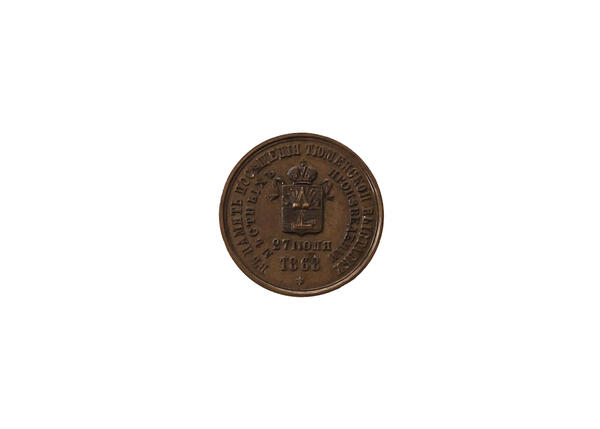
In July 1868, Grand Duke Vladimir Alexandrovich visited the Industrial Exhibition in Tyumen, which had been specially prepared for his visit. The commemorative medal displayed in the museum exhibition is the only monument of Russian medallion art devoted to the stay of the ruling dynasty’s representative in Western Siberia.

The obverse of the medal has the picture of the Grand Duke. The following inscription was minted on the edge of the medal: “Grand Duke Vladimir Alexandrovich”. The portrait bears the signature of the author — the master Vasily Alexeyev. On the reverse side of the medal, in the center, there is a coat of arms of Tyumen under the emperor’s crown with ribbons, and on the circumference, you can read the inscription in two lines:
#25
In Memory of the Visit to the Tyumen Exhibition of Local Works.
#26
Tyumen authorities received the news about the forthcoming visit of Grand Duke Vladimir Alexandrovich to the city in the middle of April 1868 and immediately started preparing for his meeting. It was decided to arrange an exhibition of industrial and agricultural goods produced in Tyumen and the Tyumen region for the arrival of the special guest.

In honor of the guest, merchant Ivan Trusov erected a brick monument in the form of a pyramid at the entrance to the city. In addition, the merchant Semen Trusov built with his own money orphanage (for the education of orphans), the honorary chairperson of the board of trustees of which became Vladimir Alexandrovich.

Grand Duke was in Tyumen from July 27 to July 28. After he visited the city and its enterprises, on the evening of the first day he and his retinue went to the exhibition in Zatyumenka, where he spent about two and a half hours. The 380 exhibitors presented 860 pieces, which were housed in several buildings. Trees and shrubs, characteristic for the region were displayed, as well as horses, cattle, and fish from local reservoirs in addition to manufactured goods.

Vladimir Alexandrovich was presented with a hunting cap made of reindeer skins and a locally made rug. He bought another one and bought several pieces of woven felt from Yadrishnikov’s factory. Grand Duke called the exhibition “expedient”. Commemorative medals were made for its participants and organizers.
#2
Полное наименование: In Memory of the Visit of Grand Duke Vladimir Alexandrovich to the Tyumen Exhibition of Local Works
Коллекция: Tyumen Museum and Educational Association
Правообладатель изображений: Tyumen Museum and Educational Association
Дата создания: 1870
Техника: embossing
Место создания: Saint Petersburg Mint
Размеры: 3.6×3.6 cm
Автор: Vasily Vladimirovich Alexeyev
#20
read morehide
00:00
00:00
1x
Point your smartphone camera to open in the app
Share
VkontakteOdnoklassnikiTelegram
Share on my website
Copy linkCopied
Copy
Open in app
To see AR mode in action:
  1. Install ARTEFACT app for 
  2. iOS or Android;
  3. Find and download the «Paintings in Details» exhibition
  4. Push the «Augmented reality» button and point your phone's camera at the painting;
  5. Watch what happens on your phone screen whilst you flip through the pictures.
 
We use Cookies
Cookies on the Artefact Website. We use cookies to ensure that we give you the best experience on our website. If you continue without changing your settings, we'll assume that you are happy to receive all cookies on the Artefact website. However, if you would like to, you can change your cookie settings at any time.
Learn more about useHide
Content is available only in Russian

X

Нашли опечатку?...

%title%%type%