#5
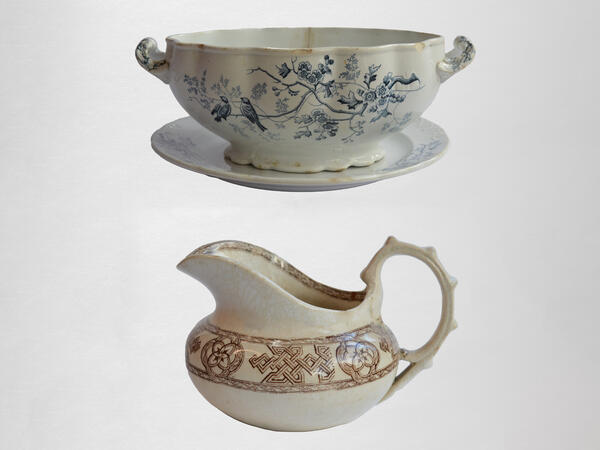
Milk jug, Tureen
#6
#7
#8
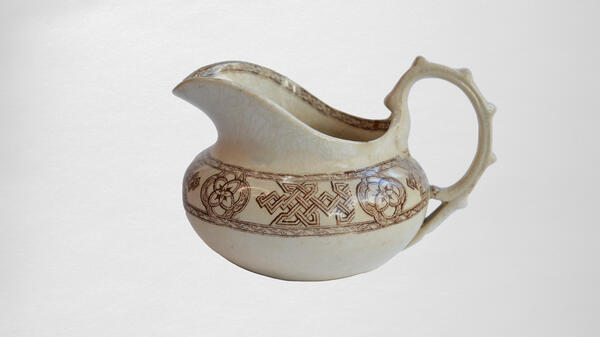
This vessel for milk or cream was owned by Izmail Semenov-Tyan-Shansky — the youngest son of Pyotr Semyonov-Tyan-Shansky, a distinguished scientist, geographer, public and state figure. Izmail Petrovich lived in the same house on Vasilievsky Island in St. Petersburg, as his father did from 1861 to 1914.
Tableware, among other things, was passed down in the family: from Izmail Petrovich, a famous meteorologist to his daughter Olga Korolkova, a Soviet chess player and a master of sports of USSR. She gave birth to two children — Nadezhda and Alexander. It was Nadezhda Korolkova, a great-granddaughter of the scientist, who donated the tableware, that was used by Semenov-Tyan-Shanskys in their everyday life, to the museum.
Specialized vessels for serving milk have existed for at least several millennia. In its modern form, milk jugs appeared in Great Britain, when the British started to add milk and sugar to tea in 1720s and felt a need for special devices. Though, the appearance of milk jugs lagged behind other items in the tea service. It was only in the 1740s, when silver milk jars became popular as gifts. Sets of a teapot, sugar bowl and milk jug, designed in a single style also started to be actively used and given as gifts in the second half of 17th century.
In the museum’s collection there is a milk jug from the Palermo service made in England by Brown Westhead & Moore. In England and abroad, this company was considered a manufacturer of high quality tableware. Next to the brand of the company there is an image of the coat of arms of Great Britain— a lion with a unicorn, supporting a shield. This is a distinctive feature of the manufacturers who supplied the goods to the royal court of Great Britain.
This image began to be added to crockery in 1890. It is also known that the firm that made the milk pot was called Brown Westhead and Moore until 1904. This means that the piece belonging to the Semyonov-Tyan-Shansky family was produced between 1890 and 1904.
Tableware, among other things, was passed down in the family: from Izmail Petrovich, a famous meteorologist to his daughter Olga Korolkova, a Soviet chess player and a master of sports of USSR. She gave birth to two children — Nadezhda and Alexander. It was Nadezhda Korolkova, a great-granddaughter of the scientist, who donated the tableware, that was used by Semenov-Tyan-Shanskys in their everyday life, to the museum.
Specialized vessels for serving milk have existed for at least several millennia. In its modern form, milk jugs appeared in Great Britain, when the British started to add milk and sugar to tea in 1720s and felt a need for special devices. Though, the appearance of milk jugs lagged behind other items in the tea service. It was only in the 1740s, when silver milk jars became popular as gifts. Sets of a teapot, sugar bowl and milk jug, designed in a single style also started to be actively used and given as gifts in the second half of 17th century.
In the museum’s collection there is a milk jug from the Palermo service made in England by Brown Westhead & Moore. In England and abroad, this company was considered a manufacturer of high quality tableware. Next to the brand of the company there is an image of the coat of arms of Great Britain— a lion with a unicorn, supporting a shield. This is a distinctive feature of the manufacturers who supplied the goods to the royal court of Great Britain.
This image began to be added to crockery in 1890. It is also known that the firm that made the milk pot was called Brown Westhead and Moore until 1904. This means that the piece belonging to the Semyonov-Tyan-Shansky family was produced between 1890 and 1904.
#9
Full name: Milk jug
Date: the second half of the 19th century — the early 20th century
Technique: casting, underglaze printing
Place: England
Copyright: The Museum-Estate of P. P. Semyonov-Tyan-Shansky
Dimensions: 8,5×1,5×6 cm
Date: the second half of the 19th century — the early 20th century
Technique: casting, underglaze printing
Place: England
Copyright: The Museum-Estate of P. P. Semyonov-Tyan-Shansky
Dimensions: 8,5×1,5×6 cm
#10
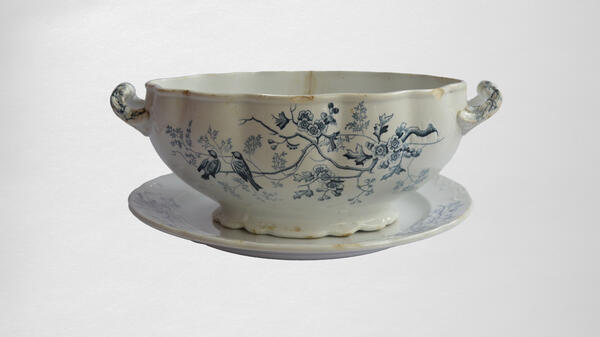
Tureen
#11
#12
A soup tureen has always been considered the centerpiece of the festive table, although it is not an essential item. Nevertheless, even the most ordinary dinner becomes festive thanks to this piece of tableware. The tureens first appeared in the 17-18th centuries in France. At that time, serving process was much more important than the food itself. The way of serving food in tureens turned out quite comfortable and over the time this type of tableware became mandatory in all European rich people’s houses.
Following the fashion of the French elite, Russian aristocrats also started to use tureens, produced by the Imperial Porcelain Factory and enterprises of the industrialist Matvey Kuznetsov. There is a tureen of “Kuznetsov faience” in the museum collection.
Continuing his family business, Matvey Kuznetsov opened a branch of his factory in 1847 in Riga where porcelain was produced. It is no coincidence that the industrialist chose that place as it was profitable due to the opportunity to transport goods by sea to different countries. In 1870 there was another momentous event: the company bought the Auerbach faience factory in 1870, one of the best in Russia.
With his business ingenuity Kuznetsov continued his family business and advanced the company: he merged eighteen of his own companies, including eight porcelain and faience factories, and created “M. S. Kuznetsov”s Partnership for the Production of Porcelain and Earthenware Products”. In 1872 Kuznetsov gained the right to put the State Emblem on his porcelain, and in 1902 he was awarded the title “Supplier to the Court of His Imperial Majesty”. The stamp of the period of the partnership crowns the bottom of the tureen from the museum’s collection.
Initially, the tableware from this collection belonged to Izmail Semyonov-Tyan-Shansky, the scientist’s youngest son, geographer, botanist, social activist and statesman. He lived in the same house on Vasilievsky Island in St. Petersburg, where his father lived from 1861 to 1914. Tableware, among other family things, were inherited: from Izmail Semyonov-Tyan-Shansky to his daughter Olga Korolkova, a Soviet chess player. The tureen was given to the museum collection by his great-granddaughter Nadezhda Korolkova.
Following the fashion of the French elite, Russian aristocrats also started to use tureens, produced by the Imperial Porcelain Factory and enterprises of the industrialist Matvey Kuznetsov. There is a tureen of “Kuznetsov faience” in the museum collection.
Continuing his family business, Matvey Kuznetsov opened a branch of his factory in 1847 in Riga where porcelain was produced. It is no coincidence that the industrialist chose that place as it was profitable due to the opportunity to transport goods by sea to different countries. In 1870 there was another momentous event: the company bought the Auerbach faience factory in 1870, one of the best in Russia.
With his business ingenuity Kuznetsov continued his family business and advanced the company: he merged eighteen of his own companies, including eight porcelain and faience factories, and created “M. S. Kuznetsov”s Partnership for the Production of Porcelain and Earthenware Products”. In 1872 Kuznetsov gained the right to put the State Emblem on his porcelain, and in 1902 he was awarded the title “Supplier to the Court of His Imperial Majesty”. The stamp of the period of the partnership crowns the bottom of the tureen from the museum’s collection.
Initially, the tableware from this collection belonged to Izmail Semyonov-Tyan-Shansky, the scientist’s youngest son, geographer, botanist, social activist and statesman. He lived in the same house on Vasilievsky Island in St. Petersburg, where his father lived from 1861 to 1914. Tableware, among other family things, were inherited: from Izmail Semyonov-Tyan-Shansky to his daughter Olga Korolkova, a Soviet chess player. The tureen was given to the museum collection by his great-granddaughter Nadezhda Korolkova.
#13
Full name: Tureen
Date: 1889-1917
Technique: manufacturing
Place: the Russian Empire
Copyright: The Museum-Estate of P. P. Semyonov-Tyan-Shansky
Dimensions: 13×34×22 см
Date: 1889-1917
Technique: manufacturing
Place: the Russian Empire
Copyright: The Museum-Estate of P. P. Semyonov-Tyan-Shansky
Dimensions: 13×34×22 см
#14
Ministry of Culture of the Russian Federation
read morehide
00:00
00:00
1x
Milk jug, Tureen
Exhibition
0
 Point your smartphone camera to open in the app
Open in app
Share