#1
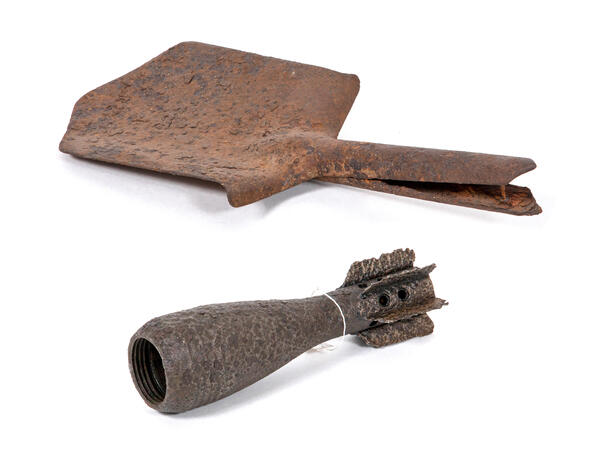
Casing of a mine, Infantry Spade
#3
#4
#5
The first mortars were created in the early 20th century during the Russian-Japanese war. Russian officer Leonid Gobyato is considered to be the inventor of this weapon type. After the October Revolution, on the orders of Vladimir Lenin, the Commission for Special Artillery Experiments began to study and carry out experiments to develop and improve the existing mortar weapons.
By the end of the 1930s, in the USSR, under the leadership of artillery and rocket engineer Boris Shavyrin, 50-mm, 82-mm, 107-mm, and 120-mm mortars, which were superior in combat power to the foreign analogs, were developed and adopted. Due to the difference in calibers (the domestically made mortars were a couple of millimeters larger), the Red Army soldiers could use captured ammunition. A combat ready mortar weighed about 10 kilograms and could fire up to 30 bombs per minute. Mortar shells hit the targets within a radius of 50 to 800 meters.
The Red Army used mortars throughout the Great Patriotic War in almost all military operations. 50 millimeter caliber mortars, designed for fire support of platoons and companies, became the most popular type of light artillery weapons. However, their popularity gradually declined, as the battalion 82-mm mortars proved to be more effective. The decisive disadvantage of the weapons was their low range — it was only a few hundred meters. Because of this, the mortar crews had to be positioned at an extremely short distances to the enemy. Their positions were not secure, and mortarmen were often killed. In 1943, the command decided to cease the production of the 50-millimeter caliber company mortars and its ammunition and remove them from the armament of the Red Army. By the end of the war, only partisans used them.
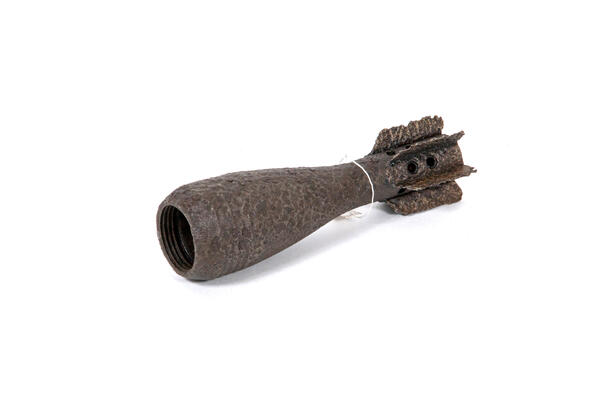
The museum displays a casing of a mine designed for a 50-millimeter mortar of the 1938 RM-38 model. A mine of this caliber could also be used with other modifications of these mortars — the 1940 and 1941 models.
Caliber of a mine is the diameter of its widest part.
The case is made of dark-colored metal and tear-drop shaped. It is also equipped with a stabilizer with 6 fins. Such artillery ammunition was called a mortar round. It consisted of the fragmentation mine itself with the main fuze M-50, and the throwing cartridge (or tail cartridge), which was placed in the stabilizer tube. It had a firing charge of about 4 grams of smokeless powder.
By the end of the 1930s, in the USSR, under the leadership of artillery and rocket engineer Boris Shavyrin, 50-mm, 82-mm, 107-mm, and 120-mm mortars, which were superior in combat power to the foreign analogs, were developed and adopted. Due to the difference in calibers (the domestically made mortars were a couple of millimeters larger), the Red Army soldiers could use captured ammunition. A combat ready mortar weighed about 10 kilograms and could fire up to 30 bombs per minute. Mortar shells hit the targets within a radius of 50 to 800 meters.
The Red Army used mortars throughout the Great Patriotic War in almost all military operations. 50 millimeter caliber mortars, designed for fire support of platoons and companies, became the most popular type of light artillery weapons. However, their popularity gradually declined, as the battalion 82-mm mortars proved to be more effective. The decisive disadvantage of the weapons was their low range — it was only a few hundred meters. Because of this, the mortar crews had to be positioned at an extremely short distances to the enemy. Their positions were not secure, and mortarmen were often killed. In 1943, the command decided to cease the production of the 50-millimeter caliber company mortars and its ammunition and remove them from the armament of the Red Army. By the end of the war, only partisans used them.
The museum displays a casing of a mine designed for a 50-millimeter mortar of the 1938 RM-38 model. A mine of this caliber could also be used with other modifications of these mortars — the 1940 and 1941 models.
Caliber of a mine is the diameter of its widest part.
The case is made of dark-colored metal and tear-drop shaped. It is also equipped with a stabilizer with 6 fins. Such artillery ammunition was called a mortar round. It consisted of the fragmentation mine itself with the main fuze M-50, and the throwing cartridge (or tail cartridge), which was placed in the stabilizer tube. It had a firing charge of about 4 grams of smokeless powder.
#6
Full name: Casing of a mine for a 50-mm infantry mortar. Armament of the Workers' and Peasants' Red Army during the Great Patriotic War
Date: the 1930s-1940s
Technique: factory-made
Place: USSR
Copyright: Museum Resource Center of Noyabrsk
Dimensions: 17,5×4,9 cm
Goskatalog Number: 8337728
Date: the 1930s-1940s
Technique: factory-made
Place: USSR
Copyright: Museum Resource Center of Noyabrsk
Dimensions: 17,5×4,9 cm
Goskatalog Number: 8337728
#7
Infantry Spade
#8
#2
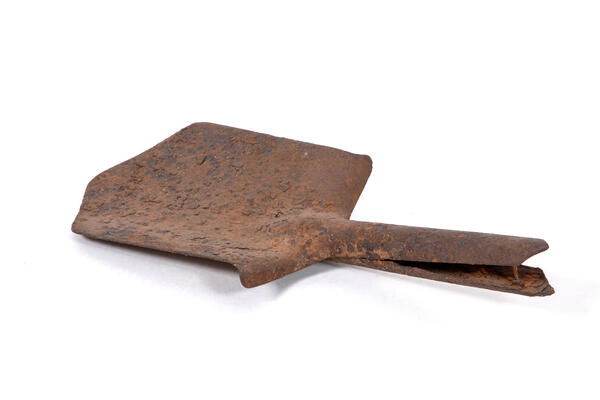
This small infantry spade, which was used during the Great Patriotic War, was found during battlefield excavations, conducted in 2008-2010 in the Nelidovsky district, Tver Oblast. Natalia Usenko, head of the Noyabrsk joint search party ‘Vitalis’, transferred it to the museum.
These pentagonal spades were made of steel, the handles were made of hardwoods, and they were polished but not painted. Both bottom sides of the steel blade were sharpened. Soldiers called this tool a ‘sapper shovel’ (‘intrenching shovel’) or ‘saperka’ but this nickname did not correspond to the official documents.
In the ‘Instruction on engineering for the Red Army infantry’, which was enacted by the order of the People’s Commissar of Defense of the USSR No.172, dated from September 13, 1939, the names of the tools used by the Red Army were clearly defined: “Entrenching tools and materials used for engineering work. <…> For engineering work the infantry is provided with a compact portable and a larger transportable intrenching tool. This includes a small spade <…> The transportable intrenching tool is carried by the convoy and is delivered to the place of work by special order. It includes the sapper spade <…>“
The Russian term for an intrenching tool is “Schantsevy” (from the German “Schanze” meaning “trench, fortification”). Those were hand tools with which soldiers worked in the field. They were used to fortify positions — dig trenches, build earth ramparts (breastworks), and break down barriers.
In the field, every soldier always carried a small spade along with their rifle or submachine gun. It was worn on the back of the left hip in a special pouch, and hung from the waist belt. During battles, the blade was often simply tucked behind the waist belt to make it easier to grab it and dig under enemy fire or to use in hand-to-hand combat.
Usually, soldiers used the small infantry spade while lying down, kneeling, or sitting. It was inserted into the ground at a slight angle to cut small roots. After every 10-15 minutes of continuous work with the spade, soldiers were supposed to rest for 5-10 minutes. The soldiers who knew how to use a small infantry shovel correctly could dig a trench in 8 to 12 minutes, while those who could not use the tool would spend up to 20 to 30 minutes.
These pentagonal spades were made of steel, the handles were made of hardwoods, and they were polished but not painted. Both bottom sides of the steel blade were sharpened. Soldiers called this tool a ‘sapper shovel’ (‘intrenching shovel’) or ‘saperka’ but this nickname did not correspond to the official documents.
In the ‘Instruction on engineering for the Red Army infantry’, which was enacted by the order of the People’s Commissar of Defense of the USSR No.172, dated from September 13, 1939, the names of the tools used by the Red Army were clearly defined: “Entrenching tools and materials used for engineering work. <…> For engineering work the infantry is provided with a compact portable and a larger transportable intrenching tool. This includes a small spade <…> The transportable intrenching tool is carried by the convoy and is delivered to the place of work by special order. It includes the sapper spade <…>“
The Russian term for an intrenching tool is “Schantsevy” (from the German “Schanze” meaning “trench, fortification”). Those were hand tools with which soldiers worked in the field. They were used to fortify positions — dig trenches, build earth ramparts (breastworks), and break down barriers.
In the field, every soldier always carried a small spade along with their rifle or submachine gun. It was worn on the back of the left hip in a special pouch, and hung from the waist belt. During battles, the blade was often simply tucked behind the waist belt to make it easier to grab it and dig under enemy fire or to use in hand-to-hand combat.
Usually, soldiers used the small infantry spade while lying down, kneeling, or sitting. It was inserted into the ground at a slight angle to cut small roots. After every 10-15 minutes of continuous work with the spade, soldiers were supposed to rest for 5-10 minutes. The soldiers who knew how to use a small infantry shovel correctly could dig a trench in 8 to 12 minutes, while those who could not use the tool would spend up to 20 to 30 minutes.
#9
Full name: Small Spade. Intrenching tool of the Workers’ and Peasants' Red Army Soldiers
Date: 1940–1945
Technique: stamping
Place: USSR
Copyright: Museum Resource Center of Noyabrsk
Dimensions: 37×16,2×5,5 cm; steel blade — 20 cm
Goskatalog Number: 16663713
Date: 1940–1945
Technique: stamping
Place: USSR
Copyright: Museum Resource Center of Noyabrsk
Dimensions: 37×16,2×5,5 cm; steel blade — 20 cm
Goskatalog Number: 16663713
#10
Ministry of Culture of the Russian Federation
read morehide
00:00
00:00
1x
Casing of a mine, Infantry Spade
Collection
Exhibition
0
 Point your smartphone camera to open in the app
Open in app
Share