#5
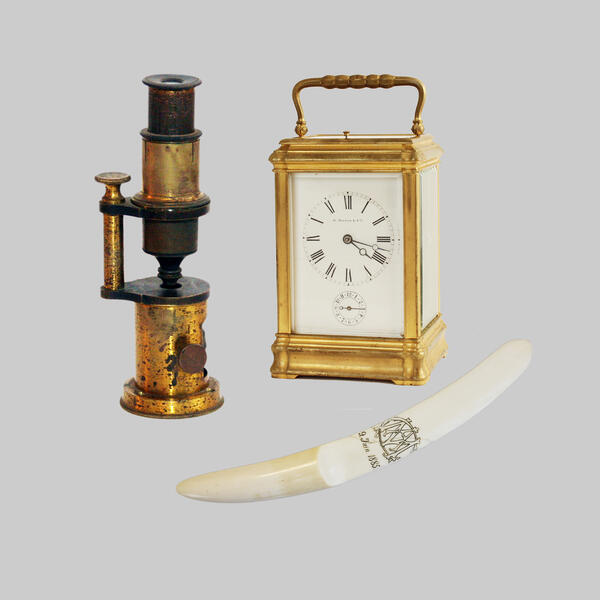
Collapsible microscope, Carriage clock, Paper cutter knife
#6
#7
#8
Optical magnifiers were invented relatively late in history. Spectacles appeared in the thirteenth century, and microscopes three hundred years after that, at the end of the sixteenth century. The rapid spread and improvement of microscopes kicked off after Galileo perfected the telescope he had constructed and began using it as a sort of microscope. The invention consisted of two convex lenses mounted inside one tube. Focusing on the object under study was achieved due to a retractable tube, which made it possible to increase the image of the object being studied several times.
The genesis models of the microscope were very simple at first glance. But over time, with high society’s increased interest in science, they began to be made according to all the rules of decorative art, from expensive materials, including ivory, valuable wood, bronze, and decorated with special ingenuity. Their cases had embossed gold leather trimming.
Patrons of art created cabinets of curiosities and cabinets of rarities and ordered scientific instruments, including optical ones. With the development of science in the first half of the nineteenth century, there were a fairly large number of places where microscopes were produced. According to researchers, in 1820 an optics workshop at Kazan University produced high quality microscopes. The optical industry in Russia did not develop, since more often optical devices were imported from abroad.
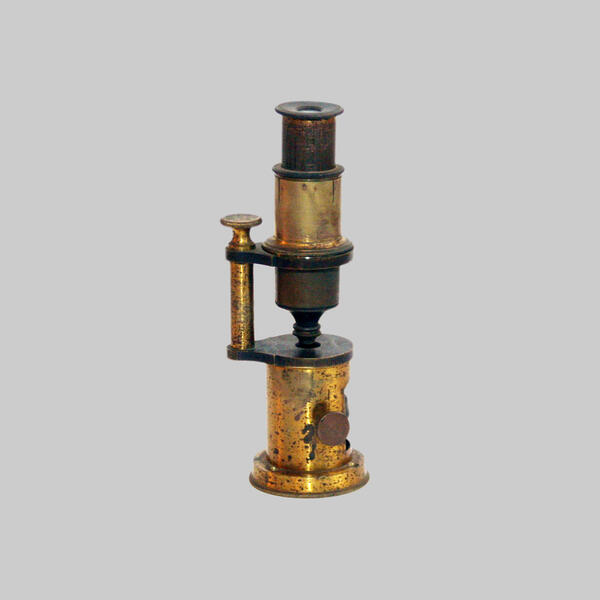
The microscope from the Decembrists in Yalutorovsk exhibit consisted of two tubes of different diameters, located one above the other. In the upper tube there was a complex objective and eyepiece, and in the lower tube there was a mirror controlled by an external gear.
The device belonged to Vladimir Tokarev, heir to the exiled Yevgeny Obolensky. After the uprising in 1825, Obolensky was stripped of his princely title and sentenced to a life of hard labor in Siberia. Later, the term was reduced to 20, 15, and then 13 years. After surviving hard labor, he settled down in Yalutorovsk and married the maid Varvara Baranova. Like all Decembrists, Obolensky had a good education, helped local residents with advice, and after his restoration of rights, he participated in the work on the peasant reform of 1861.
The genesis models of the microscope were very simple at first glance. But over time, with high society’s increased interest in science, they began to be made according to all the rules of decorative art, from expensive materials, including ivory, valuable wood, bronze, and decorated with special ingenuity. Their cases had embossed gold leather trimming.
Patrons of art created cabinets of curiosities and cabinets of rarities and ordered scientific instruments, including optical ones. With the development of science in the first half of the nineteenth century, there were a fairly large number of places where microscopes were produced. According to researchers, in 1820 an optics workshop at Kazan University produced high quality microscopes. The optical industry in Russia did not develop, since more often optical devices were imported from abroad.
The microscope from the Decembrists in Yalutorovsk exhibit consisted of two tubes of different diameters, located one above the other. In the upper tube there was a complex objective and eyepiece, and in the lower tube there was a mirror controlled by an external gear.
The device belonged to Vladimir Tokarev, heir to the exiled Yevgeny Obolensky. After the uprising in 1825, Obolensky was stripped of his princely title and sentenced to a life of hard labor in Siberia. Later, the term was reduced to 20, 15, and then 13 years. After surviving hard labor, he settled down in Yalutorovsk and married the maid Varvara Baranova. Like all Decembrists, Obolensky had a good education, helped local residents with advice, and after his restoration of rights, he participated in the work on the peasant reform of 1861.
#9
Date: First half of the 19th century
Place: Russia
Technique: stamping
Dimensions: Height - 16 cm; diameter - 2.5; 4.5 cm
Copyright: Tyumen Museum and Educational Association
Collection: Metal
Goskatalog Number: 10178322
Place: Russia
Technique: stamping
Dimensions: Height - 16 cm; diameter - 2.5; 4.5 cm
Copyright: Tyumen Museum and Educational Association
Collection: Metal
Goskatalog Number: 10178322
#10
Carriage clock
#11
#13
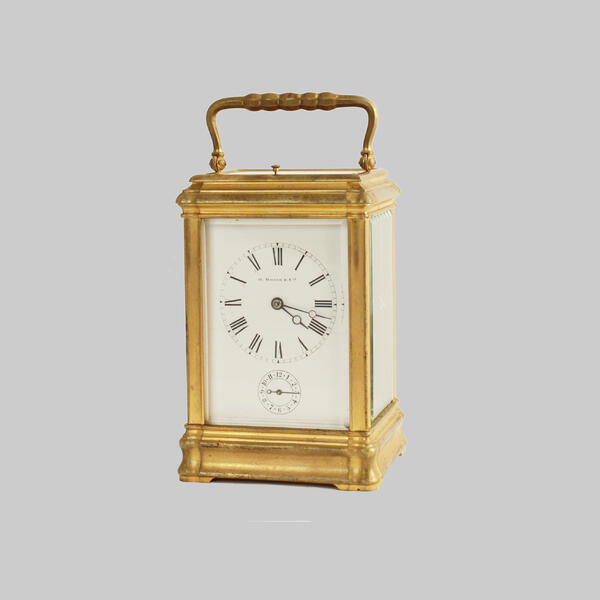
The item displayed is the Yakushkin family heirloom. The last owner was Vladimir Yakushkin, the great-great-grandson of the Decembrist Ivan Yakushkin. A carriage clock is a type of travel clock. It got its name because these clocks were frequently placed in carriages.
The first such travel clock was created by the French watchmaker Jean Libour in 1451. He placed the time keeping mechanism in a copper case and installed a striking device in it. The most important condition for obtaining information about travel time was the sound signal. In the dark, when you couldn’t light a candle or lamp, the chiming or beep of the clock announced how long it was necessary to go to the nearest settlement. Therefore, improving the clock for the traveler, the craftsmen, took care of developing the combat system and increasing its volume.
In France at the beginning of the 19th century, carriage clocks were called “officer clocks”. They received widespread recognition thanks to Napoleon, for whose campaigns the first copy was created. Emperor Napoleon Bonaparte attached great importance to the discipline of his highest command personnel. Among other things, officers needed reliable and accurate clocks that could be with them at all times, both at home and abroad. When watchmakers received an order for a carriage clock, it would invariably be accompanied by a note something like – “clock for an officer”.
Carriage clocks reached the masses in the early 20th century. Their frame was made of brass and glazed on all sides. In the upper part there was a movable curving handle to carry it by. The upper edge of the case was complemented by an oval glazed window through which you could see the mechanism at work. The dial was made of porcelain and Roman numerals were used on the face. On the side of the case opposite the dial, there was a glazed door that opened access to the mechanism. The mechanism was wound up with a special key and had a precision adjustment. In a carriage clock, the running gear was usually standard sized, and was placed in a metal case. The most common case was in the form of a cornice, in which a chronometer was placed, as well as a running gear with the striking device. Sometimes these clocks had calendars and bells.
The first such travel clock was created by the French watchmaker Jean Libour in 1451. He placed the time keeping mechanism in a copper case and installed a striking device in it. The most important condition for obtaining information about travel time was the sound signal. In the dark, when you couldn’t light a candle or lamp, the chiming or beep of the clock announced how long it was necessary to go to the nearest settlement. Therefore, improving the clock for the traveler, the craftsmen, took care of developing the combat system and increasing its volume.
In France at the beginning of the 19th century, carriage clocks were called “officer clocks”. They received widespread recognition thanks to Napoleon, for whose campaigns the first copy was created. Emperor Napoleon Bonaparte attached great importance to the discipline of his highest command personnel. Among other things, officers needed reliable and accurate clocks that could be with them at all times, both at home and abroad. When watchmakers received an order for a carriage clock, it would invariably be accompanied by a note something like – “clock for an officer”.
Carriage clocks reached the masses in the early 20th century. Their frame was made of brass and glazed on all sides. In the upper part there was a movable curving handle to carry it by. The upper edge of the case was complemented by an oval glazed window through which you could see the mechanism at work. The dial was made of porcelain and Roman numerals were used on the face. On the side of the case opposite the dial, there was a glazed door that opened access to the mechanism. The mechanism was wound up with a special key and had a precision adjustment. In a carriage clock, the running gear was usually standard sized, and was placed in a metal case. The most common case was in the form of a cornice, in which a chronometer was placed, as well as a running gear with the striking device. Sometimes these clocks had calendars and bells.
#12
Author: Henry Moser & Co
Date: Second half of the 19th century
Technique: Factory made
Place: Switzerland
Dimensions: 14,5×9,5×8,3 cm
Collection: Metal
Copyright: Tyumen Museum and Educational Association
Goskatalog Number: 10178281
Date: Second half of the 19th century
Technique: Factory made
Place: Switzerland
Dimensions: 14,5×9,5×8,3 cm
Collection: Metal
Copyright: Tyumen Museum and Educational Association
Goskatalog Number: 10178281
#14
Paper cutter knife
#15
#16
The knife is an age-old tool, but the paper cutter is a relatively new addition to society. The first mentions of them can be found dating back to the 16th century. But, apparently, at that time the most ordinary household or military blades and daggers were often used to open letters and envelopes. Later, at the beginning of the 19th century, there appeared paper cutting knives. Previously, a new book could not be opened without a book knife, since there was no hydraulic press capable of cutting through the thickness of book pages. Therefore, a large sheet folded several times, containing up to 20 pages of a future book, was simply stitched, joined to others, this was how a book was compiled, which immediately, without trimming, was bound. The pages of such a book could not be turned over without first cutting. For this, there were bone, wood and metal knives for paper of various types, thicknesses and with different designs. Such knives were also used when opening letters. Knives were made of precious metals, ivory and stones, cast by hand and decorated with carvings.
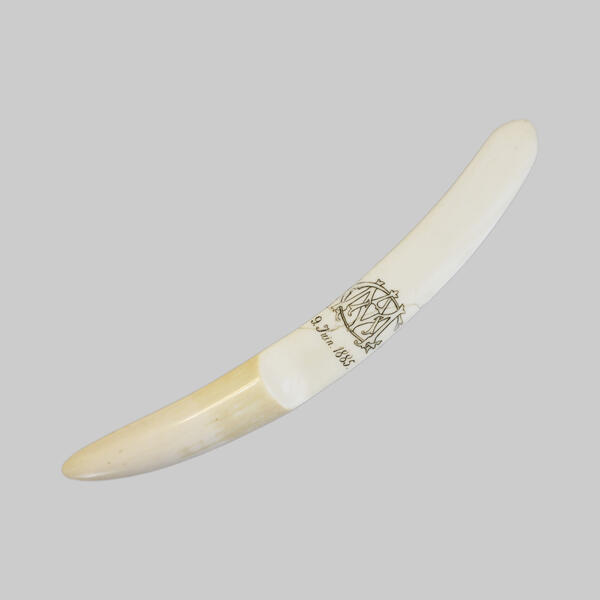
The paper knife, presented in the Decembrists in Yalutorovsk exhibit, during its history belonged to different representatives of the Muravyov-Apostol family. The first owner of this clerical knife was the Decembrist Sergei Ivanovich Muravyov-Apostol. He was the brother of Matvey Muravyov-Apostol, who owned the house where the museum is located today. The knife was passed on through generations. The last owner of this knife was the great-grand-nephew of Matvey Ivanovich Muravyov-Apostol, Andrei Vladimirovich Muravyov-Apostol-Korobyin. Muravyov-Apostol-Korobyin donated the knife to the museum in November 1992 during a trip to the city of Yalutorovsk. It so happened that during the meeting of the guest in the city of Tyumen, Muravyov-Apostol-Korobyin dropped the family heirloom, and the knife split into two halves. The knife was fastened, but the joint remained noticeable.
On the white surface of the knife you can see a black monogram, which consists of three letters, SMA, the initial letters of the owner’s name - Sergei Muravyov-Apostol. Below you can make out the date “9. Juin. 1885”.
The paper knife, presented in the Decembrists in Yalutorovsk exhibit, during its history belonged to different representatives of the Muravyov-Apostol family. The first owner of this clerical knife was the Decembrist Sergei Ivanovich Muravyov-Apostol. He was the brother of Matvey Muravyov-Apostol, who owned the house where the museum is located today. The knife was passed on through generations. The last owner of this knife was the great-grand-nephew of Matvey Ivanovich Muravyov-Apostol, Andrei Vladimirovich Muravyov-Apostol-Korobyin. Muravyov-Apostol-Korobyin donated the knife to the museum in November 1992 during a trip to the city of Yalutorovsk. It so happened that during the meeting of the guest in the city of Tyumen, Muravyov-Apostol-Korobyin dropped the family heirloom, and the knife split into two halves. The knife was fastened, but the joint remained noticeable.
On the white surface of the knife you can see a black monogram, which consists of three letters, SMA, the initial letters of the owner’s name - Sergei Muravyov-Apostol. Below you can make out the date “9. Juin. 1885”.
#17
Date: Early 19th century
Technique: carving, engraving
Place: Russia
Dimensions: 31,7×34 cm
Collection: Other materials
Copyright: Tyumen Museum and Educational Association
Goskatalog Number: 7252280
Technique: carving, engraving
Place: Russia
Dimensions: 31,7×34 cm
Collection: Other materials
Copyright: Tyumen Museum and Educational Association
Goskatalog Number: 7252280
read morehide
00:00
00:00
1x
Collapsible microscope,clock,Paper cutter knife
Collection
Exhibition
0
 Point your smartphone camera to open in the app
Open in app
Share