Flour is a food product made by grinding grains — primarily cereal crops. As early as the Neolithic era, roughly 9,000 years ago, humans began mastering the art of grain processing. Initially, grains were pounded in mortars with pestles; later, rotating stone or wooden disks — often reinforced with iron — were developed for more efficient grinding.
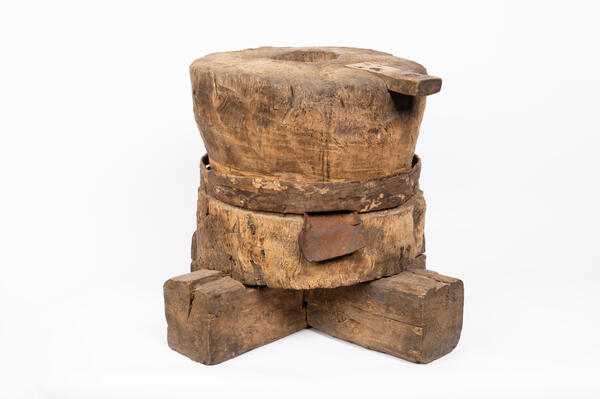
On the territory of present-day Russia, hand-operated mills were widespread and considered essential to peasant households. These compact devices, powered entirely by hand, typically featured millstones set into a sturdy wooden frame. Crafted from oak logs, the mills often had cast-iron inserts embedded in the grinding surfaces in fan-shaped rows to enhance durability and efficiency. Their diameter and height varied depending on the maker’s or customer’s preferences.
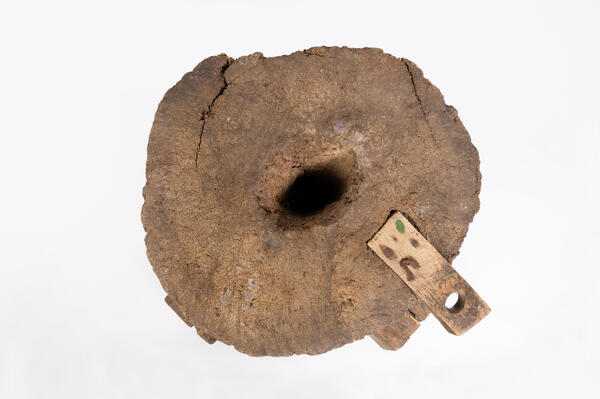
The design was simple yet ingenious. Each mill consisted of two circular millstones: the lower one was fixed in place, while the upper stone rotated via a handle. Both grinding surfaces were fitted with iron segments etched with grooves to create the necessary roughness for effective milling. Grain was poured into a central hole in the upper stone, fell between the two stones, and was crushed as the top stone turned. The resulting flour or coarse grits then flowed out through a channel on the lower stone into a container.
Rye, wheat, barley, peas, and other grains were commonly ground in these mills. The work was demanding, and this task was often assigned to children. Despite its physical toll, the mill was highly valued — so much so that it was frequently included in a bride’s dowry.
Russian folk culture is rich with proverbs tied to millstones, reflecting both practical wisdom and spiritual insight. Here are some examples: “A grain has fallen between two millstones” — meaning to be trapped in a hopeless, difficult situation; “The soul has fallen into the millstones of the Lord” — to undergo divine judgment or a profound trial; “The millstones themselves do not eat, but people are fed” — a reminder to respect labor and the tools that sustain life; “The millstone grinds, and so does the tongue” — equating gossip (“grinding” rumors) with the ceaseless motion of the mill.
Over time, many traditional household tools faded from daily use, and hand mills were no exception. Today, they survive primarily in museums. The Unecha Local Lore Museum preserves two such rare and evocative artifacts.