

The medal ‘For Diligence’ was established in 1801 by decree of Emperor Alexander I. It was awarded for different services rendered to the government. For example, lower military ranks received the medal for service in the army beyond the prescribed period, and the nobility — when they performed the duties of church elders. Actresses and ballet dancers were given bracelets with gold medals, which were decorated with diamonds.
The award was a medallion about 32 mm in diameter. The profile of Emperor Nicholas I was originally depicted on the obverse, and on the reverse there was the inscription ‘For Diligence’. The medal was worn on a red Ann’s ribbon.
The medal “For Diligence” was awarded on a massive scale several times in the Russian Empire. For the first time in 1833, it was awarded as the encouragement for long-serving soldiers, non-commissioned officers of the company of palace grenadiers and the Life Guards Garrison Battalion.
The next awarding of the medal was in 1837, after the fire in the Winter Palace. The soldiers of a company of palace grenadiers, Life Guards Battalion of sappers and Preobrazhensky Regiment, who were on duty in the palace, and saved from fire most of the furniture, paintings and objects of palace decoration, and also did not let the fire spread to the halls and rooms of the neighboring Hermitage, received the award.
In 1841, two varieties of the medal “For Diligence” were introduced. A breast medal on the Ann’s ribbon was intended for those soldiers who had served in the army for five years more than they were supposed to. A neck medal on the Alexander’s ribbon is for those who served another five years after the first award.
Soon after the Crimean War of 1853–1856, the appearance of the medal has changed again: on its front side there was a profile of the new Emperor — Alexander II, and the inscription “For Diligence” was placed in a wreath of oak and laurel twigs.
Under Alexander III, new varieties of the award “For Diligence” were introduced: for those who received all the breast medals — award on the Alexander’s ribbon, and for those who underwent 24 years of supernumerary service — award on the Andrey’s ribbon with a gold medallion.
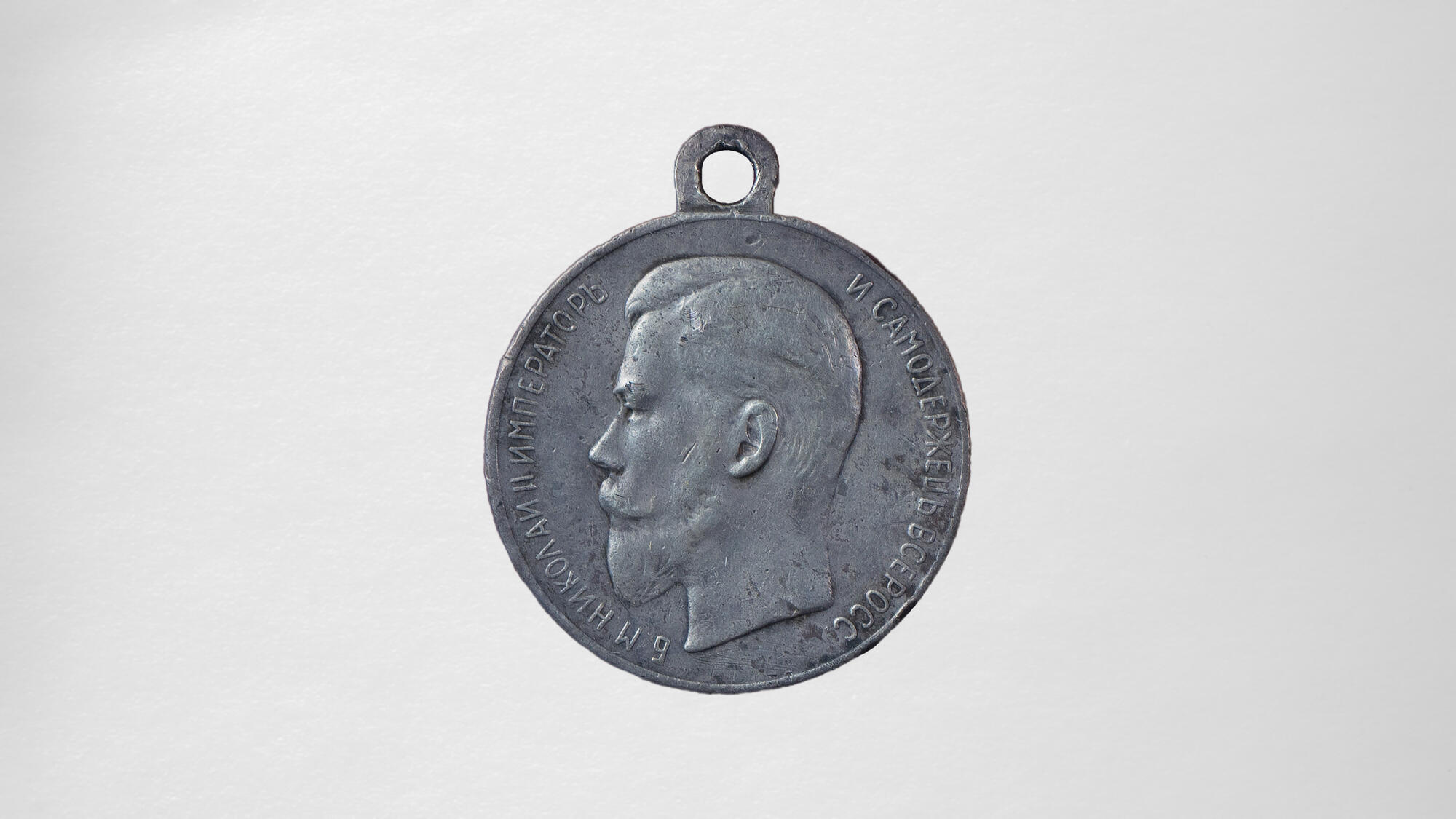
Under Nicholas II, the design of the award changed again: the profile of the emperor appeared on the medallion. During his reign, an average of 1900 gold and 3000 silver neck medals, 2700 gold and 15300 silver breast medals were issued annually.
Medal was donated to the museum’s collection by Vyacheslav Lavrov on June 3, 1992. It is not known to whom this award belonged.
The award was a medallion about 32 mm in diameter. The profile of Emperor Nicholas I was originally depicted on the obverse, and on the reverse there was the inscription ‘For Diligence’. The medal was worn on a red Ann’s ribbon.
The medal “For Diligence” was awarded on a massive scale several times in the Russian Empire. For the first time in 1833, it was awarded as the encouragement for long-serving soldiers, non-commissioned officers of the company of palace grenadiers and the Life Guards Garrison Battalion.
The next awarding of the medal was in 1837, after the fire in the Winter Palace. The soldiers of a company of palace grenadiers, Life Guards Battalion of sappers and Preobrazhensky Regiment, who were on duty in the palace, and saved from fire most of the furniture, paintings and objects of palace decoration, and also did not let the fire spread to the halls and rooms of the neighboring Hermitage, received the award.
In 1841, two varieties of the medal “For Diligence” were introduced. A breast medal on the Ann’s ribbon was intended for those soldiers who had served in the army for five years more than they were supposed to. A neck medal on the Alexander’s ribbon is for those who served another five years after the first award.
Soon after the Crimean War of 1853–1856, the appearance of the medal has changed again: on its front side there was a profile of the new Emperor — Alexander II, and the inscription “For Diligence” was placed in a wreath of oak and laurel twigs.
Under Alexander III, new varieties of the award “For Diligence” were introduced: for those who received all the breast medals — award on the Alexander’s ribbon, and for those who underwent 24 years of supernumerary service — award on the Andrey’s ribbon with a gold medallion.
Under Nicholas II, the design of the award changed again: the profile of the emperor appeared on the medallion. During his reign, an average of 1900 gold and 3000 silver neck medals, 2700 gold and 15300 silver breast medals were issued annually.
Medal was donated to the museum’s collection by Vyacheslav Lavrov on June 3, 1992. It is not known to whom this award belonged.