After the death of Peter the Great, the tradition of awarding medals to participants in wars and battles was completely forgotten in Russia.
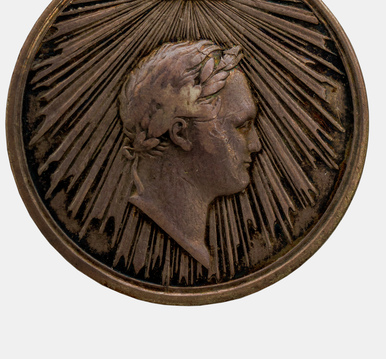
Only at the very end of the reign of Elizabeth Petrovna, during the Seven Years’ War (1756 –1763), a medal was minted for the victory over the Prussian troops at Kunersdorf, near Frankfurt an der Oder, in August 1759.
This was a battle in which the Prussian army, which was considered to be the gold standard military organization in all of Europe, suffered a disastrous defeat. King Frederick II himself narrowly escaped capture — the Prussian cavalry miraculously managed to save him.
After Kunersdorf, all European states admired the power of Russia and the chivalry of the Russians.
The decree of Elizabeth Petrovna dated August 11, 1760, reads ”…such a glorious and celebrated victory, which cannot compare to any other victory in the modern era… calls for the introduction of a medal fit to honor this event and for bestowing it upon the soldiers who took part in that battle.”
The matrices were based on the drawings of the junior librarian of the Academy of Sciences Ivan Ivanovich Taubert (Johann Caspar Taubert). Silver medals were awarded to soldiers, and gold medals to officers. The medal was worn on the St. Andrew’s ribbon.
The medal was “an eyesore for the Prussian kings.” However, at that time, the Holstein Prince Peter Fyodorovich (Peter III) was about to ascend the Russian throne. He spoke German, read only Prussian newspapers and adored the Prussian king. The prince wore a ring with a portrait of Frederick II and openly wished him success in the war with the Russians. Soon Peter III returned the conquered East Prussia to Frederick II, thus nullifying the results of the victorious war.
Such anti-Russian actions soon led to a coup d’état
and Catherine II seized power. In 1762, in order to appease the leaders of the
Cossack troops, she ordered to mint gold medals with a diameter of 65
millimeters and on the eve of her coronation on September 22, awarded these
“special signs to be worn around the neck on a blue ribbon” to nine colonels of
the Don Cossack Host — the participants in the famous Frankfurt battle.