


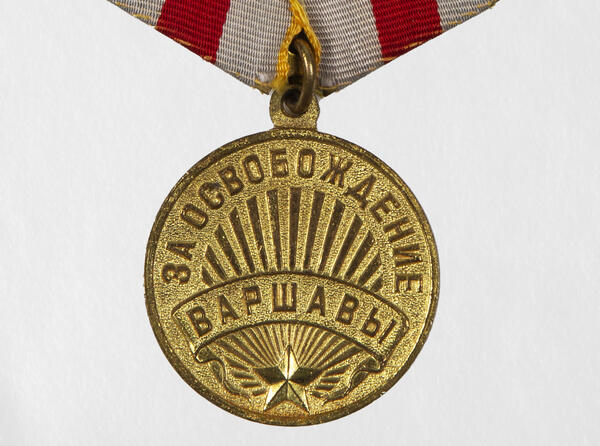
After the German troops left the territory of the USSR, the Soviet army began to liberate European countries one by one. There were long bloody battles for some cities, so the Soviet government instituted special awards. The medal “For the Liberation of Warsaw” is among them. Such a medal is housed in the collection of the Zimovniki Museum of Local History. It used to belong to Pantelei Vinnikov. He was born in the Remontnenskiy district of the Rostov region, but after the war, he lived in the village of Zimovniki.
Several artists participated in the competition creating the design of the honorary award. An artistic committee had to choose among more than ten different designs. Some artists suggested adding a symbol of fraternal relations between Red Army and Polish soldiers. As a result, the design of E. Kuritsyna was taken as the basis: on the front side of the medal, there was a pentagonal star with the sun’s rays coming in different directions. Above them there was the inscription “For liberation”, in the center was the name of the city — “Warsaw”. The reverse side of the medal had a star and the city’s liberation date — January 17, 1945.
After the war, about 701.7 thousand Soviet soldiers got the award. There were also medals for the liberation of Belgrade and Prague.
The liberation of Warsaw happened in several stages. By the end of June 1944, the Red Army came close to the city, but it was impossible to attack the city, because Soviet soldiers were moving through Europe faster than supplies were coming. There was not enough food, ammunition, and medicines at the front. In addition, the aircraft was unable to help, because the air army troops did not have time to relocate to new airfields in the liberated territories. Considering all these facts, the Soviet command gave the order to switch from offensive to defense.
The situation improved in the autumn of 1944. In August, there was an uprising in the Polish capital — its tried to overthrow the Hitler regime they hated. The confrontation lasted until October, and then the rebels needed the support of Soviet troops. Therefore, in January 1945, a large-scale operation to liberate Warsaw began. The battles took place in the area stretching for 100 kilometers. Two days later, the Red Army drew the Germans back over the Vistula and was able to approach the city from the northern side. By the evening of January 17, the Polish capital became free.
Several artists participated in the competition creating the design of the honorary award. An artistic committee had to choose among more than ten different designs. Some artists suggested adding a symbol of fraternal relations between Red Army and Polish soldiers. As a result, the design of E. Kuritsyna was taken as the basis: on the front side of the medal, there was a pentagonal star with the sun’s rays coming in different directions. Above them there was the inscription “For liberation”, in the center was the name of the city — “Warsaw”. The reverse side of the medal had a star and the city’s liberation date — January 17, 1945.
After the war, about 701.7 thousand Soviet soldiers got the award. There were also medals for the liberation of Belgrade and Prague.
The liberation of Warsaw happened in several stages. By the end of June 1944, the Red Army came close to the city, but it was impossible to attack the city, because Soviet soldiers were moving through Europe faster than supplies were coming. There was not enough food, ammunition, and medicines at the front. In addition, the aircraft was unable to help, because the air army troops did not have time to relocate to new airfields in the liberated territories. Considering all these facts, the Soviet command gave the order to switch from offensive to defense.
The situation improved in the autumn of 1944. In August, there was an uprising in the Polish capital — its tried to overthrow the Hitler regime they hated. The confrontation lasted until October, and then the rebels needed the support of Soviet troops. Therefore, in January 1945, a large-scale operation to liberate Warsaw began. The battles took place in the area stretching for 100 kilometers. Two days later, the Red Army drew the Germans back over the Vistula and was able to approach the city from the northern side. By the evening of January 17, the Polish capital became free.


