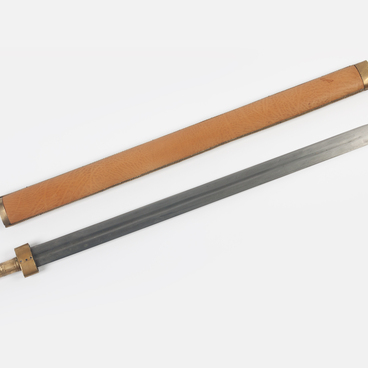
Like many other items in the collection, the sword and sword belt set with carnelian inserts were transferred to the Kursk State Regional Museum of Archaeology by law enforcement agencies. They prevented the illegal export of unique items from an ancient burial site destroyed by treasure hunters. Several items from this set were inlaid with carnelians. These likely belonged to another blade that was part of the find but was probably broken and discarded by the looter.
The hollow mushroom-shaped pommel of the hilt made of gold, decorated with convex red stones, resembles a series of eastern swords, possibly of Iranian or Sassanid origin, which are found in Hunnic-period monuments east of the Dnieper. A similar conical lower part of the pommel can be seen in the materials from a cache in a crypt in Kerch, where three similar items with flat tops were found, including those decorated with inlaid red glass in separate settings.
A similar pommel might have crowned the hilt of a short sword, akin to a unique example from the Museum of Historical Treasures in Kyiv, which features garnet cabochon inserts. The scabbard was crafted in a very similar style. Its throat plate and, possibly, other design elements — two plates with carnelian inlays, embellished with embossing, — have been preserved. Simple gilded U-shaped clamps likely belonged to the scabbard of this blade. It is also probable that the small gilded buckle and pendant with shields, inlaid with carnelian cabochons, belonged to this sword belt set.
Small buckles are often found at the feet of the
skeleton and are considered to be shoe buckles, but the Volnikovka hoard
contains no other elements of clothing besides ceremonial belts. Additionally,
judging by stylistic features, three triplets and one fragment of triplet
plates with carnelian inlays can be attributed to this set. Most of the items
belong to the so-called polychrome style, characterized by the combination of
gold and predominantly blood-red inserts of precious stones and glass.