In pre-revolutionary Russia, music-making was a common entertainment for the affluent social groups. This was particularly true about Tsaritsyn, which grew from a small town to a major industrial center within a few decades.
The capital inflow led to a cultural boom in the city. One of its highlights were various concerts given by famous singers or organized by the townspeople.
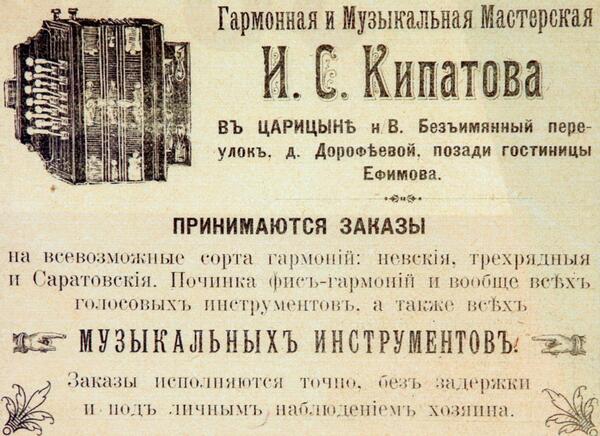
The extraordinary demand, however, meant that it was necessary to have somewhere to buy musical instruments and have them serviced. “I. S. Kipatov’s Garmon and Music Workshop” offered its services to clients in “ordering musical instruments, tuning and repairing them”. Thus, it kept musical life going in pre-revolutionary Tsaritsyn.
Reference books were regularly published in the Russian Empire in the late 19th and early 20th centuries. In 1902, the “All Tsaritsyn” Address Calendar came out. In the commercial and industrial section, on page 240, there was information about I. S. Kipatov’s workshop. However, according to the book, it was located in Neskuchny lane, not in Bezimanny lane, as advertized. There was no information about Yefimov’s hotel.
The physharmonica, which the advertisement offered to repair in case of a failure, was a keyboard and pneumatic musical instrument of the harmonica family. It had a piano keyboard and was offered in a floor-standing or table-top version.
In those years, craftsmen had to deal, for example, with symphonions — musical boxes in which a metal disc with prongs was installed instead of a shaft. Unlike a box with a permanent shaft, the discs could be changed: so, the device could play different pieces of music.
Bandeons — reed and keyboard musical instruments — were probably also brought to the workshop. They resembled a button accordion, or bayan, a garmon and an accordion as well. The bandeon was played alternately with the right and left hands.