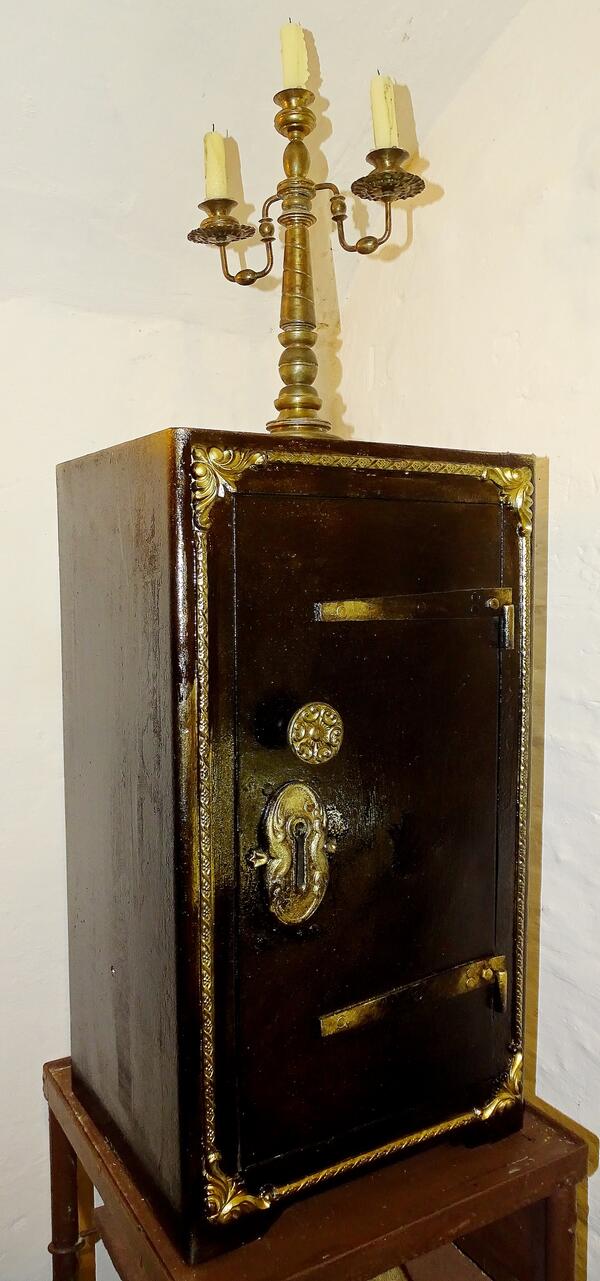
Up until the first half of the 19th century, safes were small chests with padlocks. The modern, burglary-proof safes originated in Great Britain. There, simple cabinets and chests were replaced by steel cabinets with strong locks.
As early as 1827, Thomas Milner started producing fireproof safes. These safes were coated with sheet iron, and the space between the walls and the contents was filled with a non-flammable substance.
The layer usually consisted of sawdust. Alum, a double salt, was added to it. In case of fire, it would melt and smother the sawdust, which prevented the heat from reaching the inside of the safe. Milner’s invention is considered to be the first fireproof safe in history.
Originally safes were locked with a key, but later there were mechanical code locks with dials made of several rotating discs. One such safe with a code lock was the “Eureka”, which was patented in 1862.
The US Treasury also had a safe like this. The number of letters and numbers on the lock made it possible to set more than one billion combinations, all of which would take a burglar about 2042 years to figure out.
At the end of the 19th century, two companies, Carron in Scotland and Coalbrookdale in England, almost simultaneously started to produce cast-iron chests with single and double doors. Safes were 1.27 centimeter thick containers cast from metal and hermetically sealed. Such products had a long period of use.
In the 19th century, “padlock” safes appeared in Russia. The key to this type of safe had a large circular ring. When closed, the key was replaced by a plug so that it looked like there was no keyhole. The competition between bankers and safecrackers began.
Dial safes could be cracked with a medical stethoscope, which picked up a slight click when the correct digit was dialed. This shortcoming was overcome after the Second World War, when dials and locks began to make a series of extra clicks, which prevented the combination from being picked correctly.
As early as 1827, Thomas Milner started producing fireproof safes. These safes were coated with sheet iron, and the space between the walls and the contents was filled with a non-flammable substance.
The layer usually consisted of sawdust. Alum, a double salt, was added to it. In case of fire, it would melt and smother the sawdust, which prevented the heat from reaching the inside of the safe. Milner’s invention is considered to be the first fireproof safe in history.
Originally safes were locked with a key, but later there were mechanical code locks with dials made of several rotating discs. One such safe with a code lock was the “Eureka”, which was patented in 1862.
The US Treasury also had a safe like this. The number of letters and numbers on the lock made it possible to set more than one billion combinations, all of which would take a burglar about 2042 years to figure out.
At the end of the 19th century, two companies, Carron in Scotland and Coalbrookdale in England, almost simultaneously started to produce cast-iron chests with single and double doors. Safes were 1.27 centimeter thick containers cast from metal and hermetically sealed. Such products had a long period of use.
In the 19th century, “padlock” safes appeared in Russia. The key to this type of safe had a large circular ring. When closed, the key was replaced by a plug so that it looked like there was no keyhole. The competition between bankers and safecrackers began.
Dial safes could be cracked with a medical stethoscope, which picked up a slight click when the correct digit was dialed. This shortcoming was overcome after the Second World War, when dials and locks began to make a series of extra clicks, which prevented the combination from being picked correctly.