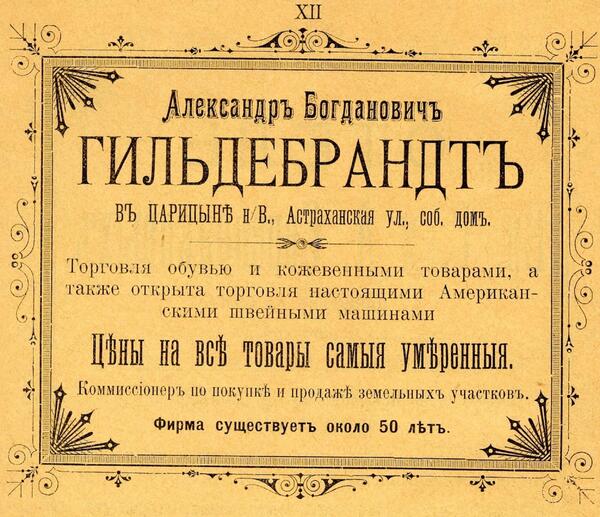
At the turn of the 20th century, advertisement posters were everywhere in all major cities of the Russian Empire. Their texts and illustrations for them were often created by famous poets and artists of the time. For example, the Saint Petersburg orthopedic factory of Markus Sachs started producing bodices in the early 20th century. To create advertisements the company invited Sergey Lodygin, who was known as the Russian Beardsley and whose style suited these products so well.
The Russian painter Valentin Serov in 1909 designed the advertising poster for Sergey Diaghilev’s “Russian Seasons” in France. This poster depicted the ballerina Anna Pavlova, who performed the role of Giselle in Adolphe Adam’s famous ballet.
Print advertising in the Russian Empire era offered readers various kinds of luxury items such as European tobacco and coffee — all things that were expensive and not affordable for the average citizen. Its main aim was to appeal to the affluent, yet small, segments of the population.
For ordinary people, advertising was very different, taking into account the low levels of education and income. In this case, print advertising was primarily focused on the use of visual images that surrounded ordinary consumers. Sign makers relied on traditional compositions and used bright and intense colors.
Signs were commonly painted for bakeries and confectioneries in gold against a dark background. A pretzel with two lions or a pyramid of bread in the shape of a yellow triangle on a black background were the most popular types of bakery advertising.
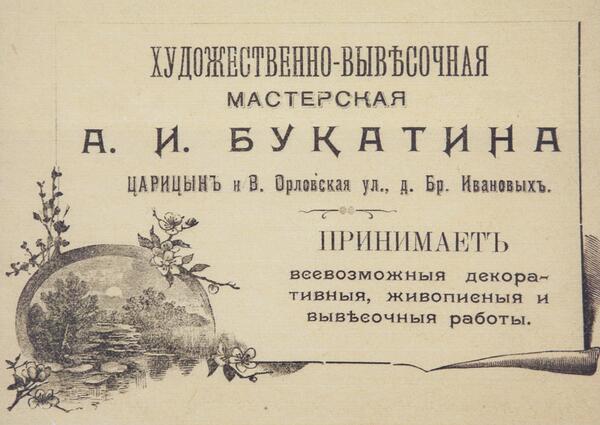
In Tsaritsyn, advertisements were produced by Alexander Bukatin’s workshop, which provided decorative, signboarding and painting services. His workshop produced signs mostly for retail shops, which were usually figurative: the composition on the signboard consisted of the goods sold in the shop.
Bukatin owned not only a workshop; he was a merchant of the second guild. His businesses also included two sawmills in Tsaritsyn and Beketovka, and also a tannery in Kuporosnaya Balka. On top of that, he owned a large orchard.
The Russian painter Valentin Serov in 1909 designed the advertising poster for Sergey Diaghilev’s “Russian Seasons” in France. This poster depicted the ballerina Anna Pavlova, who performed the role of Giselle in Adolphe Adam’s famous ballet.
Print advertising in the Russian Empire era offered readers various kinds of luxury items such as European tobacco and coffee — all things that were expensive and not affordable for the average citizen. Its main aim was to appeal to the affluent, yet small, segments of the population.
For ordinary people, advertising was very different, taking into account the low levels of education and income. In this case, print advertising was primarily focused on the use of visual images that surrounded ordinary consumers. Sign makers relied on traditional compositions and used bright and intense colors.
Signs were commonly painted for bakeries and confectioneries in gold against a dark background. A pretzel with two lions or a pyramid of bread in the shape of a yellow triangle on a black background were the most popular types of bakery advertising.
In Tsaritsyn, advertisements were produced by Alexander Bukatin’s workshop, which provided decorative, signboarding and painting services. His workshop produced signs mostly for retail shops, which were usually figurative: the composition on the signboard consisted of the goods sold in the shop.
Bukatin owned not only a workshop; he was a merchant of the second guild. His businesses also included two sawmills in Tsaritsyn and Beketovka, and also a tannery in Kuporosnaya Balka. On top of that, he owned a large orchard.