

#1
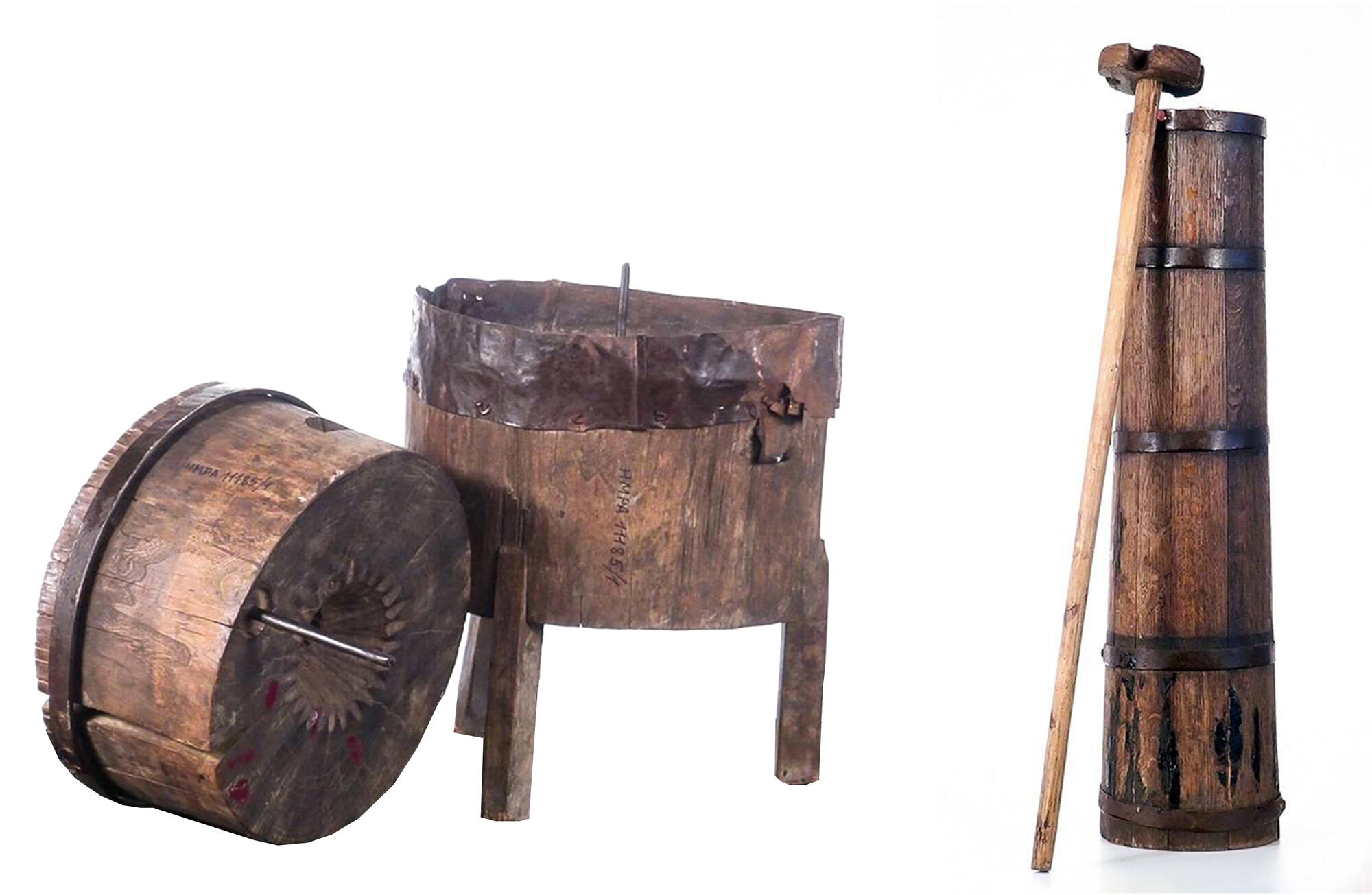
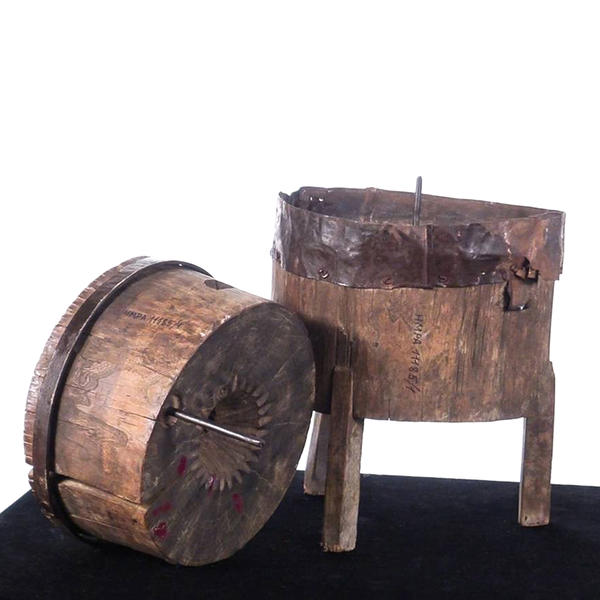
Butter-churn, Hand mill
#19
#20

#2
Home-made butter- tkhu — has always been an essential ingredient in the Adyghe diet. It was made of fresh milk in special vessels, butter-churns. The butter preparation process, Adyghe style, started in the evening. Milk was boiled and left to stand overnight. The next morning, the settled cream was put into the churn and beaten with a dasher while morning milk, still hot, was being gradually mixed in.
#3
The Circassians added butter to numerous dishes of the national cuisine. It was served for cakes and polenta (mamalyga), put into tea, mixed with honey and nuts. The so-called spring butter churned from cow milk in May was considered the best and most delicious.
#4
But their favourite was drawn butter. To make it, they melted butter hot until it became brownish. Such kind of butter became grained structure, more savoury and stored longer.
Drawn butter was widely used for roasting, stewing and even boiling when cooking lots of main dishes. Onions and paprika for soup were pan-fried in drawn butter; it was added to different cooked cereals and pastries.
#5
Fresh butter was beaten in the churn. Its cylindrical body consisted of eight wooden planks fastened with metal hoops. The bottom was round and was attached to the body with the help of grooves. In order to make the churn strong and leak-proof, at a certain stage in the process of making, it was placed in water. The wood swelled thus making the planks fit tighter together and the gaps between them shrank.
#6
The vessel had a lid on top with a hole through which a dasher, a staff with a cross-point screw at the end, was inserted.
#7
Butter-churns, along with other household items and kitchenware, were made of wood. Circassia was rich in forests, therefore woodwork became one of the first crafts mastered by the Adyghes. Typically, to create different articles, Adyghe craftsmen worked with mahogany, oakwood, hazelwood, pearwood, harewood, and boxwood. In the traditional Adyghe house, plates and spoons, dishes and trays, rolling pins and soup ladles, along with all kinds of scoops, washtubs and mortars were wooden. Carved wooden folders were used to keep drawings in; home-made cheese was prepared in wicker baskets; special wooden planks with notches were used by seamstresses to wind on galloons, fragments of gold or silver lace.
#9
Hand mill
#8
#10
People learned to grind grain into flour back in ancient times. Scholars believe that humankind began to make flour with most primitive implements as early as during the Neolithic age, ca. 9 thousand years ago.
#11
To process grain, Adyghe used several implements. First, in order for grain to be shucked, it was loaded into wooden mortars and only then sent to big mills or hand mills.
#12
English explorer Edmund Spencer, who visited the Adyghes in the middle of the 19th century, wrote:
‘Their mills for grinding corn, usually termed horse-mills, are equally primitive, being situated under the earth, with a wheel at the top, which is turned by a horse: the man who brings corn to grind must also bring a horse to turn the wheel; and, as there is no money in circulation, they pay the owner for the use of his mill in grain. The lighter seeds, such as millet (the favourite food of a Circassian), is generally ground by the women, at home, with the common hand-mill’.
#13
The body of hand mills was made from wood, while the grinder could be of two types — wooden for coarse-ground flour and stone for finer flour.
#14
The traditional diameter of the grinder was approximately 70 centimetres, so the mills were not too cumbersome and were convenient to use at home. At the same time, their design was such that it allowed grinding any types of cereals and grains without applying too much effort.
#15
The main grain cultures of the Adyghe people were millet and barley. They were usually harvested in September with scythes and sickles. Barley usually served as cattle fodder, for horses in particular. Millet was the staple food of Circassians themselves.
#16
Rather than bread, the Adyghe diet gave preference to thick millet gruel, kasha, or pshastey [пIастэ] in the Adyghe language. It was served as a side dish to practically all main dishes — meat, dairy and vegetables. It was cooked in a very simple way: well washed cereal was put in pure water without salt and boiled on a medium heat until it became soft. Then, on a low heat and stirring, it was brought to the right dense consistency.
#17
Millet was also used to bake mejaj, similar to bread, and to make kh’elau, a sweet dense confection which tasted much like halvah. Wheat flour was rarely used for cooking, mainly for baking traditional cheese pies, guubat.
#18
In the 16th century, maize appeared in the Adyghe diet. It was called natryf in the local language which can be translated as “food of the Narts” (heroes of the local epos). By the beginning of the 20th century, maize had become the “queen” of meals practically ousting millet.
read morehide
00:00
00:00
1x
Butter-churn, Hand mill
Technique
Wood, metal. Carving, forging
Exhibition
3
 Point your smartphone camera to open in the app
Open in app
Share