#1
Ceramic butter dish, Glass spice set on metal stand, Wooden cabinet for books
#8
#2
#3
In past centuries, villages used to store traditional and clarified butter in ceramic pots of various shapes and sizes. These pots were placed in a cellar or other cool place, and anything that was fetched from them was immediately eaten. Therefore, the butter dish was not so much a serving item as a vessel for storing a product.
Now all our homes are equipped with refrigerators, and the need for ceramic pots has long disappeared. But butter dishes can still be found in many kitchens - they are easy to use and brighten up the act of serving. Cookware manufacturers offer a wide variety of butter dishes made from ceramic, metal, glass, plastic and even wood - both minimalist and richly decorated. An important addition to the butter dish is the lid. Thanks to it, the butter does not absorb foreign odors and does not become dried out. The most convenient are flat butter dish plates of round or rectangular shape with a covering lid.
The ‘father’ of Russian porcelain was Dmitry Vinográdov, a classmate and friend of Mikhail Lomonosov. He was able to obtain the first porcelain of satisfactory quality at the end of 1746. At first, his manufactory produced small items - mainly snuff boxes for Empress Ekaterina Petróvna. Later, he pivoted to the production of larger items.
After the revolution, porcelain production managed to be resurrected. The so-called propaganda porcelain of the USSR of the 1930s is highly valued among collectors, since it has significant cultural and aesthetic value and is a reflection of the time in which it was created.
By the 1940s, a new direction of art was born — the Stalinist ‘Empire style’. Its characteristic features — a mixture of various design techniques, luxury, and pomp — were also adopted by porcelain products.
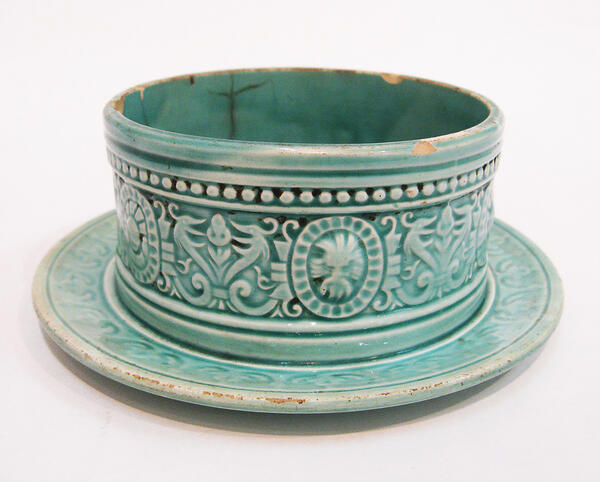
This green ceramic butter dish, presented in the exhibition ‘Kótlas from Ancient Times to 1946’, was made at a factory in the 1940s. The item, for storing and serving butter, has a cylindrical recess in the center and is decorated with floral designs along the body and edge of the stand.
Now all our homes are equipped with refrigerators, and the need for ceramic pots has long disappeared. But butter dishes can still be found in many kitchens - they are easy to use and brighten up the act of serving. Cookware manufacturers offer a wide variety of butter dishes made from ceramic, metal, glass, plastic and even wood - both minimalist and richly decorated. An important addition to the butter dish is the lid. Thanks to it, the butter does not absorb foreign odors and does not become dried out. The most convenient are flat butter dish plates of round or rectangular shape with a covering lid.
The ‘father’ of Russian porcelain was Dmitry Vinográdov, a classmate and friend of Mikhail Lomonosov. He was able to obtain the first porcelain of satisfactory quality at the end of 1746. At first, his manufactory produced small items - mainly snuff boxes for Empress Ekaterina Petróvna. Later, he pivoted to the production of larger items.
After the revolution, porcelain production managed to be resurrected. The so-called propaganda porcelain of the USSR of the 1930s is highly valued among collectors, since it has significant cultural and aesthetic value and is a reflection of the time in which it was created.
By the 1940s, a new direction of art was born — the Stalinist ‘Empire style’. Its characteristic features — a mixture of various design techniques, luxury, and pomp — were also adopted by porcelain products.
This green ceramic butter dish, presented in the exhibition ‘Kótlas from Ancient Times to 1946’, was made at a factory in the 1940s. The item, for storing and serving butter, has a cylindrical recess in the center and is decorated with floral designs along the body and edge of the stand.
#12
Full name Ceramic butter dish
Author unknown
Date 1940s
Technique factory made
Place Russia
Dimensions 5,5×15 cm
Copyright MUK ‘Kótlas Museum of Local Lore’
Collection Kótlas Museum of Local Lore
Author unknown
Date 1940s
Technique factory made
Place Russia
Dimensions 5,5×15 cm
Copyright MUK ‘Kótlas Museum of Local Lore’
Collection Kótlas Museum of Local Lore
#10
Glass spice set on metal stand
#4
#5
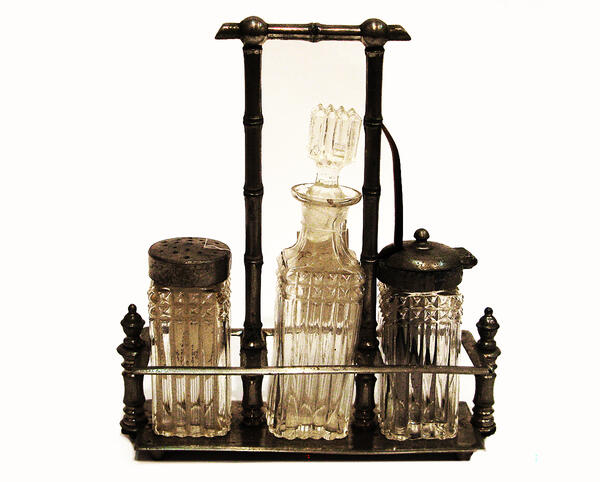
Made in the 1930s, this display consists of a stand, three glass spice jars and a spoon. The set belonged to the Kovrigín family - Zosíma Alekséevich and Anna Grigórievna. Zosíma Kovrigín were born in the village of Grikhnevó, Solvychevódsky district (now - Kotlássky district), and worked on the railway.
The salt shaker is a rectangular glass container with embossed sides and has a threaded metal lid with perforation. The upper part is cut in the form of squares.
The rectangular bottle for vinegar or vegetable oil is made of colorless transparent glass, the elongated neck is equipped with a square-shaped ground stopper. In the upper part of the bottle there is a square cut.
The shaker for pepper or mustard also has a rectangular shape with embossed sides and a threaded metal lid with a side hole for a spoon. In the upper part there is a similar cutting in the form of squares.
The mustard spoon is made of bone in the shape of a shoulder blade, with an oval-shaped scoop and a flat long curved handle.
Spice holders are a unique creation. They are small vessels for storing and serving salt, pepper, mustard and other spices. The most common are salt shakers — they are created from a variety of materials.
Until the middle of the 19th century, the word ‘salt shaker’ was usually used to refer to boxes for storing salt and spices, and there were no special holes in the lids. The prototype of the modern salt shaker with holes was a container developed by the American tinsmith John Landis Mason in 1858. The modern-looking salt shakers that prevent their contents from caking began to be produced in the 1920s by the American company Morton Salt. Such salt shakers became especially popular in the 1930s, when global ceramic manufacturers focused on producing inexpensive goods.
Now you can buy both ordinary salt shakers and salt shakers which are works of art — made from expensive materials, richly decorated or painted, or in an atypical shape: for example, in the form of an animal or a funny creature.
The salt shaker is a rectangular glass container with embossed sides and has a threaded metal lid with perforation. The upper part is cut in the form of squares.
The rectangular bottle for vinegar or vegetable oil is made of colorless transparent glass, the elongated neck is equipped with a square-shaped ground stopper. In the upper part of the bottle there is a square cut.
The shaker for pepper or mustard also has a rectangular shape with embossed sides and a threaded metal lid with a side hole for a spoon. In the upper part there is a similar cutting in the form of squares.
The mustard spoon is made of bone in the shape of a shoulder blade, with an oval-shaped scoop and a flat long curved handle.
Spice holders are a unique creation. They are small vessels for storing and serving salt, pepper, mustard and other spices. The most common are salt shakers — they are created from a variety of materials.
Until the middle of the 19th century, the word ‘salt shaker’ was usually used to refer to boxes for storing salt and spices, and there were no special holes in the lids. The prototype of the modern salt shaker with holes was a container developed by the American tinsmith John Landis Mason in 1858. The modern-looking salt shakers that prevent their contents from caking began to be produced in the 1920s by the American company Morton Salt. Such salt shakers became especially popular in the 1930s, when global ceramic manufacturers focused on producing inexpensive goods.
Now you can buy both ordinary salt shakers and salt shakers which are works of art — made from expensive materials, richly decorated or painted, or in an atypical shape: for example, in the form of an animal or a funny creature.
#13
Full name Glass spice set on metal stand
Author unknown
Date 1930s
Technique factory made
Place derevnya Grihnevo, Kotlasskij rajon, Arhangel’skaya oblast', Russia
Dimensions stand - 17,5×16 cm, pepper shaker - 7,5×3,2 cm, vinegar bowl - 13,7×3,5 cm, salt shaker - 9×3 cm, spoon - 11×1,5 cm
Copyright MUK “Kótlas Museum of Local Lore”
Collection Kótlas Museum of Local Lore
Author unknown
Date 1930s
Technique factory made
Place derevnya Grihnevo, Kotlasskij rajon, Arhangel’skaya oblast', Russia
Dimensions stand - 17,5×16 cm, pepper shaker - 7,5×3,2 cm, vinegar bowl - 13,7×3,5 cm, salt shaker - 9×3 cm, spoon - 11×1,5 cm
Copyright MUK “Kótlas Museum of Local Lore”
Collection Kótlas Museum of Local Lore
#11
Wooden cabinet for books
#6
#7
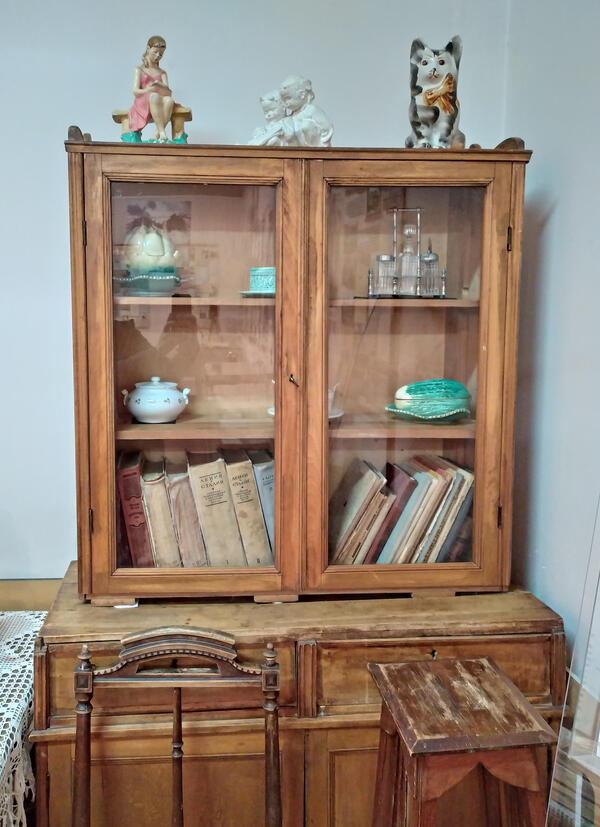
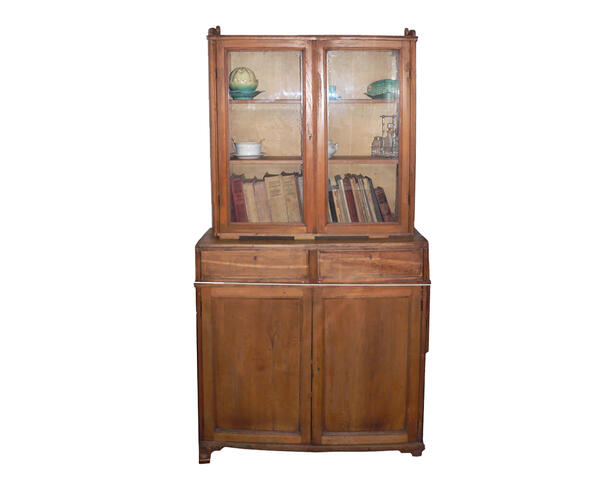
The collection of the Museum contains this bookcase from the 1930s-1940s, consisting of two components: an upper and a lower cabinet. The upper cabinet is wooden, shallow, and double-leafed. It has two glazed doors that are locked with a metal key, and the glass is decorated with wooden slats. Inside the cabinet there are two thin shelves and a small metal hook with a loop so that the door can be locked more tightly from the inside. The lower cabinet has two drawers at the top and two wooden doors at the bottom. The doors and drawers are adorned with decorative wooden slats, and they also have keyholes. There is only one shelf inside the lower cabinet.
Something as familiar as a bookcase has a long history. Although its design is now more proper, its surfacing is smooth, and its doors are glazed and lockable, this was not always the case. Archaeological excavations in different parts of the world have given us the opportunity to see what an ancient bookcase was like: a rough box hewn out of a log. Later, this box received a lid — what would become a future door.
In the traditional Russian hut, items were stacked rather than placed in cabinets, using boxes, chests, and other storage. Later, chests were arranged vertically, with the lid serving as a door. Inside, one on top of the other, small chests without lids were placed — turning into a cabinet with shelves. True, there might not have been any books in it at all. A rare example of a medieval cabinet, which has survived since the 13th century, is rough and resembles a watchman’s booth. This was still more convenient than chests upon chests. The cabinet is currently housed in the Museum of Decorative Arts in Paris. In the 16th century, separate cabinets began to appear for storing items, whereas objects where there was no concern of breakage were put into chests. The cabinet acquired its classic shape in the modern era, when bookcases with glass doors began to be produced in England.
Until the early 1960s, what is now called “mass-produced furniture” did not exist in the USSR, where standard cabinets, tables, shelves, and so on were cut from chipboard. In those years, small industries and crews of craftsmen were engaged in the creation of household furniture. Furniture was most often made from inexpensive solid wood, for example, glued board made of pine, or else from ordinary, veneered, or boarded plywood. This cabinet in the Kótlas Museum of Local Lore’s exhibition was created in a similar way.
Something as familiar as a bookcase has a long history. Although its design is now more proper, its surfacing is smooth, and its doors are glazed and lockable, this was not always the case. Archaeological excavations in different parts of the world have given us the opportunity to see what an ancient bookcase was like: a rough box hewn out of a log. Later, this box received a lid — what would become a future door.
In the traditional Russian hut, items were stacked rather than placed in cabinets, using boxes, chests, and other storage. Later, chests were arranged vertically, with the lid serving as a door. Inside, one on top of the other, small chests without lids were placed — turning into a cabinet with shelves. True, there might not have been any books in it at all. A rare example of a medieval cabinet, which has survived since the 13th century, is rough and resembles a watchman’s booth. This was still more convenient than chests upon chests. The cabinet is currently housed in the Museum of Decorative Arts in Paris. In the 16th century, separate cabinets began to appear for storing items, whereas objects where there was no concern of breakage were put into chests. The cabinet acquired its classic shape in the modern era, when bookcases with glass doors began to be produced in England.
Until the early 1960s, what is now called “mass-produced furniture” did not exist in the USSR, where standard cabinets, tables, shelves, and so on were cut from chipboard. In those years, small industries and crews of craftsmen were engaged in the creation of household furniture. Furniture was most often made from inexpensive solid wood, for example, glued board made of pine, or else from ordinary, veneered, or boarded plywood. This cabinet in the Kótlas Museum of Local Lore’s exhibition was created in a similar way.
#14
Full name Wooden cabinet for books
Author unknown
Date 1930-1940s
Technique handmade
Place Russia
Dimensions 177×91 cm
Collection Kótlas Museum of Local Lore
Copyright MUK ‘Kótlas Museum of Local Lore’
Author unknown
Date 1930-1940s
Technique handmade
Place Russia
Dimensions 177×91 cm
Collection Kótlas Museum of Local Lore
Copyright MUK ‘Kótlas Museum of Local Lore’
read morehide
00:00
00:00
1x
Butter dish, Spice Set, Bookcase
Collection
Exhibition
0
 Point your smartphone camera to open in the app
Open in app
Share