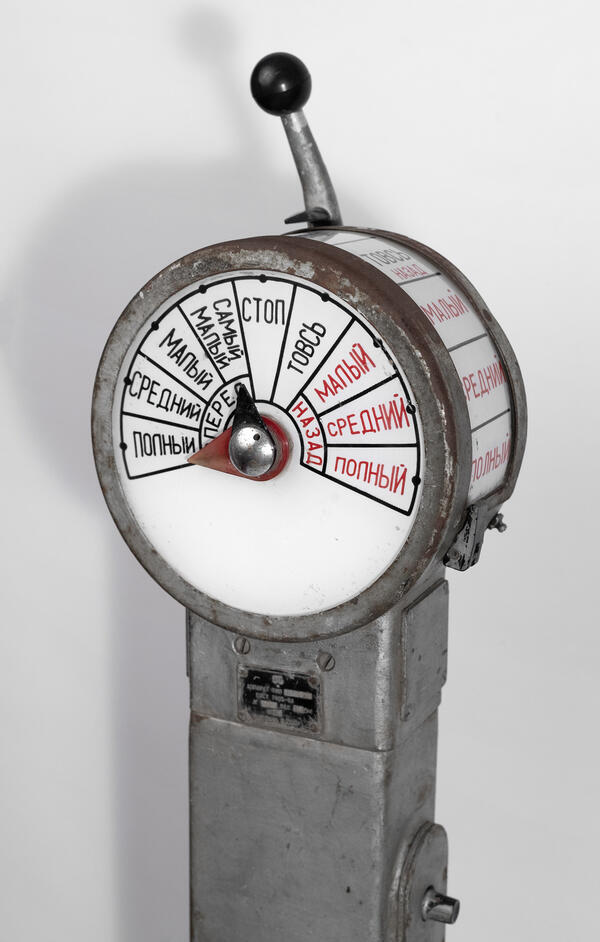
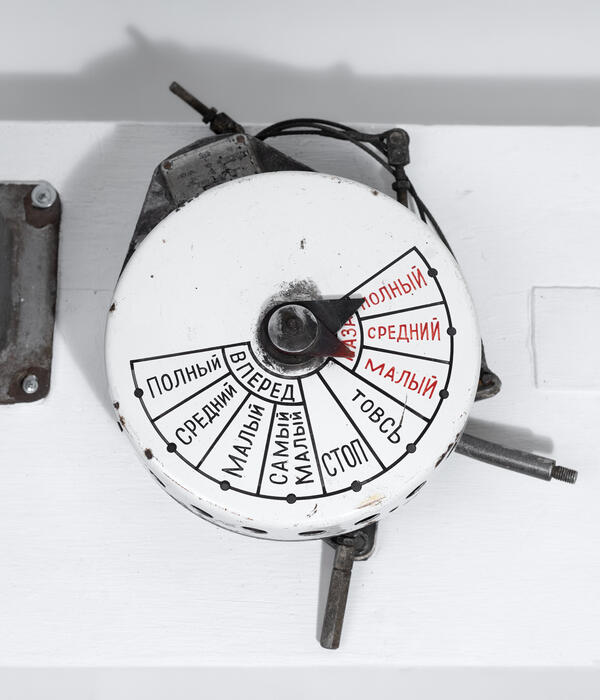
The Soviet engine order telegraph from the museum collection was made in 1976. It was transferred to the museum from the Onega seaport warehouse where it was stored after the ship was decommissioned. This telegraph is an electromechanical device that was used by the bridge crew to send orders regarding the engine speed, specifically the speed of propeller shaft rotation, to the engineers in the engine room.
The transmitting and receiving devices had dials and pointers. The telegraph consisted of several main components: a transmitter-receiver unit in the wheelhouse and on the bridge wings, a receiver-transmitter unit in the engine control room, and alarm equipment.
The circular dials are segmented to indicate various settings for forward and astern movements of the vessel, including full, half, and slow ahead or astern. There is also a “stop” sector at the top of each dial. These devices were installed on ships in the 20th century.
When the navigator or captain moved the handle on the transmitting unit, for example, to the “slow ahead” position on the bridge, the pointer automatically moved to the same position on the receiving unit in the engine room, accompanied by an audible signal. This command was visible to the mechanic or motorman.
After receiving the command, the mechanic would move the handle of the receiving unit to the “slow ahead” position, and the audible signal would stop. In this way, they notified the bridge crew that the signal had been received and confirmed in the engine room. After that, they would adjust the speed and direction accordingly.
On ships equipped with both starboard and portside engines, each engine has its own dedicated transmitting and receiving units. On automated vessels, the engine order telegraph functioned as a mode selector, sending a command signal directly to the engine control system. Contemporary ships feature automated remote control systems for engine management.