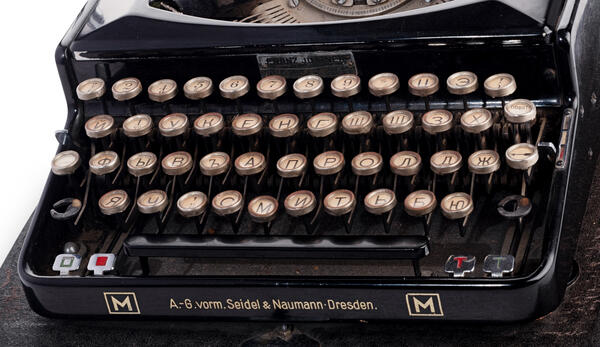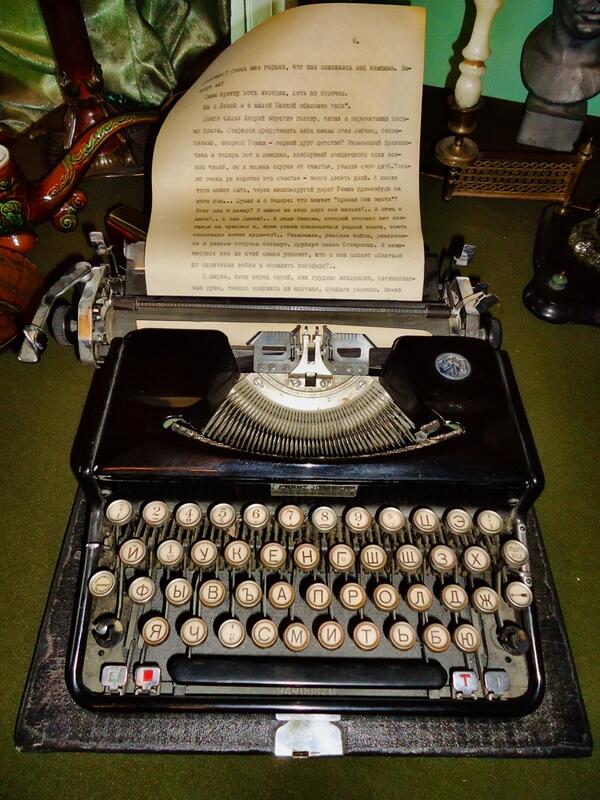
The exhibition features a typewriter displayed in a case. This trophy typewriter stands on the desk in the writer’s office and was brought back by Vitaly Zakrutkin from Germany at the end of May 1945. As a war correspondent, he traveled many front-line roads during the Great Patriotic War and even participated in battles himself.
Along with thousands of other soldiers and officers, he stormed Berlin at the end of the war, participating in fierce street battles for every building. Marshal Georgy Zhukov awarded military journalist Major Zakrutkin the Order of the Red Banner on the Alexanderplatz square, right in the heart of Berlin. Inspired by this honor, Vitaly Zakrutkin meticulously recorded the events in his notebook. He then decided to write and publish a comprehensive book about the endless roads of war and the people he encountered along the way.
Walking along the deserted streets of Berlin, Vitaly Zakrutkin spotted an object covered in dust, pebbles, and brick fragments. As he brushed off the debris, he uncovered the lid of a case, revealing a typewriter underneath. Zakrutkin thought that this was a sign.
The typewriter featured an inscription on the top that read “Erika”. At the bottom, on the base, it read “Naumann — Dresden”.
Zakrutkin recalled that even before the war, he had read extensively about the German city of Dresden, known for its famous art museums and classical architecture in the old city. By the end of the 19thcentury, this cultural center of Germany was often referred to as “Florence on the Elbe.” Dresden was renowned for its production of glass, porcelain, felt hats, sewing machines, and typewriters. However, now it lay in ruins, having been devastated by bombing during the war.
After cleaning the typewriter of dust, Zakrutkin
placed it in a duffel bag. In July 1945, after the war, the typewriter was
converted from German to Russian font at a workshop in Rostov. The first text
Zakrutkin typed on it was “Notes from the Caucasus, ” published in May 1947.
Soon after, he moved it to the Kochetovskaya stanitsa, where he wrote “Along the Roads of the Great War”, “Mother of
the Human”, “Creation of the World”, “Sunflower”, “On the Golden Sands”,
“Kochetovtsy”, “The Don Side”, and “Face of the Earth”. All these texts were
written on the Erika typewriter from Dresden.