Alexander Terentyev, an extraordinary painter and graphic artist from Nizhny Novgorod, was born in 1952. In 1972, he completed his studies at the Gorky School of Arts, and by the early 1980s he became a regular participant in city, regional and all-Russian exhibitions. In particular, he took part in major exhibition projects ‘In Memory of the Fatherland’, ‘Artists of Russia at the Nizhny Nиvgorod Fair’.
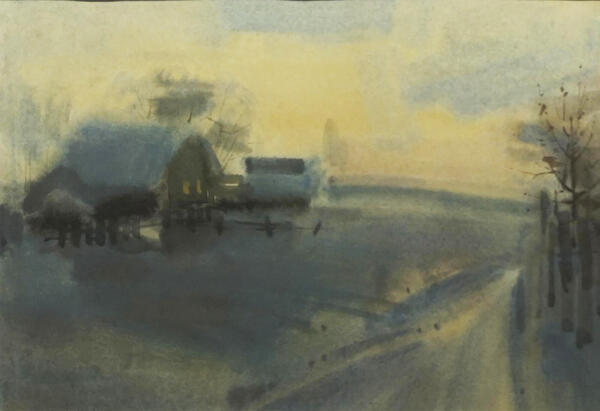
Terentyev often works in the genre of urban and lyrical landscape, and he also employs the watercolor technique. The coloring of his works is unique and instantly recognizable, because it is based on subtle transitions of light and shade, on the play of light and shadow, on the delicate pearly half-lights. His poetic and soft watercolor ‘A March Sketch’ is also full of virtuoso color solutions.
It is a rural landscape: it is still snowy and rather harsh, but the tremulous light of the newborn morning evokes the spring that is approaching. In this picture, Terentyev depicted a view of the province somewhere in central Russia that is dear to his heart. In ‘A March Sketch’, he elevated the classical genre of watercolor landscape to the level of poetry and philosophy, presenting it as a sophisticated one, allowing for a deeper look not only into the secrets of nature and life, but also into the secrets of the fine art itself.
While working on his paintings, Terentyev often resorts to the wet watercolor technique: this method suggests that the paint is applied to paper, which is abundantly moistened with water. Not many painters use such technique, due to it being too complex and unpredictable, so chances are high to make a mistake. On the other hand, the wet watercolor technique allows Terentyev to literally revive the drawing, while creating unique and unexpected effects.
Terentyev’s instantly recognizable poetic style is welcomed not only by visitors to exhibitions and museums, but also by art specialists. For example, Ivan Vorozheikin, chairman of the graphics section of the Nizhny Novgorod Union of Artists, admires the distinctive style and high artistry of the painter. To such praise, Terentyev himself would most likely say that in his works he simply tries to “allow his soul to be touched by delicate watercolors”. “How it turned out, it is for the audience to judge”, the painter emphasizes.
Terentyev often works in the genre of urban and lyrical landscape, and he also employs the watercolor technique. The coloring of his works is unique and instantly recognizable, because it is based on subtle transitions of light and shade, on the play of light and shadow, on the delicate pearly half-lights. His poetic and soft watercolor ‘A March Sketch’ is also full of virtuoso color solutions.
It is a rural landscape: it is still snowy and rather harsh, but the tremulous light of the newborn morning evokes the spring that is approaching. In this picture, Terentyev depicted a view of the province somewhere in central Russia that is dear to his heart. In ‘A March Sketch’, he elevated the classical genre of watercolor landscape to the level of poetry and philosophy, presenting it as a sophisticated one, allowing for a deeper look not only into the secrets of nature and life, but also into the secrets of the fine art itself.
While working on his paintings, Terentyev often resorts to the wet watercolor technique: this method suggests that the paint is applied to paper, which is abundantly moistened with water. Not many painters use such technique, due to it being too complex and unpredictable, so chances are high to make a mistake. On the other hand, the wet watercolor technique allows Terentyev to literally revive the drawing, while creating unique and unexpected effects.
Terentyev’s instantly recognizable poetic style is welcomed not only by visitors to exhibitions and museums, but also by art specialists. For example, Ivan Vorozheikin, chairman of the graphics section of the Nizhny Novgorod Union of Artists, admires the distinctive style and high artistry of the painter. To such praise, Terentyev himself would most likely say that in his works he simply tries to “allow his soul to be touched by delicate watercolors”. “How it turned out, it is for the audience to judge”, the painter emphasizes.