Font
Color
Graphics
Изображение точки

To see AR mode in action:

1. Install ARTEFACT app for iOS or Android;

2. Find the exhibition «Yamal: the Past and the Present»

3. Push the «Augmented reality» button and point your phone's camera at the exhibit;

Скрыть точки интересаПоказать точки интереса

Malitsa, tambourine, Tambourine mallet, Bow

0
Open in app
#1
Malitsa, tambourine, Tambourine mallet, Bow
#3
Vladimir Vylla
Malitsa
#4
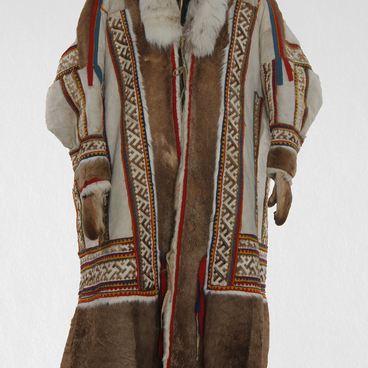
A “malitsa” is the traditional men’s clothing of the indigenous peoples of the North, in particular the Nenets. It was sewn from autumn calf skins so that the fur would be inside and it was made as a whole piece that is, it was not cut.

The malitsa could only be put on through the hole for the head. In cut, it resembled a loose shirt, reaching to the knees, and its front part was somewhat shorter than the back.

A hood was sewn to the malitsa, which replaced the hat. With the help of a string threaded through it, it was possible to narrow or widen the opening framing the face. The hood was sewn from a fawn fur in two layers — with fur outside and inside.

A fawn is a reindeer calf that is not yet a month old and has not yet begun to molt. In some classifications, calves are considered fawn in the first six months of life. The fur of such a calf is called a fawn fur. The fur of a molted calf or animal older than six months is called “neblui”.

Mittens were tightly attached to the sleeves of the malitsa. They were sewn with fur outside from kamus — a hard and short-haired part of the hide, which was taken from the legs of a deer or elk.

On the hem, the malitsa is trimmed with an edging. Usually it was made from the skin of an autumn calf or the summer skin of an adult deer — with short fur of low quality, unsuitable for other clothes. One or two strips of yellow, red or green cloth were sewn over the edge of the hem, sometimes a pattern of cuts of white and dark fur was inserted along the hem.

The wide upper part and the special cut of the sleeves with wide armholes made it possible, without removing the malitsa, to take out your hands from the sleeves and, for example, fill a pipe under it. Since the malitsa was worn with a belt so that an overlap was formed over the waist, the bosom replaced the pocket and was a kind of warehouse. It contained a pouch with tobacco and flint, a pipe and other necessary things.

The Nenets usually had three or four malitsa shirts for all occasions. They treated this garment, sewn from rare materials by hand, with great care, since in case of loss or damage it was difficult to restore it.

To preserve the malitsa from dampness, dirt and sunlight, many Nenets wore shirts made of cloth or other dense multi-colored fabric over it. In cut, the shirt was similar to a malitsa: its front part and back were sewn from whole pieces and slightly widened downward.

In severe frosts, in a blizzard and on days when it was necessary to be outdoors for a long time — when grazing, hunting, fishing, or during the move — a “sovik” (parka) was worn on top of the malitsa. This was the name of the outerwear with a hood. Just like the malitsa, the sovik was put on through a hole for the head and worn without a belt. It was sewn from the winter or autumn fur of adult deer with the fur outside.
#5
Полное наименование: Malitsa
Автор: Vladimir Vylla
Дата создания: 1999
Техника: elk fur, handmade, sewing
Место создания: YaNAO (Yamalo-Nenets Autonomous District), Muravlenko
Размеры: 144×50 cm
Коллекция: Ethnography
Правообладатель изображений: MBIC “Muravlenko Ecological and Local History Museum”
№ Госкаталога: 14215177
#6
Marina Nakova
Shaman’s tambourine
#7
The Muravlenko museum houses a Nenets shaman’s tambourine. It was made in 2007 by the craftswoman Marina Nakova.

The Nenets are an indigenous Samoyedic people who live on the Eurasian coast of the Arctic Ocean: from the Nenets Autonomous District in the Arkhangelsk Oblast to the Taymyrsky Dolgano-Nenetsky District of the Krasnoyarsk Krai. This is the most numerous indigenous people of the Russian North.

In the olden days, the Nenets culture was characterized by deifying nature, as well as by the feeling of the absolute unity between the man and the world around him. The Nenets perceived the Universe as three worlds located vertically one above the other: the Upper, Middle and Lower one.

The upper world consisted of seven heavens inhabited by deities. In the past, a special person — a shaman — used the sound of his tambourine to connect the Upper world with the Middle world, also called the circle of life. This is the name that the Nenets people used for the land inhabited by people, animals and spirits. The spirits were masters of landscapes and elements and maintained a connection between the Middle world and the world of shadows, or the Lower world.

A tambourine with a mallet symbolized a deer, on which the shaman traveled across the Upper, Middle and Lower worlds. It was believed that while the shaman was wandering, he could find the answer to any question.

Nenets shaman tambourines were small — just about 50–60 centimeters in diameter. They could be either round or oval. The rim — an open cylindrical structural element — was made of durable larch, less often of spruce.

On the outer side of the rim, seven or fourteen posts were installed, which were carved out of birch wood, Chaga mushroom, less often out of deer antlers or mammoth bones. A reindeer tendon thread or thin straps were pulled through the posts. A large number of posts on a small circumference of the rim created a wavy edge line characteristic of Nenets tambourines.

On the inner side of the rim, iron brackets with rings or square iron plates were sometimes fixed.

The rim was covered with the skin of a wild deer. Less often the skin of a domestic animal that had been sacrificed to the good heavenly spirits was used. The skin was well processed, and then either sewn or gathered along the edge on a tendon thread, which was attached to the rim with rare stitches.

Inside the tambourine, an intricate wooden handle in the form of a slingshot was tied to the rim with straps. The handle consisted of the two sticks: the main one, which was located along the diameter, and a short side stick. The side stick was connected to the main stick at an angle, it was nailed with a wooden nail or inserted into a hole that was specially cut in the center of the main stick. Both sticks had seven carved images — usually these were flat or sculpted heads and faces of the shaman’s spirits — “tadebtse”. Sometimes, there were chains with jingles in the upper part of the tambourine.
#8
Полное наименование: Shaman’s tambourine
Автор: Marina Egorovna Nakova
Дата создания: 2007
Техника: leather, wood, handmade, assembly
Место создания: YaNAO (Yamalo-Nenets Autonomous District), Khanymei settlement
Размеры: 56×56 cm
Коллекция: Ethnography
Правообладатель изображений: MBIC “Muravlenko Ecological and Local History Museum”
№ Госкаталога: 14215123
#9
Marina Nakova
Tambourine mallet
#10
Together with the Nenets shaman tambourine, the craftswoman Marina Nakova made a special mallet in 2007. Mallets, like tambourines, can be of different shapes and sizes, but most often it is a flat and slightly elongated wooden spade.

The Nenets used the word “khorey” to denote a long, round in cross-section and slightly curved pole, which was used for riding reindeer or guarding herds. A wide bone or wooden tip was placed at the thin end, which was used to steer deer, at the other end was an iron tip in the form of a short sword. It was used to drive away predators.

Shamans cured diseases, and helped when the intervention of supernatural forces was required. They communicated with the spirits, asked them to grant well-being, health and fertility to people and animals, as well as good luck in hunting and fishing. Shamans used to read fortune with an ax or a knife and thus could predict the future, find lost things, missing people and deer. They supervised the celebrations and sacrifices at holy sites.

The main attributes of the shaman were a tambourine and a mallet, and the main action was a shamanic ritual (“kamlaniye”). This was the name of the ritual of communication with the spirits, during which the shaman reached an ecstatic state. At these moments, various figures, bizarre stones, and animal skins served as his spiritual helpers.

Before the ritual, the shaman put on a special costume. During the ceremony, he depicted how, with the help of a tambourine, he flew to the heavenly god, descended into the lower world, fought against evil spirits. His improvisation was based on a good knowledge of the myths, tales and legends of his people, and the rituals included chants accompanied by strikes of a mallet on the tambourine. The shaman could practice shamanism anywhere: in the open air, on a river bank, in the house, but more often for this ritual a “black house” or “closed raw-hide tent” was assigned, where all the inhabitants of the surrounding villages gathered.

Both men and women could become shamans in the North. Usually the gift was inherited, but sometimes the spirits themselves chose a new shaman. A special illness reminiscent of temporary madness was considered to be the sign that the person had been chosen.

The shaman’s apprentice received his own tambourine only in the seventh year. The mentor showed what kind of wood an instrument could be made out of and how to make a mallet. With its help, a tambourine was tuned near a burning fire — it got a voice. The tambourine and the mallet were kept not in simple riding sledges, but in sacred ones. A few more years later, the new shaman was allowed to make pendants for his tambourine, and 10 years later he was considered an experienced shaman. In general, the training lasted 20 years.
#11
Полное наименование: Shaman’s tambourine mallet
Автор: Marina Egorovna Nakova
Дата создания: 2007
Техника: wood, leather, carving, handmade
Место создания: YaNAO (Yamalo-Nenets Autonomous District), Khanymei settlement
Размеры: 35.5×4 cm
Коллекция: Ethnography
Правообладатель изображений: MBIC “Muravlenko Ecological and Local History Museum”
№ Госкаталога: 14215141
#12
Vladimir Vylla
Wooden bow
#13
The indigenous peoples of the North have been hunting wild animals and birds for hundreds of years. They knew the habits of animals and the peculiarities of the territory in which they lived. Hunting was carried out in different ways, which depended on the natural and climatic conditions, the prevailing way of life and traditions, as well as on the demand for certain types of prey.

The Khanty have always deftly handled one of the most ancient hunting devices — a wooden bow. At first glance, a primitive, but in fact rather complex, carefully designed and fitted weapon is still used during the hunt. Some bows can even compete with firearms in terms of lethality and rate of fire.

The main advantage of the bow is the silent shot. So, the Khanty hunter managed to release a dozen arrows at a wood grouse, which walked along the sandbank in lines, could knock out seven or eight hazel grouses from the flock feeding on the bird cherry bushes, catch up and shoot the loon.

The Khanty were especially good at hunting squirrels with a bow in the Purovsky continents — this is the name of the forests growing along the sandy ridge between the Pura River and the right tributaries of the Ob. On the territory of a low-growing forest, mainly a pine forest, the animals were shot by arrows with a thickened front end, without an iron tip: this way the skins were kept absolutely intact.

The Khanty made hunting bows of three types of wood. The outer part was carved from birch, and the inner part from the hard and resinous cedar. The halves were glued together with fish glue and wrapped tightly with thin sheets of birch bark or ligaments of tendons. The ends of the bow were made of bird cherry, and they were decorated with leather from goose or swan legs.

The Khanty wooden feathered arrows were equipped with iron or bone points of various types. Iron tips were most often made from knives. Their shape depended on the animal being hunted. For game, lanceolate ones were used — with a long narrow feather in the form of a flattened rhombus or lens. If the tip was equipped on three sides with sharpened hooks resembling the claw of a bird of prey, then such an arrow was intended for hunting a duck. The fox, otter and hare were hunted with an arrow, at the end of which two sharpened blades diverged at an angle of 40 degrees. For fish, spearheads were used.
#14
Полное наименование: Wooden bow with two arrows
Автор: Vladimir Vylla
Дата создания: 1998
Техника: handmade, wood carving
Место создания: YaNAO (Yamalo-Nenets Autonomous District), Muravlenko
Размеры: 190×4 cm
Коллекция: Ethnography
Правообладатель изображений: MBIC “Muravlenko Ecological and Local History Museum”
№ Госкаталога: 14215129
#15
read morehide
00:00
00:00
1x

Malitsa, tambourine, Tambourine mallet, Bow

0
Point your smartphone camera to open in the app
Share
VkontakteOdnoklassnikiTelegram
Share on my website
Copy linkCopied
Copy
Open in app
To see AR mode in action:
  1. Install ARTEFACT app for 
  2. iOS or Android;
  3. Find and download the «Paintings in Details» exhibition
  4. Push the «Augmented reality» button and point your phone's camera at the painting;
  5. Watch what happens on your phone screen whilst you flip through the pictures.
 
We use Cookies
Cookies on the Artefact Website. We use cookies to ensure that we give you the best experience on our website. If you continue without changing your settings, we'll assume that you are happy to receive all cookies on the Artefact website. However, if you would like to, you can change your cookie settings at any time.
Learn more about useHide
Content is available only in Russian

X

Нашли опечатку?...

%title%%type%