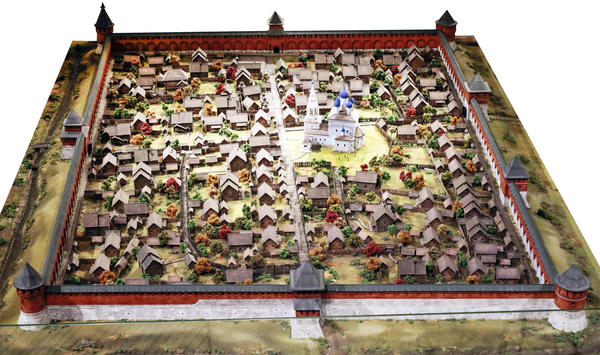
The Tula Kremlin is a medieval fortress, the oldest building in the city and region. It was founded in 1507 by Grand Prince Vasily III, father of Ivan the Terrible. The fortress was designed to protect the southern borders of the Russian state from the attacks of the Crimean Tatars. Until 1514, the Kremlin was made of stone and wood, and by 1520 it had become an impressive stone and brick fortification that protected the southern borders of the country.
Unlike most fortresses, the Tula Kremlin is located not on a hill, but in a lowland, surrounded by swamps and rivers. It has the shape of a regular rectangle with a wall perimeter of about one kilometer. It covers an area of six hectares.
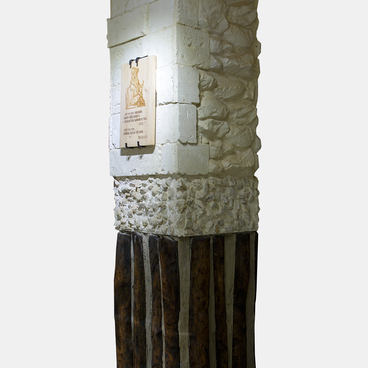
The Kremlin walls are made of red brick with a base of white stone. The height of the walls is about 11 meters, the thickness is 3 meters (in the lower part it reaches four meters), and the depth of the foundation is more than five meters. The walls are finished with two-horned battlements — “swallowtails” (this design was borrowed from northern Italian architecture). Unfortunately, the names of the architects, who developed the project of the walls and towers of the Tula Kremlin, have not been preserved. With a high degree of probability, it can be argued that Italian craftsmen took part in the construction of the Tula fortress.
The Kremlin towers extended beyond the perimeter of the walls, which made it possible to shoot at the flanks of the enemy’s army. In total, there are nine towers in the Tula Kremlin — four round corner towers without an entrance from the outside called Spasskaya, Naugolnaya, Ivanovskaya, and Nikitskaya; one rectangular tower without an entrance called the Cellar Tower and four towers with gateways: the towers of the Vodyaniye, Ivanovskiye, Pyatnitskiye and Odoyevskiye Gates.
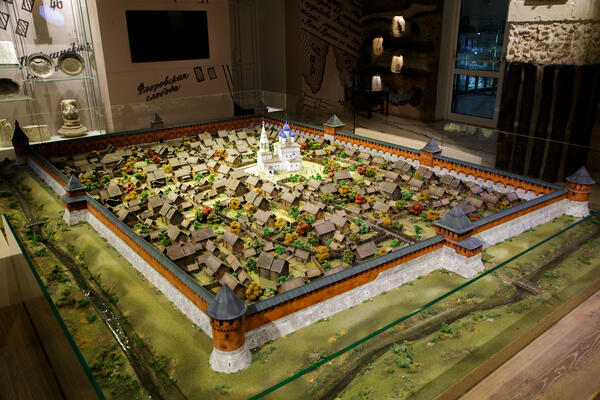
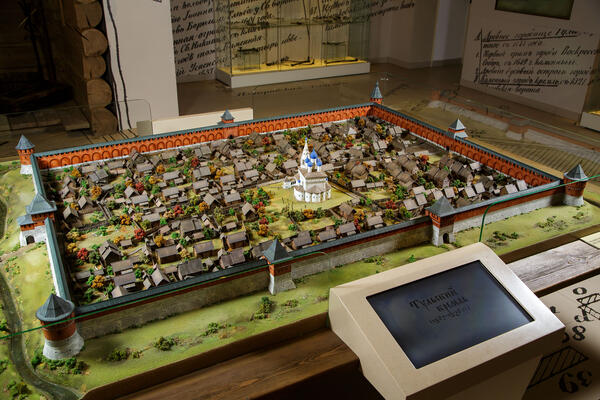
At the end of the 17th century, the space inside the Kremlin walls was densely packed. There were siege yards, in which representatives of secular and spiritual authorities, as well as nobles and boyar children who had fiefdoms and estates in the Tula district, could take refuge during the Crimean Tatar raids. In peacetime, most siege yards had keepers who were hired to look after the owner’s property.
In the main street of the Tula Kremlin called Bolshaya were local government institutions, the voivode’s courtyard, and the archbishop’s courtyard. Numerous dead ends and alleys branched off from Bolshaya Street. By 1685, there were “72 houses of people of all ranks, and 4 empty houses, 27 empty places” in the Kremlin.
The first stone cathedral of the fortress — the Assumption Cathedral, which was mentioned in the medieval Scribe Book — was situated on the Cathedral Square. In the 1640s, the construction of a new line of fortifications — the Belgorod Zasechnaya Line — was completed, the border of the Moscow state moved far to the south and Tula ceased being a border fortress.