

Zapoliarye (regions north of the Arctic Circle) is rich in mineral resources: oil, gas, diamonds, gold, copper are recovered there. But it is extremely difficult to transport supplies to the northern settlements. Cargoes are delivered there mostly in the period of summer navigation that lasts 110 to 120 days only. To transport these cargoes inland, operators have to wait 4 to 5 months when swamps freeze up deeply and snow road cutting becomes possible.
To avoid spring and autumn shortage of provision, building materials and spareparts for equipment, geologists and oilmen have to order the necessaries for keeping and calculate the volume of cargoes for many months ahead. But unforeseeable situations occur too when construction of pipelines or well drilling has to be stopped for several months.
That was exactly what happened in the 1975 winter, when the Varandey Oil/Gas Exploratory Expedition was left without fuel, drilling equipment and construction materials. Snow roads were accessible in the period from January through April only. The cargoes brought to coastal settlements in summer could not be delivered to the geologists before January of the next year.
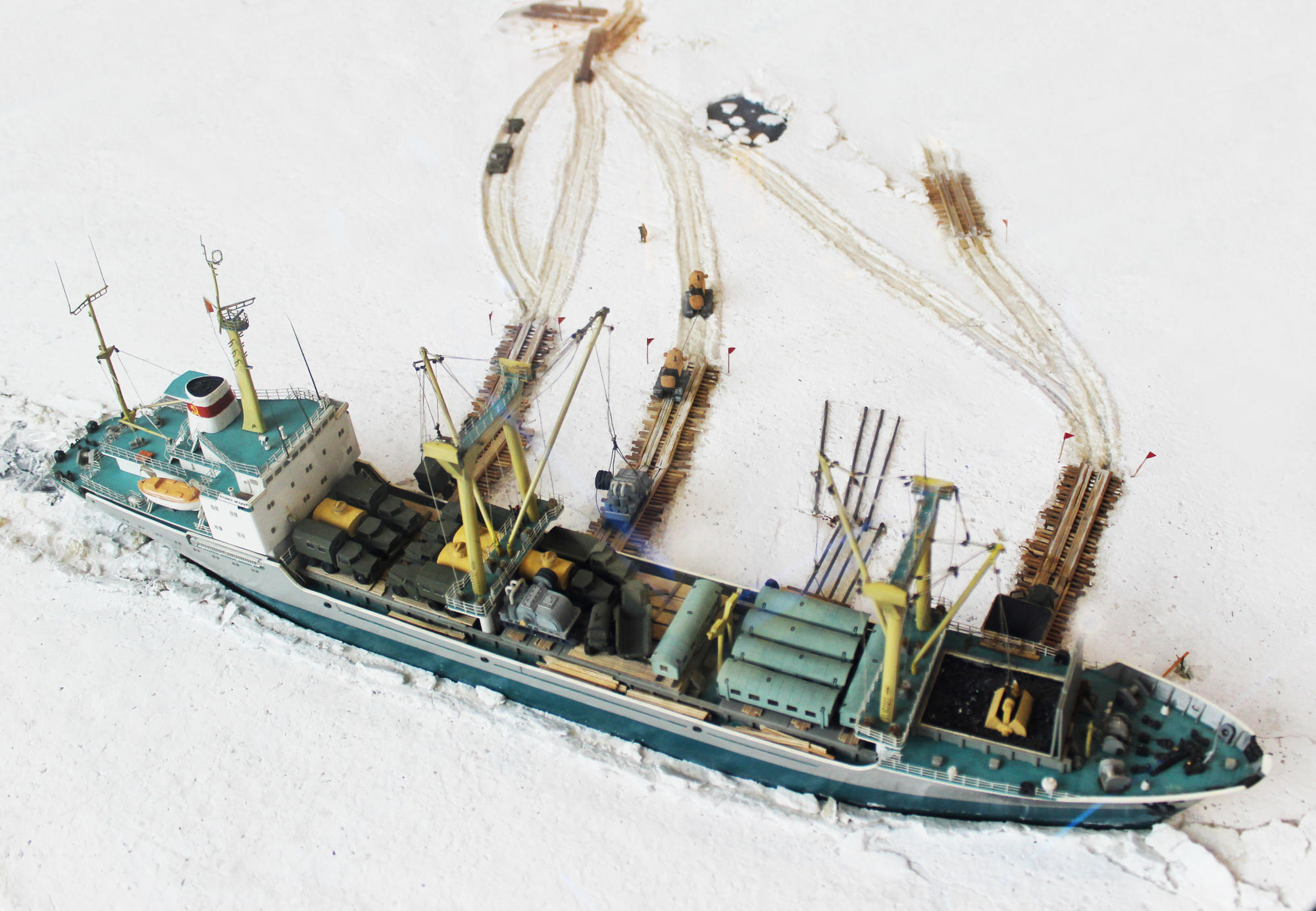
For the avoidance of stoppage the management of Arkhangelsk Territorial Geological Department and Northern Shipping Company ventured upon an experimental extra-early delivery of cargo, which they called the Ice Berth. The seasonal ice foot (the ice along the coast) had to take the part of the berth. Its thickness did not exceed 90 cm while the cargoes which had to be delivered to Varandey and Vangurey settlements were extra heavy (over 30 tons). No one in the world had ever conducted such an operation until then.
The situation was further aggravated by the fact that the depths in the south-eastern part of the Barents Sea basin were very shallow: the 5 m isobath line went at the distance of several miles from shore. Consequently, heavy cargoes had to be transported across young ice and over large distance. In order to map a route aviation carried out ice reconnaissance on the way from Arkhangelsk to Varandey.
A group of four people was air dropped. They had to choose an optimal location of the ice berth. All preliminary works had been accomplished by March 20. On April 10, icebreaker Petr Pakhtusov followed by motorship Valdayles sailed from the port of Ekonomiya toward Varandey. Space photography was used in support of this ice escort.
At 19 00 of April 12, the icebreaker broke the ice-foot edge near Varandey. The next day motorship Valdayles moored to the place of unloading. The vessel brought lumber and out of it the flooring was made immediately to increase the ice resistance. After that, MAZ, ZIL and KRAZ trucks and boring machines were unloaded. The ice settled 2 mm, then on April 14, sudden warming came and water appeared in track pits. 2812 tons had been discharged from the motorship by April 20.
On May 25, at the last stage of the experiment, 1500 tons of liquid fuel was brought to Varandey. Overall financial gain due to the extra-early navigation amounted to 1,2 mln Soviet rubles. Apart from that, geologists discovered new oil deposit one year earlier than it was planned. The operations of extra-early navigation had been carried out regularly through 1991.
To avoid spring and autumn shortage of provision, building materials and spareparts for equipment, geologists and oilmen have to order the necessaries for keeping and calculate the volume of cargoes for many months ahead. But unforeseeable situations occur too when construction of pipelines or well drilling has to be stopped for several months.
That was exactly what happened in the 1975 winter, when the Varandey Oil/Gas Exploratory Expedition was left without fuel, drilling equipment and construction materials. Snow roads were accessible in the period from January through April only. The cargoes brought to coastal settlements in summer could not be delivered to the geologists before January of the next year.
For the avoidance of stoppage the management of Arkhangelsk Territorial Geological Department and Northern Shipping Company ventured upon an experimental extra-early delivery of cargo, which they called the Ice Berth. The seasonal ice foot (the ice along the coast) had to take the part of the berth. Its thickness did not exceed 90 cm while the cargoes which had to be delivered to Varandey and Vangurey settlements were extra heavy (over 30 tons). No one in the world had ever conducted such an operation until then.
The situation was further aggravated by the fact that the depths in the south-eastern part of the Barents Sea basin were very shallow: the 5 m isobath line went at the distance of several miles from shore. Consequently, heavy cargoes had to be transported across young ice and over large distance. In order to map a route aviation carried out ice reconnaissance on the way from Arkhangelsk to Varandey.
A group of four people was air dropped. They had to choose an optimal location of the ice berth. All preliminary works had been accomplished by March 20. On April 10, icebreaker Petr Pakhtusov followed by motorship Valdayles sailed from the port of Ekonomiya toward Varandey. Space photography was used in support of this ice escort.
At 19 00 of April 12, the icebreaker broke the ice-foot edge near Varandey. The next day motorship Valdayles moored to the place of unloading. The vessel brought lumber and out of it the flooring was made immediately to increase the ice resistance. After that, MAZ, ZIL and KRAZ trucks and boring machines were unloaded. The ice settled 2 mm, then on April 14, sudden warming came and water appeared in track pits. 2812 tons had been discharged from the motorship by April 20.
On May 25, at the last stage of the experiment, 1500 tons of liquid fuel was brought to Varandey. Overall financial gain due to the extra-early navigation amounted to 1,2 mln Soviet rubles. Apart from that, geologists discovered new oil deposit one year earlier than it was planned. The operations of extra-early navigation had been carried out regularly through 1991.