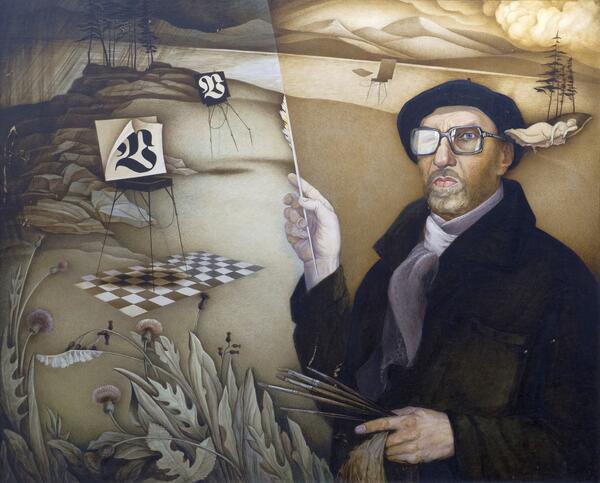
The Irbit Museum of Fine Arts holds several paintings by the Ural artist Alexey Afanasyevich Kazantsev (1928–2002), among them the pivotal work “Skiers. A Tense Moment”. Kazantsev began working on this canvas in 1960 and it would come to define the trajectory of his artistic development. On a large canvas, Kazantsev captures not the race itself, but its spectators — an array of figures gathered in tense anticipation, their gazes fixed beyond the frame toward the unseen action. Many of those depicted are participants in the competition: some have already completed their run, while others wait near the starting line, poised for their moment.
The painting was commissioned for a republican exhibition in Moscow. Yet, for reasons unexplained, the exhibition committee rejected the work and directed Kazantsev to revise it at the Akademicheskaya Dacha (Academic Countryside Retreat) — Russia’s oldest retreat for creative people. Located on a scenic peninsula formed by the source of the Msta River and Lake Mstino in the Vyshnevolotsky District of the Tver region, the Retreat was founded in 1884 through the initiative of the renowned Russian philanthropist Vasily Kokorev. Before the Russian Revolution, it served as a sanctuary for giants of Russian art: Ilya Repin, Arkhip Kuindzhi, Isaac Levitan, and others lived and worked there.
After 1917, the estate was repurposed as a children’s pioneer camp. In 1948, it was returned to the Academy of Arts, and during the 1970s and 1980s, modern workshops and administrative buildings were added to support its evolving role. By the time Kazantsev arrived in the early 1960s, the Academic Countryside Retreat had become a vital hub for Soviet artists. It was then managed by the celebrated painters — the brothers Sergey Petrovich Tkachev (1922–2022) and Alexey Petrovich Tkachev (1925–2025). Despite their influence, Kazantsev found little resonance with their expressive, folk-inspired style. After three months of intensive work, he produced no satisfactory revisions and returned to the Urals empty-handed.
It was soon after this experience that Kazantsev the painter gave way to Kazantsev the graphic artist. The museum’s collection now includes approximately five hundred and fifty graphic works — spanning five decades of his career. He worked extensively in etching (including all its variations), lithography, monotype, watercolor, gouache, tempera, varnishes, and enamels. A defining feature of Kazantsev’s graphic practice was his relentless experimentation: driven by a desire to explore new forms, textures, and chromatic possibilities, he often fused multiple media on a single sheet.