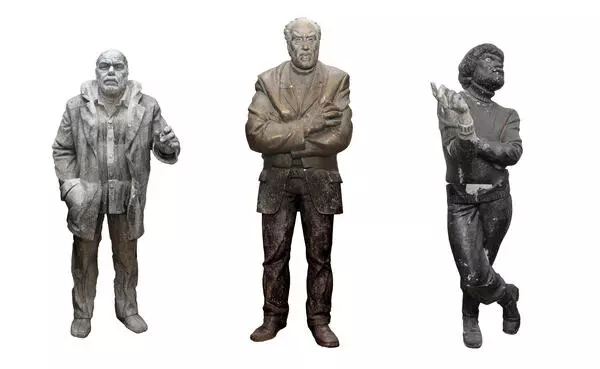
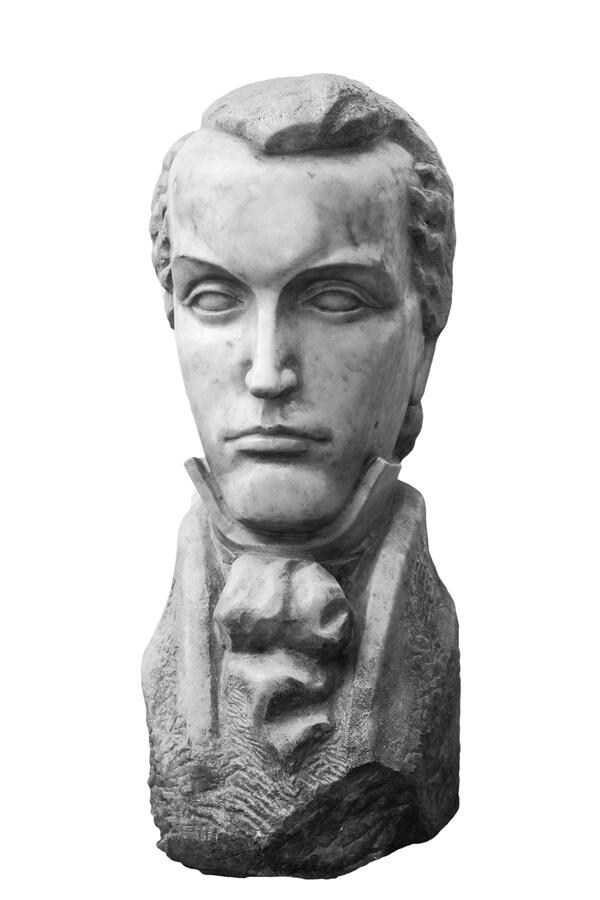
The Irbit State Museum of Fine Arts houses the sculpture “Fritz Cremer” by the Ural sculptor Andrey Gennadievich Antonov, created in 1975. This work belongs to a significant phase in Antonov’s career — the 1970s and 1980s — during which he produced a series of intimate portraits of his contemporaries from the artistic world. Among these is a tinted plaster portrait of the German sculptor, graphic artist, and illustrator Fritz Cremer.
The sculpture depicts a full-length male figure standing on a rectangular base. Cremer is rendered wearing a sweater with a high collar, a jacket with sleeves rolled up to the elbows and buttoned at the waist, trousers, and shoes. His hair is short, with some bald spots. His head is turned three-quarters to the right. His arms are slightly bent and loosely resting in his trouser pockets and his legs are planted wide apart.
Fritz Cremer’s artistic legacy is defined by his works dedicated to social justice, anti-fascist resistance, and political memory. His sculptural style uniquely synthesizes Expressionism, Realism, and classical tradition. Born on October 22, 1906, in Arnsberg, Germany, to a decorator, Albert Cremer, — who died just one year after Fritz’s birth — he was raised under challenging circumstances that would deeply inform his later worldview.
In 1921, Cremer became an apprentice stone-cutter. The following year, he began studying church sculpture while simultaneously enrolling in a sculpture course at a local academy under the guidance of Will Lammert. In the 1930s, he furthered his training at the Higher School of Fine and Applied Arts in Berlin, where he studied under Wilhelm Gerstel.
The years 1935 and 1936 marked a pivotal moment in Cremer’s development as an independent artist. He created his first major public work: the bronze bas-relief “Grieving Women” (also known as “Gestapo”), a harrowing depiction of civilian suffering under Nazi repression. The piece earned him a state prize and a scholarship to Rome. Despite his staunch anti-fascist convictions, Cremer was conscripted into the Wehrmacht during World War II. From 1940 to 1944, he served in the Balkans and on the island of Crete, where, in a profound act of personal conviction, he voluntarily surrendered to Allied forces.
After the war, Cremer settled in Vienna, where he became a professor and later Head of the Sculpture Department at the Academy of Applied Arts. There, he created some of his most enduring works: “Freedom Fighter”, the figures “In Memory of the Executed Communists of Austria”, and the “Monument to the Victims of Fascism” for the memorial complex at Vienna’s Central Cemetery.
In 1950, Cremer relocated to the German Democratic Republic, assuming leadership of a sculpture workshop at the Berlin Academy of Fine Arts. From 1974 to 1983, he served as Vice President of the Academy. Throughout his life, he made numerous creative journeys to the USSR, China, and Egypt — experiences that broadened his artistic perspective and strengthened cultural ties between East and West. Fritz Cremer died on September 1, 1993, in Berlin and was laid to rest at the Friedhof Pankow III Cemetery.