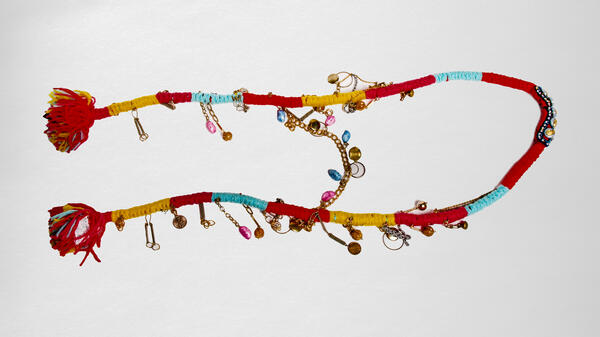
The so-called false braids were popular among the indigenous small-numbered peoples of the Far North: the Khanty, Mansi and Nenets. They were mainly worn as jewelry by little girls of six to seven years old and young women. Among the Obdorsk Khanty, women of all ages wore false braids until very old age.
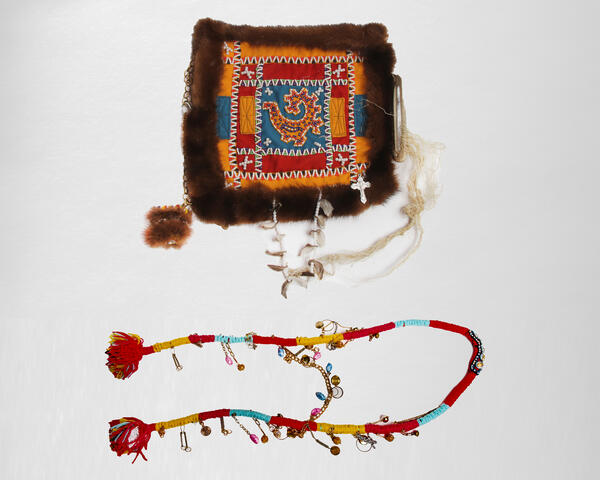
Throughout a woman’s life, the appearance of her false braids did not change. On the back of the head was an oval plate, covered with dense red cloth, decorated with several large copper buttons and tightly sewn with beads. From the plate, two long thick bundles of hair descended on the back from both sides — they were intertwined with ribbons and tightly wrapped in a spiral with a woolen cord on top.
Various pendants were attached to the lower ends of the braids: metal plaques, rings, small bells, soft woolen laces of red or burgundy shades. The entire structure was abundantly decorated with beads, metal chains, copper openwork pendants, badges, and rings. The harnesses were necessarily connected with each other by additional chains. It was believed that the brilliance and sound of metal scared evil spirits away.
In order to put on false braids, the girls divided their hair into two parts, leaving a straight parting, and made buns at the back of the head. False braids were attached to these buns and tightly fixed with strips of fabric.
In some tribes, false braids were not braided with hair, but already assembled; they were attached to a soft bandage, which consisted of three strips of cloth. One of them covered the forehead and the back of the head, while the other two were attached to it and crossed at the crown. These bands were abundantly decorated with beads.
False braids were difficult to make, expensive, bulky and heavy, so they were not worn every day. This massive decoration made the girl maintain her posture and not slouch.
A similar decoration was used in men’s hairstyles: an oval piece of birch bark or leather, covered with red cloth, on which several metal buttons, porcelain or simple beads were sewn. On the right and left sides, laces were sewn to the headdress, which wrapped tufts of hair, so the headwear was held on the back of the head.
Throughout a woman’s life, the appearance of her false braids did not change. On the back of the head was an oval plate, covered with dense red cloth, decorated with several large copper buttons and tightly sewn with beads. From the plate, two long thick bundles of hair descended on the back from both sides — they were intertwined with ribbons and tightly wrapped in a spiral with a woolen cord on top.
Various pendants were attached to the lower ends of the braids: metal plaques, rings, small bells, soft woolen laces of red or burgundy shades. The entire structure was abundantly decorated with beads, metal chains, copper openwork pendants, badges, and rings. The harnesses were necessarily connected with each other by additional chains. It was believed that the brilliance and sound of metal scared evil spirits away.
In order to put on false braids, the girls divided their hair into two parts, leaving a straight parting, and made buns at the back of the head. False braids were attached to these buns and tightly fixed with strips of fabric.
In some tribes, false braids were not braided with hair, but already assembled; they were attached to a soft bandage, which consisted of three strips of cloth. One of them covered the forehead and the back of the head, while the other two were attached to it and crossed at the crown. These bands were abundantly decorated with beads.
False braids were difficult to make, expensive, bulky and heavy, so they were not worn every day. This massive decoration made the girl maintain her posture and not slouch.
A similar decoration was used in men’s hairstyles: an oval piece of birch bark or leather, covered with red cloth, on which several metal buttons, porcelain or simple beads were sewn. On the right and left sides, laces were sewn to the headdress, which wrapped tufts of hair, so the headwear was held on the back of the head.