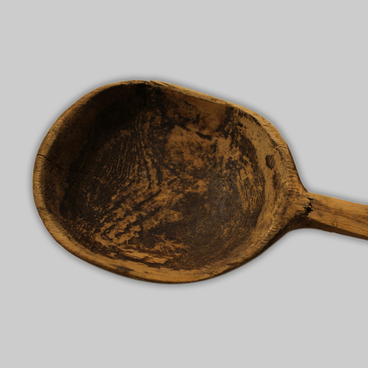


The art of bone carving — the oldest type of activity in decorative and applied arts. The origin of the bone carving industry dates back to the era of the beginning of human civilization. Ancient craftsmen made household items such as needles, knives, spoons, arrowheads, as well as jewelry and sacred objects.
Bone carving among the people of the north belongs to one of the ancient folk textile arts. Simple or complex — it allows you to get an unlimited number of product options. Mammoth bone is softer than walrus bone, easier to process, and makes it possible to use various techniques, including through carving. In addition, mammoth bones lie in the permafrost at different depths, so they can be painted in different dark colors-craftsmen appreciate this and use it for decorative purposes. Household items and cutlery were often covered with carvings depicting animals, birds, insects, fish, reptiles, which are traditionally found in mythology.
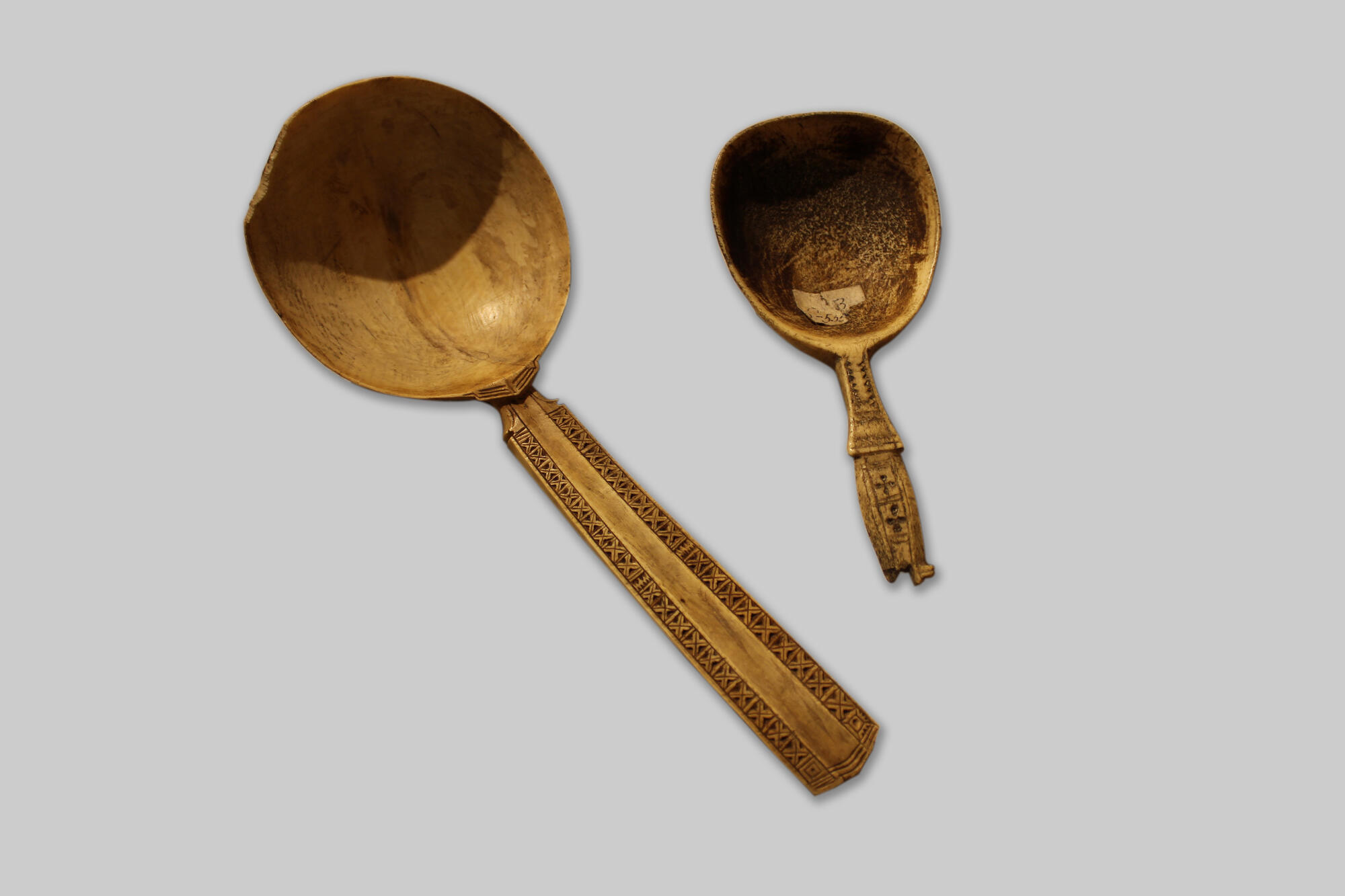
The Museum’s collection includes large and small spoons made of bone. A large spoon, more like a ladle in shape, is well polished. It has two symmetrical stripes with an ornament in the form of an expanded cross on transverse stripes on the outside. In the two squares around the edges of the spoon, the pattern resembles eyes. There are 12 notches on the left side of the handle.
The second spoon — conventionally trapezoidal with rounded edges. It is smaller, soup-like spoon, less fancy and polished than the larger one. On the dark surface, the pattern is clearly visible — these are “cross-shaped” images at the part of the handle that is located closer to the eater’s face. At the base of the handle is a drawing similar to the image of sharp animal fangs. The spoon, judging by its appearance, was actively used. The end of the handle is damaged — a small fragment is missing.
According to the stories of northern explorers, the Evenks considered the bravest and most courageous hunter to be the one who swallowed the most spoons when eating treats made from bear meat.
Bone carving among the people of the north belongs to one of the ancient folk textile arts. Simple or complex — it allows you to get an unlimited number of product options. Mammoth bone is softer than walrus bone, easier to process, and makes it possible to use various techniques, including through carving. In addition, mammoth bones lie in the permafrost at different depths, so they can be painted in different dark colors-craftsmen appreciate this and use it for decorative purposes. Household items and cutlery were often covered with carvings depicting animals, birds, insects, fish, reptiles, which are traditionally found in mythology.
The Museum’s collection includes large and small spoons made of bone. A large spoon, more like a ladle in shape, is well polished. It has two symmetrical stripes with an ornament in the form of an expanded cross on transverse stripes on the outside. In the two squares around the edges of the spoon, the pattern resembles eyes. There are 12 notches on the left side of the handle.
The second spoon — conventionally trapezoidal with rounded edges. It is smaller, soup-like spoon, less fancy and polished than the larger one. On the dark surface, the pattern is clearly visible — these are “cross-shaped” images at the part of the handle that is located closer to the eater’s face. At the base of the handle is a drawing similar to the image of sharp animal fangs. The spoon, judging by its appearance, was actively used. The end of the handle is damaged — a small fragment is missing.
According to the stories of northern explorers, the Evenks considered the bravest and most courageous hunter to be the one who swallowed the most spoons when eating treats made from bear meat.