History of the wooden spoon on Russia has its roots in centuries ago. The first mention of it can be found in the old Russian chronicle ‘Tale of Bygone Years’, dated 1110 AD. The Russian word itself comes from the root ‘log’ — deepening.
Before the Prince, Vladimir baptized Russia, people did not use cutlery — they ate food with their hands. To raise the cultural level of the Orthodox people, the Grand Prince made an order in which he ordered to bring food only with their help. There were craftsmen who were called ‘lozhkari’ — they skillfully carved them of different lengths, shapes and volumes. The wooden spoon gradually became an integral part of kitchen utensils.
For kets, Evenks, and Selkups, their native nature served not only as a place for hunting and fishing, but they drew strength and inspiration from it. And they taught their children to use the world around them wisely. The northern people made not only dishes and household items from birch bark, but also hollowed out from wood. Purchased utensils — copper pots, teapots, porcelain cups — came into use only in the XIX century.
In a Ket or Evenk family, everyone did their work. The simplest thing that men showed their growing up sons was how to make household utensils: they made dishes with scrapers and knives. Spoons were one of the most important household items. Kets, going on a journey, hid them in belts or in a bag — such cutlery was rough work and looked like Burlatsky. The depth of the spoon and its size depended on what purpose it was intended for. One of the most common was a short-handled ladle, which was convenient when migrating.
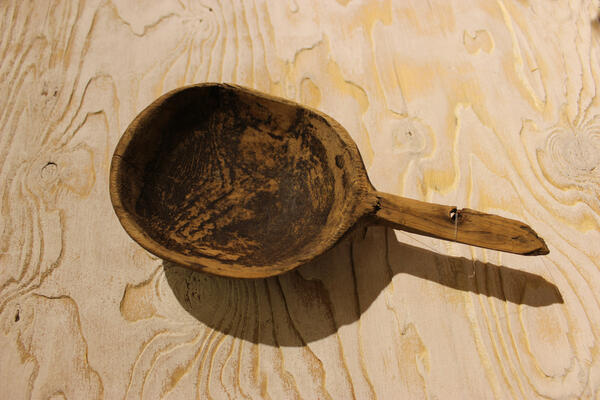
For cutting out spoons, aspen trunks were most often used, sometimes rowan. In museum collections there are also spoons made from tree roots. Spoon blanks were made from chocks, then the wood was polished with plants and stones. The exhibition features a small wooden spoon — Ket used such an instrument, most likely, for tea drinking. The rough woodwork was done, perhaps with a knife or a special scraper.
Before the Prince, Vladimir baptized Russia, people did not use cutlery — they ate food with their hands. To raise the cultural level of the Orthodox people, the Grand Prince made an order in which he ordered to bring food only with their help. There were craftsmen who were called ‘lozhkari’ — they skillfully carved them of different lengths, shapes and volumes. The wooden spoon gradually became an integral part of kitchen utensils.
For kets, Evenks, and Selkups, their native nature served not only as a place for hunting and fishing, but they drew strength and inspiration from it. And they taught their children to use the world around them wisely. The northern people made not only dishes and household items from birch bark, but also hollowed out from wood. Purchased utensils — copper pots, teapots, porcelain cups — came into use only in the XIX century.
In a Ket or Evenk family, everyone did their work. The simplest thing that men showed their growing up sons was how to make household utensils: they made dishes with scrapers and knives. Spoons were one of the most important household items. Kets, going on a journey, hid them in belts or in a bag — such cutlery was rough work and looked like Burlatsky. The depth of the spoon and its size depended on what purpose it was intended for. One of the most common was a short-handled ladle, which was convenient when migrating.
For cutting out spoons, aspen trunks were most often used, sometimes rowan. In museum collections there are also spoons made from tree roots. Spoon blanks were made from chocks, then the wood was polished with plants and stones. The exhibition features a small wooden spoon — Ket used such an instrument, most likely, for tea drinking. The rough woodwork was done, perhaps with a knife or a special scraper.