#1
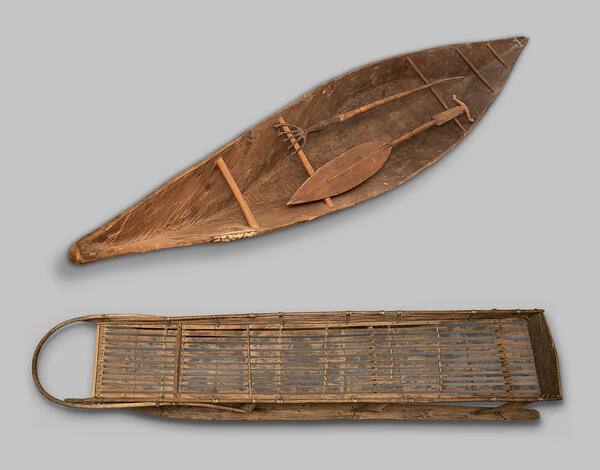
Dugout canoe, Driving dog sleds
#11
#2
#4
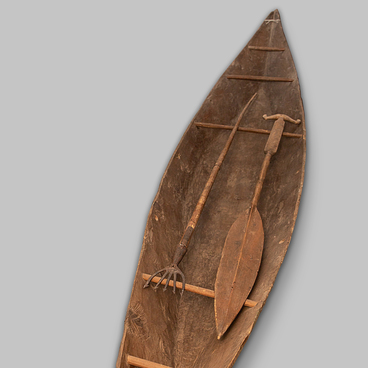
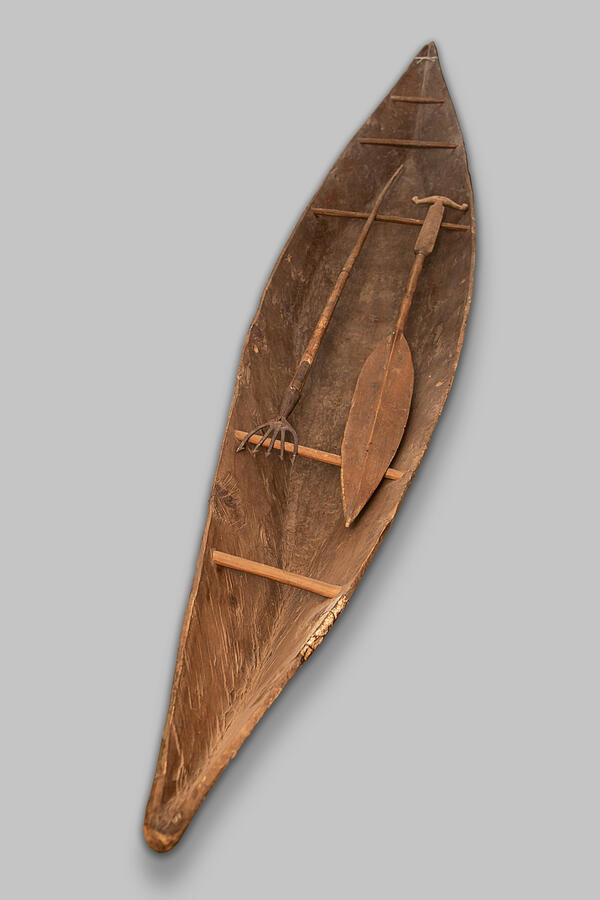
Dugout canoe is a part of the ethnographic collection of the Tobolsk Provincial Museum. The Selkups, an indigenous small-numbered people living in the North of Western Siberia, moved along the Siberian rivers. Another name for the boat in the Selkup language is ‘oblas’. These boats were narrow and long made from a single tree trunk. Most often, the Selkups used aspen, since its wood only becomes stronger when wet, but if the boat had to be often carried on land, then cedar was used. Such wood was light and practically did not get wet in water. Trunks for boats were prepared in the winter, and they began to make a boat in the spring, with the arrival of heat.
It was not easy to make a good dugout, so only the men were engaged in its construction. Depending on the size, it was supposed to accommodate from one or two people to ten. The bark was removed from the selected aspen, and then the trunk was appropriately marked. Having formed the bow and stern, they began to hollow out the wood. When the dugout took shape, and the sides were the right thickness, they began to diverge them. In order to steam the wood, hot water was poured into the future boat. If it was not possible to heat the water, then stones heated over a fire were used. The most risky way is to set the boat on a trestle over the fire and pour water into it. Such steaming had to be constantly monitored so as not to burn the wood.
Struts made of spruce knots were installed inside the future boat. As the wood steamed, the knots were replaced with longer ones. When the sides were diverged sufficiently, holes were made in them, to which frames, i.e. transverse stiffeners, were attached by bast, rope, or birch bark. After that, the almost finished boat was tarred. It was rubbed with a mixture of soot with pine or fir resin, so that the dugout glided through the water noiselessly and did not get wet.
The dugout was controlled using a pole and oar from 1 to 1.5 meters long made of pine, spruce, or cedar. Relatively short oars with a rounded blade were used to push off from the shore. Usually the man steered the boat from the stern, while the women and children rowed. Men’s oars differed from women’s by their larger size, more massive handles, and the shape of the blade. The upper part of the handle of women’s oars was designed in the form of a hexagon and decorated with carvings, with the sign of family affiliation often applied. Sometimes the groom made special oars as a gift to their brides.
It was not easy to make a good dugout, so only the men were engaged in its construction. Depending on the size, it was supposed to accommodate from one or two people to ten. The bark was removed from the selected aspen, and then the trunk was appropriately marked. Having formed the bow and stern, they began to hollow out the wood. When the dugout took shape, and the sides were the right thickness, they began to diverge them. In order to steam the wood, hot water was poured into the future boat. If it was not possible to heat the water, then stones heated over a fire were used. The most risky way is to set the boat on a trestle over the fire and pour water into it. Such steaming had to be constantly monitored so as not to burn the wood.
Struts made of spruce knots were installed inside the future boat. As the wood steamed, the knots were replaced with longer ones. When the sides were diverged sufficiently, holes were made in them, to which frames, i.e. transverse stiffeners, were attached by bast, rope, or birch bark. After that, the almost finished boat was tarred. It was rubbed with a mixture of soot with pine or fir resin, so that the dugout glided through the water noiselessly and did not get wet.
The dugout was controlled using a pole and oar from 1 to 1.5 meters long made of pine, spruce, or cedar. Relatively short oars with a rounded blade were used to push off from the shore. Usually the man steered the boat from the stern, while the women and children rowed. Men’s oars differed from women’s by their larger size, more massive handles, and the shape of the blade. The upper part of the handle of women’s oars was designed in the form of a hexagon and decorated with carvings, with the sign of family affiliation often applied. Sometimes the groom made special oars as a gift to their brides.
#5
Date: 20th century
Technique: wood, chiseling, steaming, handmade
Place: Ratta settlement, Krasnoselkupskiy District, Yamalo-Nenets Autonomous District, Tyumen Region, Russia
Dimensions: 21×70×350 cm
Collection: Ethnography of Siberian Tatars and the Peoples in the Russian Far North
Copyright: Tyumen Province State Autonomous Cultural Institution “Tyumen Museum and Educational Association”, Structural Division “Tobolsk Historical and Architectural Museum Reserve”
Goskatalog Number: 10913123
Technique: wood, chiseling, steaming, handmade
Place: Ratta settlement, Krasnoselkupskiy District, Yamalo-Nenets Autonomous District, Tyumen Region, Russia
Dimensions: 21×70×350 cm
Collection: Ethnography of Siberian Tatars and the Peoples in the Russian Far North
Copyright: Tyumen Province State Autonomous Cultural Institution “Tyumen Museum and Educational Association”, Structural Division “Tobolsk Historical and Architectural Museum Reserve”
Goskatalog Number: 10913123
#8
#7
Driving dog sleds
#9
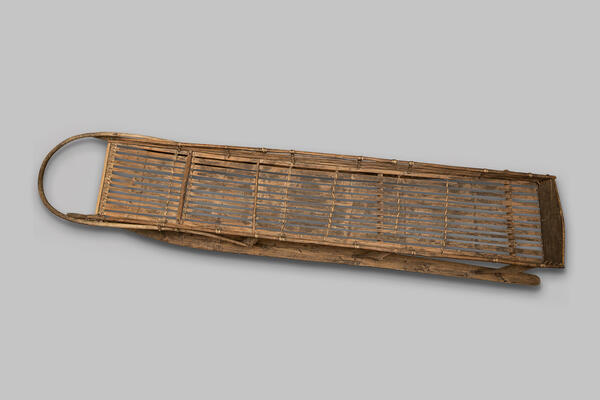
Narrow driving dog sleds were received by the Tobolsk Provincial Museum in 1910 as a gift from a private person Mr. Novitskiy. Such sleds were used by the Khanty everywhere.
The sleds are completely handmade. The master assembled them from parts cut from different types of trees and carefully processed. Elms are laid and a short-backed seat is installed on two runners with three high vertical wooden posts that supported the main part of the sled. The master attached a shackle for tying and a handle in the form of an arc to the front posts. Tobolsk sleds are not the largest. Some could make more than 2.5 meters in length.
The sleds exhibited at the museum are designed for dog sledding. With their help, they brought food and necessary things to the hunting site, and took out the loot. The load capacity of the sleds depending on the size reached 400 kilograms. The driver of a sled was called ‘musher’. Usually, the musher sat on a polar bear skin in the middle of the sled and held on with their left hand to a special arc designed for balancing. They controlled the dogs with their right hands using a stick with metal rings on the end. With a clink, the musher directed the dogs in the right direction. The pole also served as a brake. The musher rested it on the ground, and if they were very dissatisfied with the dogs, they could launch the pole at a careless animal.
To reduce friction, the skids were hosed with water, which was carried in a special flask. At the same time, an ice crust was formed on the skids, thus ensuring sliding. 10-12 dogs were harnessed to such a sled in pairs one after the other. The dog harness consisted of a horizontal noose with back and abdominal straps. The noose was put on the neck and secured with ropes under the chest behind the front legs.
At short distances, dog sleds were slower than reindeer sleds, and at long distances, they were faster, since dogs are more resilient. Even three dogs could safely carry two people on sleds. However, with deep loose snow, it was difficult for the dogs to pull the team, and then the skier went ahead and made a rut. On average, a dog sled went 4-5 kilometers per hour, with more than 30-40 kilometers run in a day. With light cargo and good dogs, it was possible to travel 100-200 kilometers per day.
The sleds are completely handmade. The master assembled them from parts cut from different types of trees and carefully processed. Elms are laid and a short-backed seat is installed on two runners with three high vertical wooden posts that supported the main part of the sled. The master attached a shackle for tying and a handle in the form of an arc to the front posts. Tobolsk sleds are not the largest. Some could make more than 2.5 meters in length.
The sleds exhibited at the museum are designed for dog sledding. With their help, they brought food and necessary things to the hunting site, and took out the loot. The load capacity of the sleds depending on the size reached 400 kilograms. The driver of a sled was called ‘musher’. Usually, the musher sat on a polar bear skin in the middle of the sled and held on with their left hand to a special arc designed for balancing. They controlled the dogs with their right hands using a stick with metal rings on the end. With a clink, the musher directed the dogs in the right direction. The pole also served as a brake. The musher rested it on the ground, and if they were very dissatisfied with the dogs, they could launch the pole at a careless animal.
To reduce friction, the skids were hosed with water, which was carried in a special flask. At the same time, an ice crust was formed on the skids, thus ensuring sliding. 10-12 dogs were harnessed to such a sled in pairs one after the other. The dog harness consisted of a horizontal noose with back and abdominal straps. The noose was put on the neck and secured with ropes under the chest behind the front legs.
At short distances, dog sleds were slower than reindeer sleds, and at long distances, they were faster, since dogs are more resilient. Even three dogs could safely carry two people on sleds. However, with deep loose snow, it was difficult for the dogs to pull the team, and then the skier went ahead and made a rut. On average, a dog sled went 4-5 kilometers per hour, with more than 30-40 kilometers run in a day. With light cargo and good dogs, it was possible to travel 100-200 kilometers per day.
#10
Date: second half of the 19th — beginning of the 20th century
Technique: wood, handmade
Place: Tyumen Region, Russia
Dimensions: 27×45×225 cm
Collection: Ethnography of Siberian Tatars and the Peoples in the Russian Far North
Copyright: Tyumen Province State Autonomous Cultural Institution ‘Tyumen Museum and Educational Association’, Structural Division ‘Tobolsk Historical and Architectural Museum Reserve’
Goskatalog Number: 10913103
Technique: wood, handmade
Place: Tyumen Region, Russia
Dimensions: 27×45×225 cm
Collection: Ethnography of Siberian Tatars and the Peoples in the Russian Far North
Copyright: Tyumen Province State Autonomous Cultural Institution ‘Tyumen Museum and Educational Association’, Structural Division ‘Tobolsk Historical and Architectural Museum Reserve’
Goskatalog Number: 10913103
read morehide
00:00
00:00
1x
Dugout canoe, Driving dog sleds
Collection
Exhibition
0
 Point your smartphone camera to open in the app
Open in app
Share