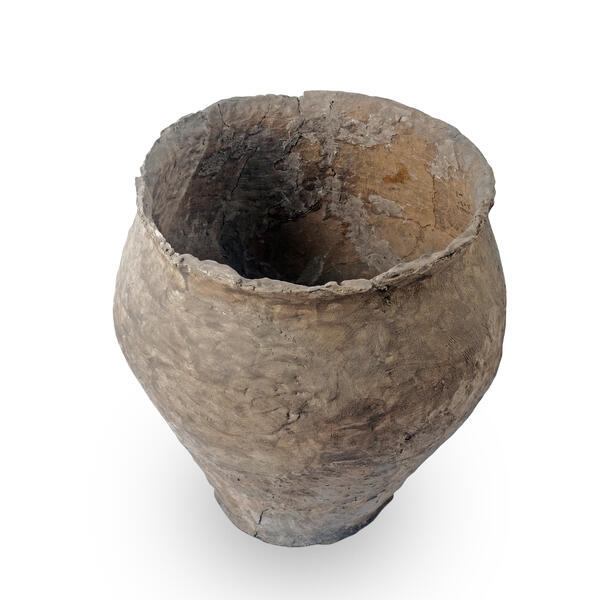
The Kursk Museum of Archaeology houses a hand-molded wide-necked vessel known as a korchaga. The pot was discovered in 1986 by archaeologist Olga Alekseevna Shcheglova during the exploration of the Gochevo-1 settlement in the Belovsky district of the Kursk region. The vessel is dated to the 3rd–4th centuries and belongs to the Kyiv archaeological culture, whose bearers are considered by scholars to be the ancestors of the Slavs.
Large vessels, with a rim diameter of 40–60 centimeters were used as grain storage jars or for storing supplies. Smaller vessels with a rim diameter of 20–28 centimeters were most likely used as cooking pots for cooking or reheating food. In the Middle Dnieper and Desna regions, all the pottery in Kyiv settlements and burial sites is hand-molded, except for imported items. The majority of the pottery has a rough surface.
Chamotte — crushed ceramics with an admixture of organic matter — was added to the clay as an emaciating material. Chamotte grains are often quite large and protrude outward, creating a markedly rough texture on the vessel. The most common vessels have surfaces that are reddish or gray-yellow in color, with a bumpy texture due to the inclusions. Tableware is neatly smoothed or burnished, with a dark gray or reddish surface. Most of the vessels are not decorated. The rims of pots and storage jars sometimes feature indentations made by fingers or parallel diagonal notches. Some vessels have elegant decorative patterns in the form of horizontal ridges below the rim and overlay horseshoe-shaped elements on the upper part of the vessel.
In rare cases, the surface of a pot could be
decorated with a composition of complex solar symbols etched into the surface
before it was fired with some sharp object. In all areas where the Kiev culture
was present, kitchen pots and storage jars were the predominant types of
pottery. Much less common were miniature pots, lid-pans in the form of discs,
and tableware (bowls and pot-shaped vessels). In addition to locally made
hand-molded pottery, a small number of imported pots from the Chernyakhov
archaeological culture or ancient imported ceramics can be found.