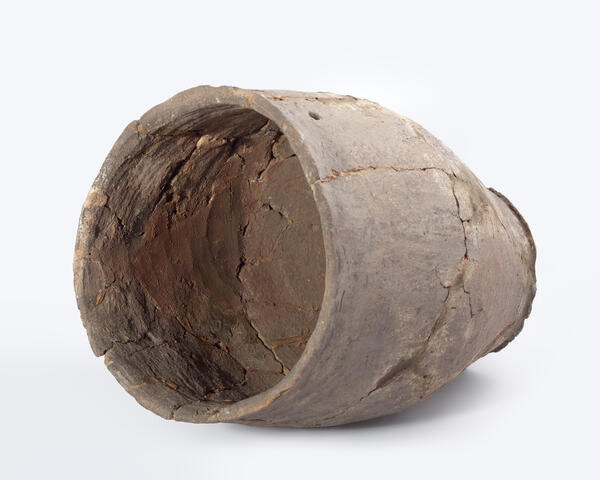
The Kursk Museum of Archaeology houses a hand-molded tulip-shaped vessel. The technique used is hand-molding, and the material is clay mixed with sand and chamotte. The object is dated to the 5th–7th centuries and belongs to the Kolochin archaeological culture, whose bearers are classified by scholars as early Slavs. The pot was discovered in 1964 by the prominent Kursk archaeologist Yuri Alexandrovich Lipking during the examination of a burial mound near the village of Knyazhiy in the Sudzhansky District of the Kursk region. The vessel was found in a pit 0.38 meters deep, placed upside down, covering a miniature urn that contained several selected small bones.
Tableware made of baked clay is the most common find in the course of archaeological research. However, the vast majority of ceramic products survive only as fragments. This happens for various reasons, for example, the pottery could have been broken in ancient times. A whole pot, upon entering the cultural layer, could disintegrate into many fragments over hundreds or even thousands of years, while burrowing animals may scatter the shards several meters away from the original site. Discovering an intact ancient vessel is always a significant stroke of luck for researchers.
As a rule, the reconstruction of the original shape of ancient tableware occurs by gluing together fragments of ceramics, which are found in compact clusters in the cultural layer or during the sampling of objects. The general characteristics of Kolochin ceramics were first described by Yuri Alexandrovich Lipking. The vessels from the Lebyazhinsky and Knyazhinsky burial grounds are molded, unornamented, made of clay with an admixture of chamotte, often asymmetrical, with a rough surface. The vessels are shaped like pots.
In terms of function, large vessels with rim
diameters of 40–60 centimeters were used as storage jars for grain. Smaller
vessels with rim diameters of 20–28 centimeters were likely used as kitchen
pots for cooking and heating up food. In burial rituals, they became part of
the ceremony, serving as containers for cremated human remains.