The pictures of Alexander Ilyich Geyker, a distinctive Nanai artist, abound with now-forgotten everyday objects, and some scenes require ethnographic research. For example, “Ice Drift on the Amur” depicts the change of seasons, bringing up an ancient legend and traditions associated with it.
According to belief, once upon a time, the then-unnamed river belonged to the White Dragon. The creature ruthlessly sank the first fishermen who risked launching their boats. People asked the Black Dragon, a willful but benevolent deity, for its help. The dragons fought for fourteen moons, and none could gain the advantage. Then shamans began beating their tambourines and making rattling noises with their heavy belt pendants, and people called upon the spirits, playing their jaw harps, and the White Dragon was finally defeated. The river waters darkened from the spilled blood. Since then, the Chinese part of the river was called Heilongjiang (“the Black Dragon River”), the Manchus named it Sahalyan ula (“the Black Water”), and the Mongols came up with the name Amur Hara-Muren (“the Big Black River”). The indigenous peoples of the Russian Far East — the Nanai, Ulch, Udege, Oroch, Even and Evenk — call the river “Amur”, which means “a big river” (from the Manchu-Tungus morpheme “amar, damur”).
With the onset of winter, the Black Dragon fell asleep for six months, covering itself with an ice shield. During that time, the Amur River and its tributaries — the big rivers Zeya, Amgun and Shilka — become ice-bound. The spring ice drift was a big event because the indigenous peoples of the Amur are ichthyophagous, which means that for them fish was not just food and source of shoes and clothing — it was also a central ritual figure. By March, hunters would return to the river from fur trapping to check up on and mend fishing gear and boats.
The period of loose ice, when neither ice nor regular fishing was possible, could last more than a month. With the first signs of ice drift, the Nanai people would gather in a fishing place called toni; only pregnant women were forbidden from attending this event. The bravest people would push the ice blocks away from the bank to free the river. Before the first fishing, the people performed a ritual of tribute to the master of water Mue edeni and the master of fire Podya edeni.
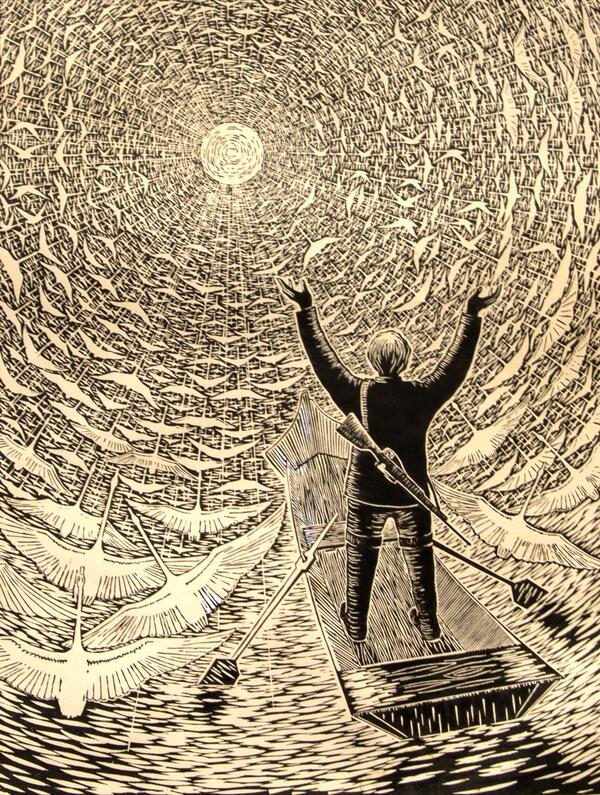
Alexander Geyker depicted those brave Nanai fishermen in this engraving. The traditional fishermen’s attire consists of a short wrap coat, gaiters, olochi boots, mittens, a garmasun headscarf and a small cap. The belt holds sheath knives and small pouches, which were used as pockets. The fast and dynamic state of the fishermen, narrow wooden omorochka boat, and wind and ice reflect their united effort and determination to let the long-awaited spring warmth in as quickly as possible.
According to belief, once upon a time, the then-unnamed river belonged to the White Dragon. The creature ruthlessly sank the first fishermen who risked launching their boats. People asked the Black Dragon, a willful but benevolent deity, for its help. The dragons fought for fourteen moons, and none could gain the advantage. Then shamans began beating their tambourines and making rattling noises with their heavy belt pendants, and people called upon the spirits, playing their jaw harps, and the White Dragon was finally defeated. The river waters darkened from the spilled blood. Since then, the Chinese part of the river was called Heilongjiang (“the Black Dragon River”), the Manchus named it Sahalyan ula (“the Black Water”), and the Mongols came up with the name Amur Hara-Muren (“the Big Black River”). The indigenous peoples of the Russian Far East — the Nanai, Ulch, Udege, Oroch, Even and Evenk — call the river “Amur”, which means “a big river” (from the Manchu-Tungus morpheme “amar, damur”).
With the onset of winter, the Black Dragon fell asleep for six months, covering itself with an ice shield. During that time, the Amur River and its tributaries — the big rivers Zeya, Amgun and Shilka — become ice-bound. The spring ice drift was a big event because the indigenous peoples of the Amur are ichthyophagous, which means that for them fish was not just food and source of shoes and clothing — it was also a central ritual figure. By March, hunters would return to the river from fur trapping to check up on and mend fishing gear and boats.
The period of loose ice, when neither ice nor regular fishing was possible, could last more than a month. With the first signs of ice drift, the Nanai people would gather in a fishing place called toni; only pregnant women were forbidden from attending this event. The bravest people would push the ice blocks away from the bank to free the river. Before the first fishing, the people performed a ritual of tribute to the master of water Mue edeni and the master of fire Podya edeni.
Alexander Geyker depicted those brave Nanai fishermen in this engraving. The traditional fishermen’s attire consists of a short wrap coat, gaiters, olochi boots, mittens, a garmasun headscarf and a small cap. The belt holds sheath knives and small pouches, which were used as pockets. The fast and dynamic state of the fishermen, narrow wooden omorochka boat, and wind and ice reflect their united effort and determination to let the long-awaited spring warmth in as quickly as possible.